
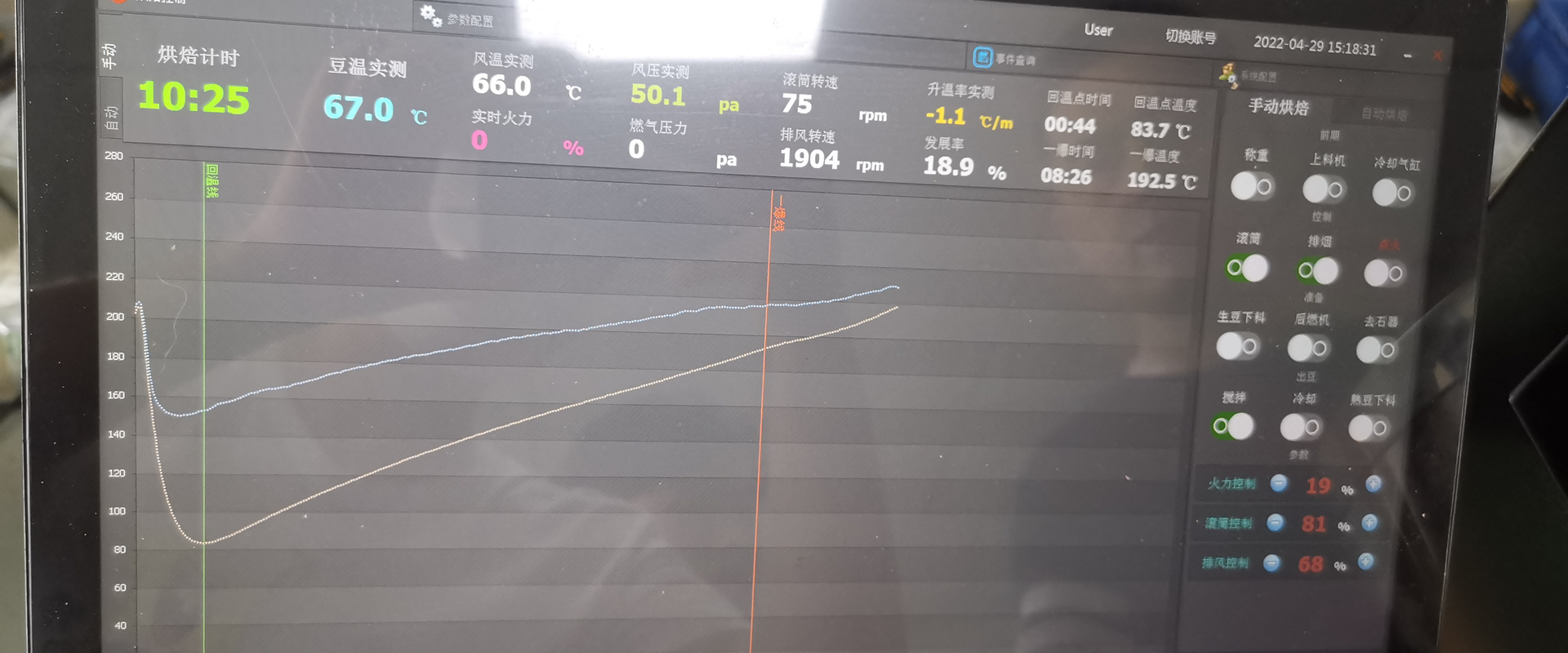
If a batch tastes wrong and you do not know why, the answer is almost always one of a small family of coffee roast defects — tipping, scorching, baking, underdevelopment, overdevelopment or uneven roasting — and each leaves a fingerprint on your bean, in your cup and on your curve. Diagnosis is a repeatable process, not intuition. Every defect below follows the same structure: what it looks like, what causes it, how your curve shows it, which control to move first.
The Roast Defect Cheat Sheet
Print this and tape it to your roaster. Nine out of ten problems will be on it.
| Defect | Visual | Cup | Primary cause | First adjustment |
|---|---|---|---|---|
| Tipping | Black pinpoint burns at your bean tip / germ end | Ashy, burnt toast, carbon bite in the finish | Too much heat in the first 2 minutes | Drop charge temp 8-15 °C, cut gas for the first 90 s |
| Scorching / facing | Dark blotch on the flat face, often oval | Burnt caramel, harsh, drying astringent finish | Beans resting on an over-hot drum wall | Raise drum speed 10-15%, increase batch to 60-80% of drum |
| Baking | Dull, chalky surface, colour looks “flat” | Bready, cardboard, no sweetness, no acidity | ROR crash to zero mid-roast | Add heat 45-60 s before the stall, not after |
| Underdevelopment | Silverskin in the centre cut, pale ground colour | Grassy, peanut, sour, mouth-drying | DTR under 15%, drop too early | Extend post-crack time to 18-22% of total |
| Overdevelopment | Early oil sheen, uniform dark brown | Roasty, tobacco, flat acidity, thin body | DTR over 25%, drop temp too high | Drop 4-6 °C earlier and cut gas at first crack |
| Uneven roast | Two or three visible colour populations | Muddled, both sour and roasty at once | Overloaded drum, low drum speed, mixed screen size | Reduce batch to 80% max, check flight wear |
| Quakers | Pale blond beans among normal ones | Peanut, cereal, papery | Unripe cherry in your green — not a roast fault | Sort green or after roast; change lot |
Tipping and Scorching: Two Burns, Two Different Causes
Tipping shows as tiny black craters at the germ end of the bean, where the wall is thinnest. It is a moisture-migration failure: heat arrives faster than water can leave the bean, so steam blows out through the weakest point and carbonises the escape path. On your curve it sits behind a violent opening — a turning point reached in under 45 seconds with a rate of rise above 35-40 °C/min in the first minute after TP. The fix is at the front of the roast, never at the end: lower charge temperature 8-15 °C, hold your burner at 40-50% for the first 90 seconds, and load more coffee if you are running a small batch in a large drum.
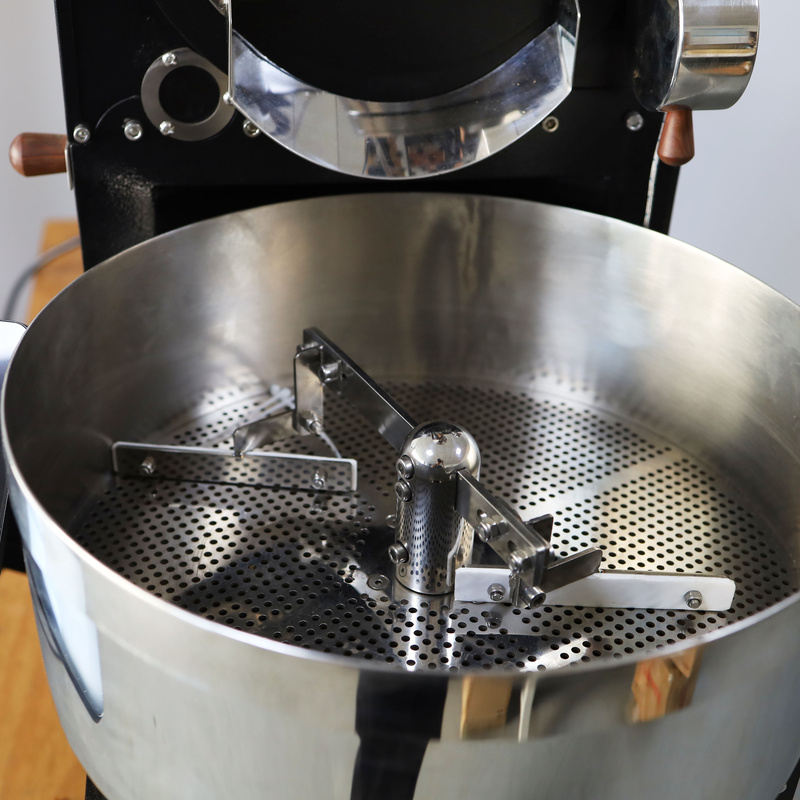
Scorching (also called facing) is a contact burn: the flat face of the bean sits against drum steel hotter than it can tolerate, leaving an oval scald mark rather than pinpoints. The cause is slow bean movement — drum speed too low, worn or bent flights, a batch so small the coffee slides rather than cascades, or a charge temperature well above what your drum mass needs. Our SD series uses a heavy cast-iron drum precisely because thermal mass buffers wall temperature, but even a heavy drum will scorch if you charge at 220 °C with 30% of rated capacity inside.
Quick test: hold ten beans under bright light. Burns at the pointed end mean tipping and a front-loaded heat problem; burns on the broad flat face mean scorching and a mechanical or loading problem.
Baking: The ROR Crash and Why It Kills Sweetness
Baking is the most misdiagnosed of all coffee roast defects because your beans look normal. The cup does not: bread crust, cardboard, flat and hollow. The mechanism is a stalled rate of rise. Between roughly 150 °C and 180 °C the coffee has released most of its free moisture, the endothermic drying load falls away, and if the operator cuts gas at that moment ROR collapses — often from 12 °C/min to under 2 °C/min within 40 seconds. The bean then sits at near-constant temperature and you get colour development without flavour development.
Read it early. A healthy curve shows a smooth, monotonically declining ROR: roughly 18-22 °C/min after the turning point, 10-14 °C/min at the dry end, 6-8 °C/min approaching first crack, and 3-5 °C/min through development. What you never want is a decline followed by a flat line or a negative dip and then a rebound “bump.” If ROR falls by more than 4 °C/min in a single 30-second window before first crack, you are about 45 seconds from a crash. Apply heat then, in 5-10% burner increments rather than 30%, because burner-to-bean lag on a 15 kg machine is typically 20-40 seconds. Building a stable declining curve is covered in our guide to roast profile development.
Underdevelopment and Overdevelopment
Underdeveloped coffee tastes grassy, sour and astringent, with a drying sensation at the back of the tongue. Split ten beans and look at the centre cut: trapped silverskin and a pale interior mean the roast never penetrated. Then compare ground colour against whole-bean colour — a gap wider than about 10 Agtron points means the outside ran ahead of the inside. Numerically, underdevelopment means a development time ratio (DTR, first crack to drop divided by total time) below 15%, or a total roast under 8:30 on a 12 kg batch. Push DTR to 18-22% and raise drop temperature 3-5 °C before changing anything else.
Overdevelopment is the mirror image: DTR above 25%, drop temperatures creeping past 215 °C for a filter roast, oils breaking early. The cup goes roasty and generic, origin character disappears, body thins. Cut your burner sharply at first crack and shorten the tail. Cooling matters too — a tray that cannot pull a batch below 40 °C in three to four minutes lets the bean keep roasting internally and will manufacture overdevelopment on its own. See our notes on cooling and quenching.
Uneven Roast and Quakers
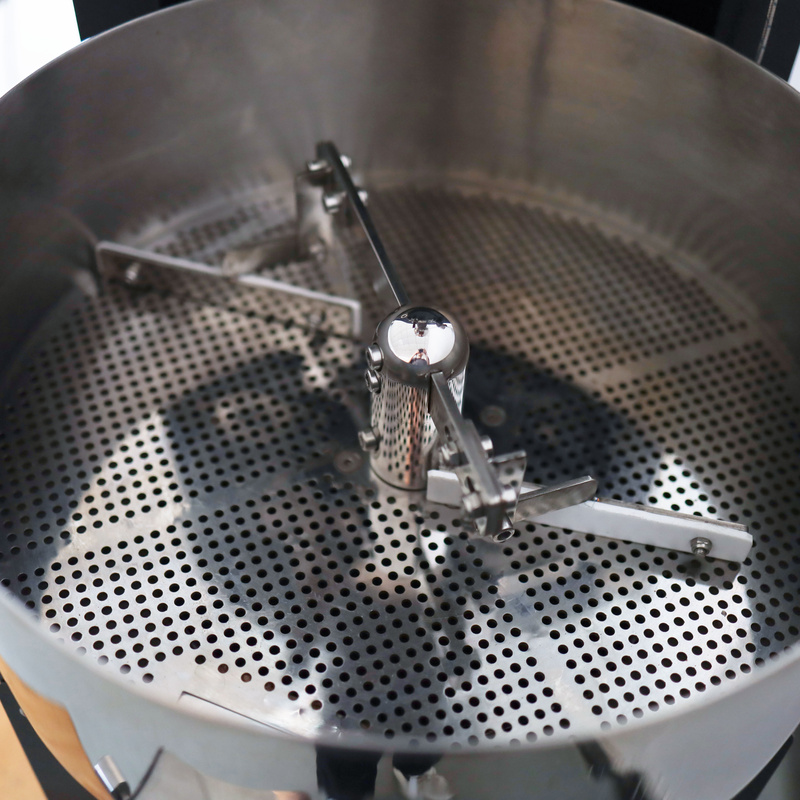
Uneven roasting produces two or three visible colour populations in one batch, and your cup shows sour and roasty notes at once because you are drinking two roasts. The causes are mechanical: an overloaded drum above roughly 90% of rated capacity where the bed cannot tumble, drum speed too low for the load, worn flights that no longer lift coffee, or green with a wide screen spread — screen 14 and screen 18 beans never roast identically. Quakers are different and are not your machine’s fault: underripe cherries lack the sugars needed for Maillard browning, so they stay blond however you roast. Sort them and talk to your green supplier.
When the Machine Is the Defect
Before you rewrite a profile, rule out the hardware. In our commissioning work these items explain most “unfixable” defects:
-
Drum speed. Too slow causes scorching and uneven roasting; too fast reduces conductive transfer. Aim for a drum peripheral speed near 0.6-1.0 m/s — roughly 60-70 rpm on a 1 kg drum, 45-55 rpm at 15 kg, 30-38 rpm at 60 kg. Variable-frequency drive lets you tune this per origin, standard on our YS series.
-
Airflow. Insufficient exhaust traps moisture and chaff around your beans, flattens ROR and adds smoky taints; excessive airflow strips heat and drives baking. Empty chaff collectors every batch and clean the cyclone every 20-40 batches — see the maintenance schedule and our ventilation requirements.
-
Thermocouple position and response. A probe touching your drum wall reads steel; one above the bed reads air. The tip belongs about one third into the tumbling bean mass. A 3 mm sheath lags a 1.5 mm sheath by 10-20 seconds, enough to hide an ROR crash until it is too late to correct.
-
Drum seasoning and buildup. A new drum needs seasoning batches before it cups clean, and accumulated oils in drum and ducting re-deposit smoke onto beans. Our commissioning and drum seasoning procedure covers both.
-
Batch size. Below about 40% of rated capacity the bed is thin and heat per bean high, so tipping and scorching are near-guaranteed; above 90% mixing collapses and ROR stalls. Work between 60% and 90%, ideally 70-80% — see our batch size guide.
Difficult Greens: Giling Basah and Light Arabic Roasts
Two cases come up constantly in our inbox. Indonesian wet-hulled coffee (giling basah) often arrives at 14-18% moisture with a soft, low-density, semi-swollen structure. Treat it gently: charge 10-15 °C below your normal setting, extend drying to 5:00-6:00, and hold ROR under 15 °C/min for the first three minutes. Pushed hard, these beans tip immediately and still cup underdeveloped because the interior never dries.
At the other extreme, Gulf roasters producing very light Arabic coffee (gahwa) drop at 175-190 °C, sometimes before first crack completes. That window is only 60-90 seconds wide, so burner turndown resolution matters more than burner power: you need fine flame trim at low fire, not a coarse three-position valve. This is why our Siemens-PLC machines allow curve-following automation and why the EC-500G sample roaster uses PID electric heating for light-roast work.
Log Everything, Then Fix One Variable
None of the above is diagnosable from memory. Record every batch, overlay the bad one against the good one, and change one variable at a time. Every digitally controlled Yoshan roaster logs to Artisan; see our Artisan connection guide, and note that Bluetooth is unreliable for logging on many machines — a wired USB connection is the fix we recommend when customers report mid-batch dropouts.
Frequently Asked Questions
Which defect should I rule out first when a batch tastes wrong?
Baking, because it is the commonest and the easiest to confirm from your log: look for a flat or dipping rate of rise between about 150 °C and first crack. If the curve is clean, look at your beans — tipping and scorching show on the surface, underdevelopment in the pale centre of a split bean — and only then consider your green. Working in that order finds nine faults in ten without a cupping table.
Can a defect come from the green rather than the roast?
Yes, and quakers are the clearest case: unripe or immature beans that stay pale whatever you do, which are a sorting problem at intake, not a profile problem. Mixed screen sizes roast unevenly on any machine, and high-moisture lots stall the drying phase. The green storage guide covers the intake numbers — moisture, density, screen — that separate a green fault from a roasting one.
Does batch size cause defects?
Underloading is the most reliable way to create tipping and scorching, because a thin bean bed exposes each bean to more drum contact and the probe reads air, so the burner is driven too hard; overloading causes uneven roasting and stalled drying. Keep the charge between 60% and 90% of rating — the batch size guide has the window — before you change anything on your profile.
Which of your machines have the controls the cheat sheet asks you to move?
All of our drums: burner turndown, adjustable airflow and, on the SD Pro and YS series, drum speed and a PLC that records the curve so you can see the crash or the stall as it happens. The manual DY and SD machines log to Artisan by USB for the same purpose. If a defect follows you across profiles on another machine, that is usually the sign your machine lacks one of those controls.
How many batches does a fix usually take?
Two or three, if you change one variable at a time and cup against the retained sample of the good batch. Change the charge temperature or the early gas for tipping and scorching, the mid-roast gas for baking, and the drop point for development, and log every batch. Changing three things at once fixes your batch and teaches you nothing, which is why the next fault takes ten.
Final Thoughts
Coffee roast defects are diagnosed, not guessed: read the bean, your cup and the curve, name the fault in profile language, move one control and cup again. Most faults are on the cheat sheet, most come from heat applied at the wrong moment or a drum loaded outside its window, and the rest come from the green. Send us a curve and a photo and we will read it with you. Talk to our engineers.
Get a Quote → WhatsApp +86 184 0771 4607Last updated: September 17, 2026
Pingback: Bean Temperature vs Exhaust Temperature on a Coffee Roaster
Pingback: Coffee Roasting Weight Loss and Yield: Green to Roasted Planning