
Every wholesale roastery ends up roasting decaf, because every café account asks for it, and most roast it badly at first by treating it as a regular coffee that happens to be brown. Decaffeination changes the bean's structure, colour, moisture and behaviour under heat, so a profile copied from the caffeinated version overshoots. This guide covers what changes in the drum and what a decaf SKU changes in the schedule, the equipment and the costing.
Why decaf roasts differently
All commercial decaffeination methods — water process, ethyl acetate, carbon dioxide and others — soak the green bean, extract caffeine, and dry it again. The wetting and re-drying leave the bean more porous, lower in moisture, lower in density and with a partly damaged cell structure. The visible result is a green bean that is yellow-brown rather than blue-green. The invisible results are what matter at the roaster:
| Property | Regular green | Decaf green | Effect in the roast |
|---|---|---|---|
| Colour | Blue-green | Straw to light brown | Looks roasted before it is |
| Density | Higher | Lower | Takes heat faster early |
| Moisture | 10–12% | Lower | Less to evaporate, drying phase shorter |
| Cell structure | Intact | Partly broken | Weaker, quieter first crack; faster after it |
| Weight loss in roast | Around 15% | Lower | More roasted kilos per green kilo |
Not all methods behave alike. Roasters who work with several report that water-process decafs develop more gradually and can be roasted much like a slightly fragile regular coffee, while sugar-cane (ethyl acetate) decafs move faster and darken sooner. Test each supplier's lot rather than assuming.
What changes in the profile
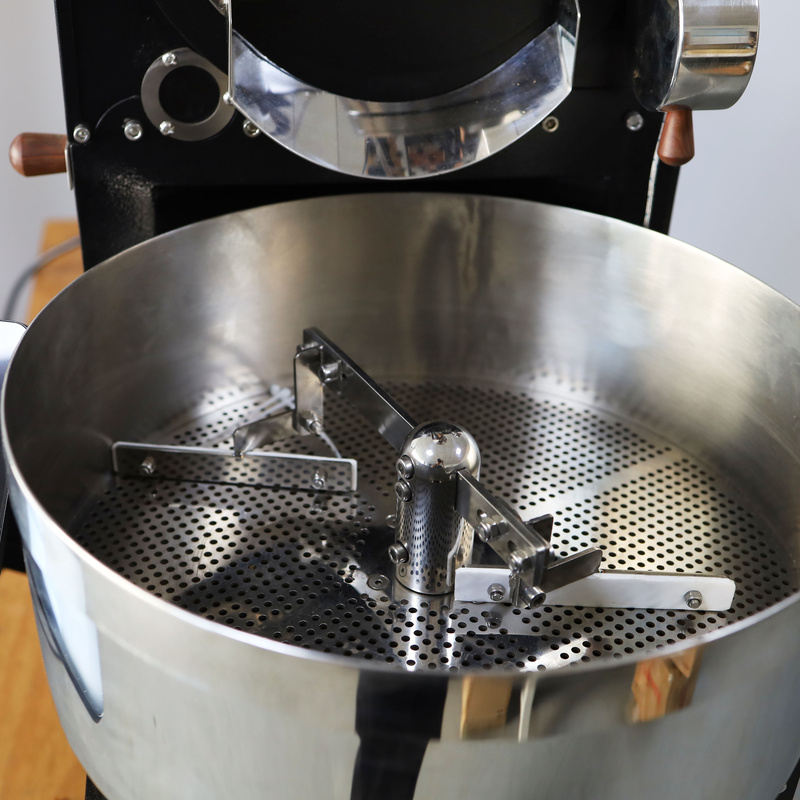
The practical adjustments roasters converge on:
- Charge a little lower — commonly 5–10 °C below the regular coffee's charge on the same machine — because the porous bean takes heat quickly and scorches easily at the start.
- Keep the early phase gentle, with a touch more airflow than usual, to avoid the surface racing ahead of the core.
- Approach first crack on a steady, declining rate of rise; a decaf that arrives at first crack too fast races through development. Reading the curve is in rate of rise in production roasting.
- Expect a quiet, short first crack and be ready for what follows: the roast accelerates after it, and second crack comes earlier than on the regular coffee. Most roasters extend development slightly and drop before any sign of second crack.
- Aim medium. Medium roasts are the most stable place for decaf; very light decaf roasts are difficult because first crack is hard to hear and colour changes fast, and dark decaf roasts turn ashy quickly.
Numbers such as a 5–10 °C lower charge are references from other roasters' machines; calibrate them to yours. A small-batch trial — 100–500 g on a sample roaster — before the first production batch is the cheapest insurance.
The probe, not the eye
The rule roasters repeat most is: do not judge decaf by colour. The green is already brown, and the roasted bean looks a shade darker than it is throughout. Two consequences for equipment:
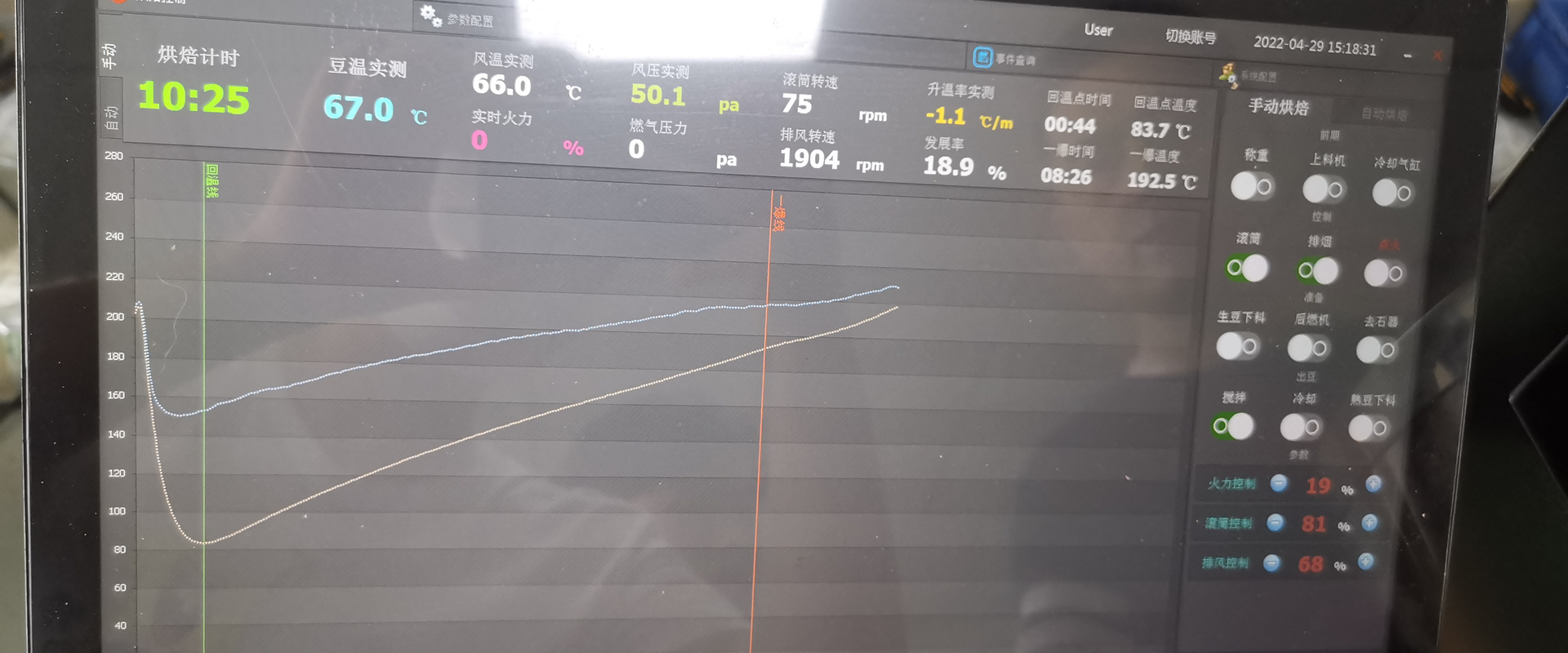
- Trust the bean probe. A roastery running decaf by sight on a manual machine will drop too early. The bean-temperature thermocouple — a German-made pair on our YS series, and the same two readings on the DY and SD machines — is the only reliable indicator. Keep the tip clean, because a coated probe reads low and compounds the problem.
- Log the profile. Because the eye is unreliable, the profile is the standard. On our SD Pro series the decaf profile is stored on the PLC and selected at charge; on the DY series it is a saved reference curve in Artisan. Either way, the operator follows the curve, not the colour. How the control levels differ is in manual vs automatic coffee roasters.
For quality control after the roast, use ground colour rather than whole-bean colour — a colour meter reading on ground coffee is comparable across lots, whole-bean colour on decaf is not — and cup against the regular version of the same origin.
The four production consequences
Adding decaf to a wholesale roastery is more than one more coffee on the list.
1. A separate profile and SKU. The regular profile cannot be reused, so decaf is its own recipe, its own batch group in the schedule and its own bag. Roast it in its own run, not squeezed between regular batches, because the drum's thermal state after a regular coffee is wrong for it — the routine is in the between-batch protocol.
2. Separate grinding. Cafés run decaf through a second grinder, and a roastery grinding for retail should too — decaf in a shared grinder contaminates the regular coffee. How many grinders a café needs is in how many grinders does a café need.
3. Different yield and cost. Decaf loses less weight in the roast, so a green kilo returns slightly more roasted coffee, which offsets part of its higher green price. Cost it on its own weight loss, not the house figure; the arithmetic is in coffee roasting weight loss and yield.
4. Small batches on a big drum. Decaf is typically 5–10% of a roastery's volume, so it is roasted in small batches — often at the bottom of the machine's range. A machine with a wide batch range copes; one that only roasts well near its nameplate does not. Our YS-6 is rated 1–7 kg per batch and the YS-12 1–13 kg, which is what lets a wholesale roastery run a 2 kg decaf batch on the same machine as a 12 kg house blend.
Where decaf fits in the account list
Café buyers list decaf among the things they expect a wholesale roaster to carry, alongside a house espresso and a filter option. A roastery without one loses accounts that would otherwise fit. Keep two or three decafs at most, buy in whole bags like any other coffee, and give each its own profile — how the account list turns into roaster hours is in selling wholesale coffee to cafés.
FAQ
Why is decaf coffee harder to roast?
Decaffeination soaks and re-dries the bean, leaving it more porous, lower in moisture and density, and browner in colour. It takes heat faster early, gives a weak first crack, and moves quickly afterwards, so a profile copied from the regular coffee overshoots and the roasted colour misleads the eye.
What charge temperature should I use for decaf?
Roasters commonly charge decaf 5–10 °C lower than the regular coffee on the same machine, then keep the early phase gentle with slightly more airflow. Treat that as a starting reference and calibrate it on your own probe with a small trial batch.
Does decaf have a first crack?
Yes, but it is quieter, shorter and easier to miss than on regular coffee, and the roast accelerates after it with second crack arriving earlier. Follow the bean probe and the rate-of-rise curve rather than listening for it.
Does decaf lose less weight in roasting?
Usually. Decaf green starts with less moisture, so it loses a little less in the roast than the regular coffee of the same origin, returning slightly more roasted kilos per green kilo. Cost each decaf on its own measured loss.
Should decaf be roasted on a separate roaster?
Not necessarily — the same drum roaster handles it, provided the machine roasts well at small batch sizes and the decaf runs as its own batch group with its own stored profile. A separate grinder, however, is standard so decaf does not contaminate regular coffee.
What roast level is best for decaf?
Medium. It is the most stable window: light decaf roasts are hard to read because first crack is faint and colour changes fast, and dark decaf roasts turn ashy quickly because the bean develops faster after first crack.
Final Thoughts
Roast decaf as its own coffee — lower charge, gentle start, probe not eye, medium target — and plan it as its own SKU with its own batches, grinder and costing. We build the wide batch ranges that make small decaf runs practical on a production machine, from the 3 kg roaster to the 12 kg roaster, with stored profiles on the SD Pro series.
Get a quote or message Leon on WhatsApp at +86 184 0771 4607.
Get a Quote → WhatsApp +86 184 0771 4607Last updated: September 23, 2026
Pingback: How Many Grinders Does a Café Need? Espresso, Decaf, Filter