
Two roasters looking at the same tray of beans under different lights will disagree about its colour by ten points on any scale; a colour meter measuring the same sample twice agrees with itself within half a point. That gap is why the coffee roast color meter — usually read on the Agtron scale — has moved into production roasteries. This guide covers what the number means, why ground and whole-bean readings differ, and how to build the reading into a batch-release procedure with tolerances.
What the meter measures
A roast colour meter shines light — most instruments use near-infrared — onto a coffee sample and measures how much reflects. Darker coffee absorbs more and reflects less, so the reading falls as the roast progresses. The most widely used scale is the Agtron scale, adopted by the Specialty Coffee Association for its roast classification; different instruments report on slightly different versions of it (the Gourmet scale, the Commercial scale, or a 0–150 range), so readings compare only within one instrument and one scale.
Reference points roasters commonly quote on the Gourmet scale:
| Roast description | Approximate Agtron (ground) |
|---|---|
| Very light | Around 90 and above |
| Light | Roughly 80–100 |
| Medium | Around 55–65 |
| Medium-dark | Around 45–55 |
| Dark | Roughly 25–45 |
Treat the table as orientation. What matters in production is not where a coffee sits on it but whether today's batch reads the same as the reference batch.
Whole bean vs ground: the second number
Measure the whole beans and you read the surface; grind them and you read the average of the interior. The two readings differ, and the difference — often called the roast delta, or RD — is information:
- Small delta (a few points): the interior developed close to the surface — even heat penetration, typical of medium and darker roasts.
- Large delta (10 points or more): a surface darker than the core — the roast moved fast at the end, or the batch was large or the charge hot for the coffee's density. Light roasts run a larger delta by nature; a delta that grows on the same coffee and profile is a signal.
That makes the delta the bridge between the colour meter and the roaster. A rising delta on a stable recipe points at the machine or the batch: heat applied too hard late in the roast, a batch above the machine's comfortable range, or a probe reading low so the profile ran hotter than it showed. The readings that explain it are in rate of rise in production roasting, and the probe check in coffee roaster temperature probe calibration.
Sample preparation decides the reading
The meter is only as repeatable as the sample. Four things move the number:
- Whole or ground. Ground is the standard for QC — more uniform, more repeatable. Measure whole bean as well only if you use the delta.
- Grind size. Finer grinds read lighter; coarser read darker. Fix one setting on one grinder for QC and never change it.
- Timing. Beans reabsorb moisture and change reflectance after roasting. Measure at a fixed point — commonly once the batch has cooled to room temperature, the same interval every time.
- Filling. Let the grounds fall freely into the sample dish and level them without pressing; tamping darkens the reading. Keep the optical window clean.
Sample size is around 20 g or more on most instruments. Write the procedure down and put it on the wall above the meter; the value of the instrument is the discipline around it.
A batch-release procedure
This is the flow a wholesale roastery can run in three minutes per batch.
- Reference. For each SKU, record the colour of the batch the profile was signed off on — the one that cupped right — as the target, with its delta.
- Tolerance. Instrument makers and roasteries commonly work to about ±1.5 points on the Gourmet scale; a roastery starting out may use ±2 and tighten later.
- Measure every batch once cooled, ground on the QC grinder, and record the reading on the batch card — the fields are in the coffee roasting batch record.
- Decide.
| Reading | Action |
|---|---|
| Within tolerance, weight loss within its own band | Release |
| Colour within tolerance, weight loss outside | Hold; cup — the roast may have stalled or raced with the same end colour |
| Colour outside tolerance by a little | Hold; check the curve for the cause; cup before deciding |
| Colour outside by a lot, or delta jumped | Do not release; find the cause on the machine before the next batch |
Weight loss is the second gate because colour alone cannot see development: two batches can reach the same colour by a fast, hot route and a slow, baked one. The loss figures are in coffee roasting weight loss and yield.
- Cup on a schedule, not per batch — a weekly cupping of released batches against the reference catches drift that colour and weight loss both miss. The routine is in cupping lab and quality control.
Colour, curve and cupping are three instruments for three questions: is it the same (colour), why not (curve), is it good (cupping). None replaces the others.
Instruments, without brand advice
Meters fall into three price bands: the original laboratory analysers, portable professional units used in competitions and larger roasteries, and newer compact devices at a fraction of the cost. All report on an Agtron-type scale; the differences are repeatability, sample size and whether they read whole bean. For a production roastery the deciding features are repeatability on a ground sample, a clean calibration routine — some instruments want checking against a reference tile before each session, others monthly — and a data log. We do not sell colour meters and have no preference among them.
Calibrating the roaster to the meter
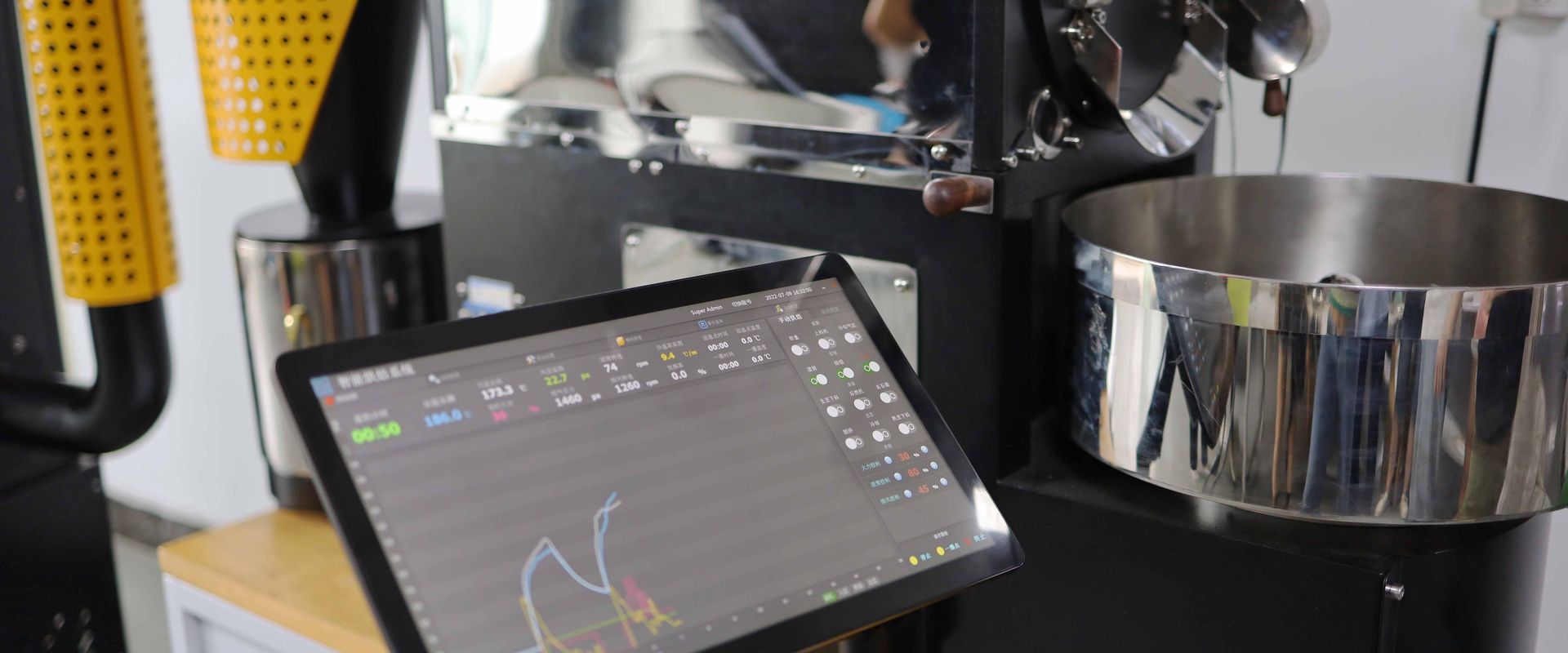
Once the meter is in the flow, it also calibrates the machine. A stored profile that produces the reference colour batch after batch is what a PLC-controlled roaster is for; on our SD Pro series the profile is run by the controller and the colour reading confirms it landed. On a manual machine the reading tells the operator how far the batch strayed, which is training as much as QC — see manual vs automatic coffee roasters. Either way, a reference sample roasted on the sample roaster, measured on the same meter, is the anchor the production batches are compared to.
FAQ
What is the Agtron scale for coffee?
A reflectance scale used to express roast colour as a number: the darker the roast, the lower the reading. It was adopted by the Specialty Coffee Association for roast classification. Instruments report on slightly different versions of the scale, so compare readings only within one instrument.
What Agtron number is a medium roast?
On the Gourmet scale most roasters place medium around 55–65 for ground coffee, light around 80–100 and dark around 25–45. Use the ranges for orientation; production QC compares each batch to your own reference batch, not to a chart.
Should I measure whole bean or ground coffee?
Ground, for release decisions — it averages the interior and repeats better. Measure whole bean as well if you track the roast delta, the difference between the two, which shows how evenly heat penetrated.
What does the roast delta tell you?
How far the surface colour is from the interior. Small on medium and dark roasts, larger on light ones. A delta that grows on a stable recipe points at the machine: heat applied too hard late in the roast, an over-large batch, or a probe reading low.
What tolerance should a roastery use for roast colour?
About ±1.5 points on the Gourmet scale is a common working tolerance; ±2 is reasonable to start. Pair it with a weight-loss band and a weekly cupping, because colour alone cannot distinguish a well-developed batch from a baked one at the same colour.
Do I need a colour meter to run a roastery?
Not to roast well, but to prove consistency to wholesale accounts and to catch drift before customers do. Eyes disagree with each other by around ten points under different lighting; a meter repeats within half a point.
Final Thoughts
Ground sample, fixed grind, fixed timing, a reference per SKU, a tolerance, and weight loss as the second gate — that turns a colour meter into a release procedure. The stored profiles on our fully automatic SD Pro roasters and the reference batches from our sample coffee roasters are what the meter checks against.
Get a quote or message Leon on WhatsApp at +86 184 0771 4607.
Get a Quote → WhatsApp +86 184 0771 4607Last updated: September 23, 2026
Pingback: Coffee Cupping Lab Setup: Minimum Bench, Protocol, QC Log | Yoshan