
If someone on your floor is still cutting 60 kg sacks, tipping beans into a bucket and carrying it up a ladder to the hopper, you already know the problem: it works, it wrecks backs, and it quietly caps how much your roastery produces in a day. A green bean loader ends that. Here is how to choose the loading method, size a silo, place the destoner, and the point below which manual loading is still the better call.
The Hidden Cost of Loading Green Beans by Hand
Do the arithmetic on your own floor. If you run a 30 kg roaster at 20 batches a day, you move 600 kg of green coffee. Every kilogram is lifted at least twice — sack to bucket, bucket to hopper — so your operator handles more than a tonne per shift, much of it above waist height. Over a five-day week that is roughly 6 tonnes, and it is the most common source of injury in a roastery.
Spillage during manual tipping runs a few tenths of a percent, which on 150 tonnes of annual throughput is several hundred kilograms swept off the floor. Labour is the bigger number: 45 to 90 minutes per shift moving sacks is time your staff do not spend roasting, cupping or packing. There is also an opportunity cost owners miss — when loading is exhausting, operators let the hopper run down and gaps appear in the roast schedule. Past roughly 300 to 500 kg of green coffee a day, a loader repays you inside a year on labour alone.
Three Ways to Move Green Coffee
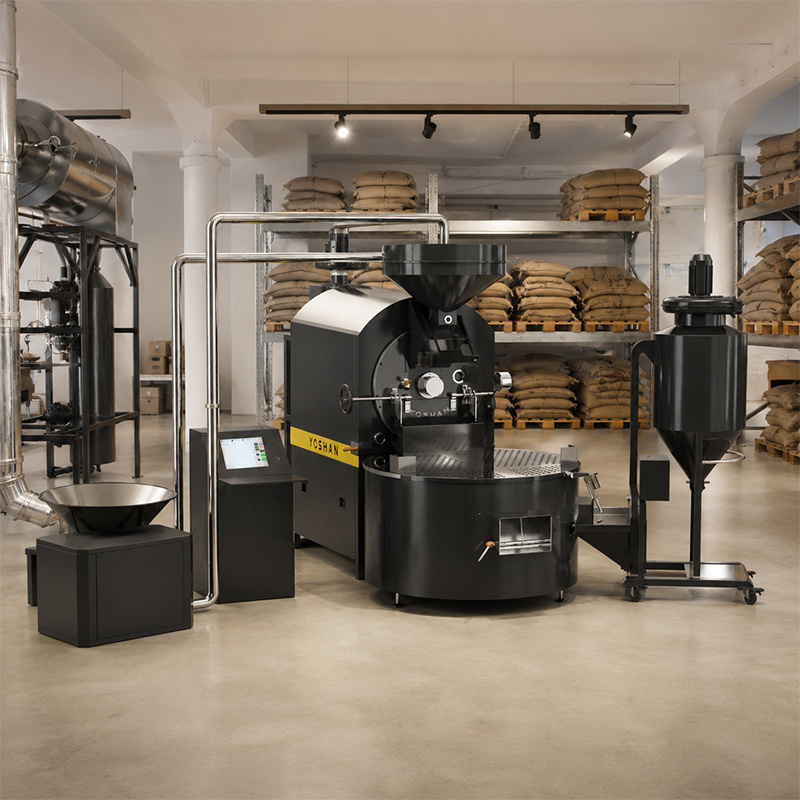
Vacuum (pneumatic) conveying pulls beans through a hose using a side-channel blower, dropping them into a cyclone receiver with a discharge valve. It is by far the most popular choice in coffee: the hose is flexible, so you can pick up from a sack on the floor or a bulk bag and route around obstacles, and it self-clears between origins.
Auger (screw) conveying turns a helical screw inside a tube. Mechanically simple, energy-efficient and good for continuous duty, but it is a fixed route, and an undersized or over-speeded screw will chip beans.
Bucket elevators carry beans in buckets on a belt or chain. Gentlest on the bean and most efficient at high tonnage and real height, but large, needing a pit and headroom, and harder to clean between origins — plant-scale equipment, as on our industrial coffee roasters.
| Method | Capacity | Distance / lift | Strengths | Limitations |
|---|---|---|---|---|
| Vacuum / pneumatic | 300 – 3,000 kg/hr | 20-30 m run, 6-10 m lift | Flexible routing, easy changeover, compact | Noisy, higher power draw, filter maintenance |
| Auger / screw | 500 – 5,000 kg/hr | 8-12 m, best under 45 degrees | Low energy, quiet, continuous duty | Fixed route, breakage risk, harder to clean |
| Bucket elevator | 1,000 – 20,000 kg/hr | Vertical 3-20 m+ | Gentlest handling, efficient at scale | Large footprint, needs headroom and a pit |
If you run a YS series machine from 6 kg to 60 kg, a vacuum loader is almost certainly your answer. Augers and elevators start to win above roughly 500 kg per hour sustained.
Sizing a Silo or Day Hopper
A loader without storage above your roaster only moves the problem — someone still triggers a lift for every batch. The silo is what buys uninterrupted roasting. Take your batch size, multiply by the batches you want between refills, and add 20 percent headroom so the vessel never runs to the cone. A 30 kg roaster doing 20 batches a day, refilling twice per shift, holds 10 batches: 30 × 10 × 1.2, so roughly 360 kilograms. Green coffee runs about 600 to 700 kg per cubic metre, putting your vessel at just over half a cubic metre.
| Batch size | Batches between refills | Working volume | Approx. capacity |
|---|---|---|---|
| 6 kg | 8-10 | 60-75 kg | 0.1 m3 |
| 15 kg | 10 | 180 kg | 0.28 m3 |
| 30 kg | 10 | 360 kilograms | 0.55 m3 |
| 60 kg | 8-10 | 600-720 kg | 1.0 m3 |
Two details decide whether your silo works. Bridging — beans arching over the outlet and refusing to flow — is prevented by a cone angle of at least 60 degrees from horizontal, a smooth stainless interior, and an outlet six to eight times the largest bean dimension; on larger vessels a vibrating pad is cheap insurance. Moisture is the second: green coffee sits at 10 to 12 percent moisture and absorbs more from humid air, a live concern for the many buyers we serve in the Philippines, Southeast Asia and East Africa. Keep silos sealed, out of sun and away from your roaster’s radiant heat.
Where the Destoner Belongs in the Chain
The correct sequence is: sacks or bulk bags → loader → destoner → silo → roaster. That order is deliberate.
Green coffee arrives with foreign matter — small stones, nails, glass, dried cherry, sack string. A single stone entering a drum roaster will chip the drum vanes, damage the discharge door mechanism or crack a cooling tray paddle, and it ends up in someone’s grinder. A coffee destoner uses controlled airflow to lift beans over a weir while denser stones and metal drop into a collection jar.
Put it after your loader and before your silo because you want to clean the coffee once on the way into storage, not on every batch discharge, and because the destoner can then run during the loading cycle when the airflow is already there. One caution: a destoner is calibrated by airflow, and the right setting differs between a dense washed Central American and a lighter natural. Check the reject jar for the first few lots of any new origin.
Power, Compressed Air, Noise and Dust
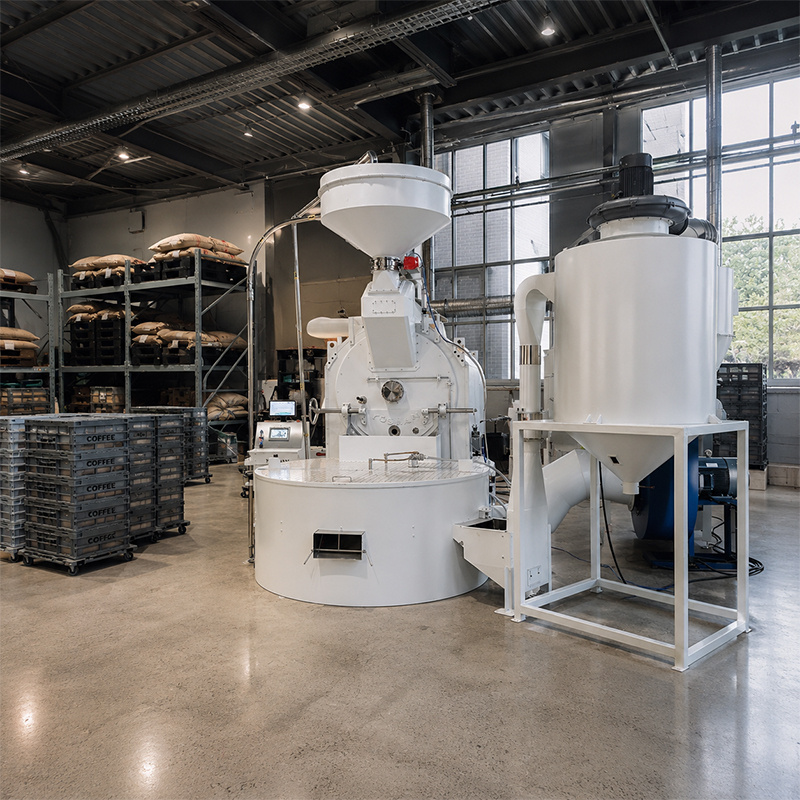
Power. Pneumatic loaders run a side-channel blower, typically 1.5 to 4 kW feeding 6 to 30 kg roasters and 5.5 to 11 kW for larger plant, usually three-phase. Confirm voltage and phase at quotation stage — 220 V and 380 V variants are not interchangeable, and this is one of the most common causes of delay we see. Augers are more modest, often 0.75 to 2.2 kW.
Compressed air. The loader itself usually needs none, but discharge valves, silo slide gates and filter pulse-cleaning generally do — budget a small compressor at 0.6 to 0.8 MPa with a dryer.
Noise. A side-channel blower runs 75 to 85 dB at one metre. It is intermittent, but disruptive in a customer-facing roastery. Mount it in a separate room or acoustic enclosure and run pipework through — decide before siting the machine, not after.
Dust. Moving green coffee liberates silverskin, jute fibre and chaff. The cyclone receiver’s filter must be cleaned on a schedule; a clogged filter kills conveying capacity long before any alarm, and is the most common cause of “my loader has lost power”. This dust extraction is entirely separate from roaster exhaust — see our ventilation requirements guide for that.
Space, Ceiling Height and Platforms
Loading equipment is why your ceiling height matters. Gravity feed needs your silo outlet above the hopper inlet and the cyclone above the silo. In practice a 15 to 30 kg installation wants 3.5 to 4.5 m of clear height; a 60 kg system with a real silo wants 5 m or more.
Without the height there are two workarounds: a smaller day hopper directly above your roaster, refilled more often, or a loader discharging into a floor-level receiving hopper feeding a short auger up to your roaster — less elegant, but it fits under 3 m. If the silo lid, filter or level sensor sits above 2 m, plan a fixed platform with a handrail; anything needing weekly cleaning at height eventually stops being cleaned. Leave 600 to 800 mm around the cyclone and blower for service, and work the layout out early with our roastery equipment setup guide.
When Not to Buy One — and Why to Order It With the Roaster
Be honest about scale. If you run a 1-2 kg shop roaster, or a 6 kg machine doing a handful of batches, a loader is the wrong purchase — you are moving 30 to 80 kg a day, which is a bucket and two minutes. The same holds if you rotate through many micro-lots, where changeover and cleaning can exceed the loading time saved. Below roughly 150 kg per day, spend the money on green coffee or packaging. Between 150 and 300 kg it is a judgement call driven by staffing and layout. Above 300 to 500 kg a day it is no longer optional.
When you do buy, buy it with the roaster. About 60 percent of our buyers are in the Philippines, Saudi Arabia, Latin America, Southeast Asia and East Africa, and ordering together matters beyond freight. Interfaces match: we cut the hopper inlet, flange and discharge valve to your specific roaster at the factory, rather than you paying a local fabricator to marry two machines never designed to meet. Electrics are unified: one panel, one voltage, one set of interlocks, instead of a loader that starts separately and can overfill a hopper because it cannot see the roaster’s level state. One shipment, and one commissioning — loader, destoner, silo and roaster set up and airflow-balanced together, as in our guide to commissioning and drum seasoning. Retrofitting to an installed roaster is always possible, but consistently more expensive and disruptive than specifying it on day one.
Frequently Asked Questions
Can your loader pick up directly from a bulk bag instead of sacks?
Yes — a vacuum loader's flexible hose takes coffee from a sack, a bulk bag on a frame or a floor-level receiving hopper equally well, which is the main reason it is the choice for roasteries that buy in different units at different times. For a plant receiving only bulk bags, a floor hopper with a bag-emptying frame feeding an auger is cleaner and quieter; tell us how your green arrives and we specify the pick-up.
How do I switch origins without mixing beans?
Run your loader empty for a few seconds after each lot so the hose and cyclone clear — a vacuum system self-clears, which is one of its quiet advantages — and empty the silo to the cone before charging the next origin, or fit a second day hopper for the second coffee. Roasteries rotating many micro-lots usually keep the silo for the house blend and hand-charge the small lots, which is cheaper than cleaning a silo daily.
What maintenance does a pneumatic loader need?
Very little, but one item is non-negotiable: the receiver filter. Silverskin and jute fibre load it every cycle, and a clogged filter is the reason behind almost every "my loader has lost power" message we get. Clean it weekly, check the discharge valve seal monthly, and keep a spare filter element and valve seal on the shelf; the blower itself runs for years with no attention beyond keeping its intake clear.
Does the silo need a level sensor?
On anything above a day hopper, yes — a high-level sensor stops the loader before the silo overfills and a low-level sensor calls the next lift, so nobody watches a sight glass. When the loader is ordered with the roaster we wire both into one panel with the roaster's controls, which is also what stops a loader overfilling a hopper it cannot see; a retrofit from another supplier usually cannot share that state.
What do you need from me to quote a loading chain?
Five things: your roaster model and batch size, the daily green throughput you plan for, your clear ceiling height, how the green arrives (sacks or bulk bags), and your voltage and phase. From that we size the loader, the silo and the destoner, cut the hopper inlet and flanges to your machine, and tell you what the building needs — air, a platform, an acoustic enclosure — before anything ships. Video of a running system is available on request.
Final Thoughts
A green bean loader is the first ancillary a growing roastery buys after the roaster, and the arithmetic decides it: past 300–500 kg of green a day it repays itself in a year, below 150 kg a bucket is cheaper. Size the silo by batches between refills, put the destoner before it, plan the height, and order it with the roaster so the interfaces match. Send us your throughput and your ceiling. Talk to our engineers.
Get a Quote → WhatsApp +86 184 0771 4607Last updated: September 17, 2026
Pingback: 20 kg Coffee Roaster: What Changes Stepping Up From 12 kg | Yoshan
Pingback: Sizing an Industrial Coffee Roasting Line: 30–300 kg | Yoshan
Pingback: Coffee Roastery Layout and Space Requirements by Capacity