
If you have just bought the roaster, the second threshold is the one nobody warns you about: buying and storing green coffee. It is where a roastery that chose its drum carefully loses five to fifteen percent of its coffee's value — to moisture drift, mould, insects, or cash sitting in beans for eight months. Here is how much to buy, where, the four storage numbers that matter, and what changes in a humid country.
Green Coffee Is Your Biggest Working-Capital Line
For most small and mid-size roasteries, green coffee is 55-70% of your cost of goods and by far the largest single use of your cash. The buying unit you choose decides how much of that cash sits still.
| Buying unit | Typical volume | Cash tied up | Main risk |
|---|---|---|---|
| Full container (FCL) | 250-320 bags, 15-19.2 t | Very high, 6-12 months of stock | Quality decays before you roast it |
| Pallet / part-load | 10-20 bags, 600-1,200 kg | Moderate, 2-4 months | Higher unit price; needs real storage |
| Single bags from an importer | 1-5 bags, 60-350 kg | Low, 2-6 weeks | Premium of 15-40%; lot may sell out |
| Samples / online micro-lots | 0.2-5 kg | Negligible | Evaluation only, not supply |
The honest rule for a roastery running one 6 kg or 12 kg machine: do not buy a container. Buy pallets, keep 6-10 weeks of cover, and let the importer carry the warehouse risk.
Sourcing Channels Compared
| Channel | Minimum order | Relative price | Quality risk | Fits monthly use of |
|---|---|---|---|---|
| Direct from origin / producer | 1 container, or 1 pallet by air | Lowest per kg | Highest — no recourse | 2,000 kg+ |
| Importer with local warehouse | 1 bag (60-70 kg) | +15-30% | Low — cupped and graded | 150-2,000 kg |
| Local distributor / re-bagger | 5-25 kg | +30-60% | Medium — storage unknown | Under 300 kg |
| Online sample platforms | 200 g – 5 kg | Highest per kg | Low, tiny volume | Evaluation only |
Most roasteries end up with a mix: a house-blend base from an importer on standing order, plus one or two rotating single origins. Origin-direct buying makes sense once you burn a pallet a month.
Storage: The Four Numbers That Matter
Green coffee is a living seed: it breathes and exchanges moisture with the air in your store. Four specifications decide whether it stays worth what you paid:
| Parameter | Target | What goes wrong outside it |
|---|---|---|
| Storage temperature | 15-25 °C, stable | Above 30 °C accelerates fading; daily swings drive condensation inside bags |
| Relative humidity | 50-60% RH | Above 65% beans reabsorb water and mould risk climbs; below 40% they turn brittle |
| Bean moisture content | 10-12% | Above 12.5% invites mould and a flat, “baggy” cup; below 9%, uneven development and more quakers |
| Water activity (aw) | 0.50-0.60, never above 0.65 | Above 0.65 microbial growth is possible even at acceptable moisture readings |
Moisture content tells you how much water is present; water activity tells you how much of it is free and available to microbes. A lot that passes on moisture can still fail on aw, so a combined moisture/aw meter is one of the cheapest pieces of QC equipment a roastery can own — budget it alongside the scales when you plan your roastery equipment setup.
The failure modes you will meet are physical, not mystical. Beans stored too wet develop the woody, damp, “baggy” character buyers reject, and in the worst case visible mould. Beans stored too dry crack violently in the drum, drop weight faster than your profile expects and produce more underdeveloped quakers — which is why a profile that worked in March may need re-tuning in September. If your curves stop repeating, check moisture before you blame the machine; our notes on roast profile development cover how to isolate the variable.
Packaging: Jute, Barrier Liners, Vacuum Bricks
| Packaging | Practical shelf life | Added cost | Notes |
|---|---|---|---|
| Jute / sisal bag only | 3-6 months in a controlled room | Baseline | Breathes with the room — poor in the tropics |
| Jute + hermetic barrier liner (GrainPro, Ecotact and similar) | 9-12 months | Roughly 2-5 US cents per kg | Best cost/benefit; reseal after every scoop |
| Vacuum brick (10-35 kg) | 12-24 months | Highest | Competition lots and long-hold specialty |
The most common mistake we see on visits is a barrier liner opened once and then left folded loosely over your beans for three months. An unsealed liner is just an expensive plastic bag.
How the Warehouse Should Be Laid Out
-
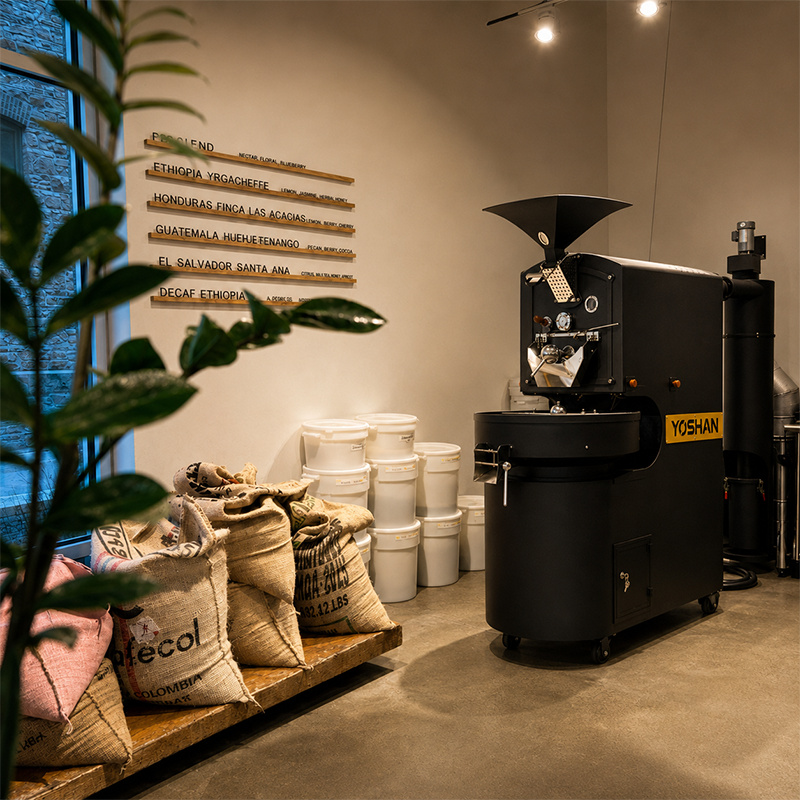
Off the floor. Pallets or slatted racks, 10-15 cm clearance minimum. Concrete wicks moisture upward, and the bottom row is always the row that moulds.
-
Off the wall. 30-50 cm from exterior walls, so air moves and wall condensation never touches jute.
-
Stack height. Four to five bags; taller stacks compress the lower bags and trap heat.
-
No neighbours with a smell. Green coffee absorbs odours aggressively — never store it beside fuel, paint, detergents, spices or onions.
-
Strict FIFO, enforced physically by the layout, not by memory.
-
Label every lot with origin and farm/mill, process, crop year, arrival date, bag count and net weight, screen size, moisture % and aw at intake, and your internal lot code — that label is what traces a cupping problem back to a shipment three months later.
Calculating How Much to Buy
Use one formula for your own order: monthly roasted volume ÷ 0.84 × purchase cycle in months + safety stock. The 0.84 accounts for roughly 16% weight loss in the drum at a medium roast — check your own figure, it moves between 13% and 20% depending on how far you take the roast.
Worked example, a 6 kg shop roaster running three days a week, four batches a day at 5 kg charge:
-
5 kg × 4 batches × 3 days = 60 kg green per week → about 260 kg green per month
-
Roasted output: 260 × 0.84 ≈ 218 kg per month
-
On a 6-week purchase cycle: 260 × 1.5 = 390 kg
-
Plus 3 weeks of safety stock (shipping delays are normal): +195 kg → order around 585 kg, or 9-10 bags
That is one modest pallet — comfortably storable in 4-6 m² of your conditioned room. If your batch sizing is still undecided, our batch size guide and roaster selection guide work the same arithmetic from the machine side, and running costs covers the gas, power and labour on top of the green.
Intake QC and the Cleaning Step Before the Drum
Check every lot you receive before it enters the FIFO queue: pull a representative sample from several bags, run 300 g through a sample roaster, and cup it against the offer sample you approved. Our EC-500G electric sample roaster exists for exactly this job — small charges, fast turnaround, repeatable curves; the full workflow is in our sample roasting article.
At intake, record moisture and water activity, defect count on a 300 g green sample (SCA full-defect equivalents), screen size distribution, and bean density in g/L. Density and screen matter directly to your curve — dense high-grown beans at 700-760 g/L need more early energy than a soft low-grown lot at 620-660 g/L, and a mixed screen distribution roasts unevenly no matter how good the machine is.
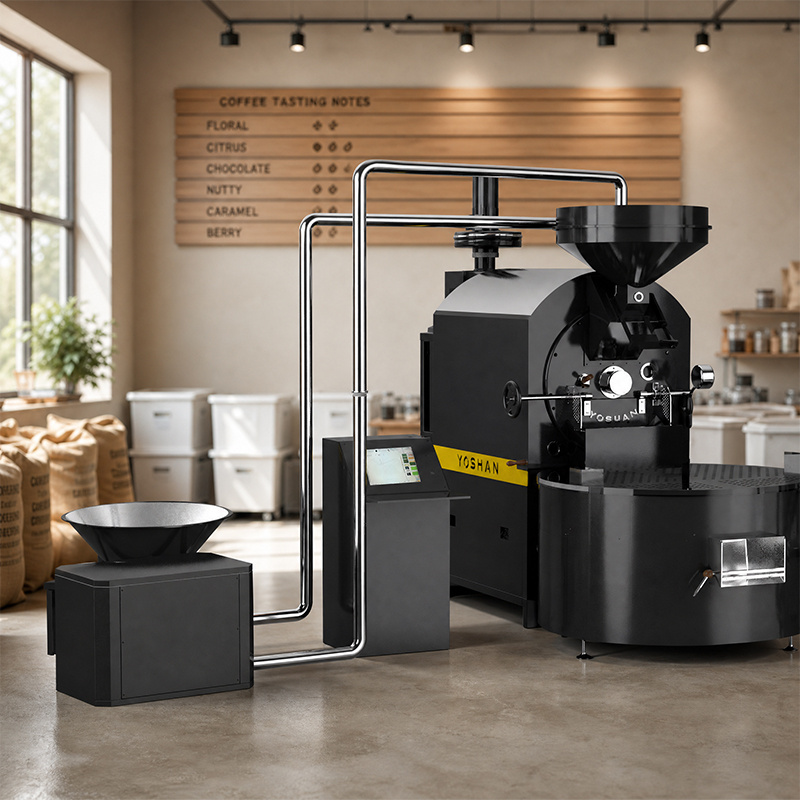
Your intake bench should also clean the coffee. Green arrives with stones, nails, glass, twine and metal fragments, and a single stone in a 60 kg batch will chip a drum vane, damage a bearing seat or destroy a grinder burr set downstream. Any roastery above roughly 15-20 kg per hour should pass every batch through a destoner before charging. Ours integrate with our pneumatic loaders and feed straight into the hopper of any of our commercial roasters, so nobody handles the beans between cleaning and charge. Plan the destoner, loader, cyclone and afterburner as one system when you design the green room — retrofitting later always costs more.
Tropical and High-Humidity Countries
In the Philippines, Indonesia, Malaysia, Vietnam, coastal Brazil or the Gulf, ambient conditions sit at 28-34 °C and 70-85% RH for much of the year — far outside the window above. Two practical options:
| Approach | Typical equipment | Running cost | Verdict |
|---|---|---|---|
| Dehumidifier in an insulated room | One 20-30 L/day unit per 30-50 m² | Low — 300-600 W running | Controls RH, not temperature. Enough for most small roasteries |
| Air-conditioned green room | Split AC plus a small dehumidifier | Several times higher | Needed above roughly 1-2 tonnes held |
Two more tropical rules: buy smaller and more often during the rainy season rather than filling the warehouse, and never let a container sit at the port or in a sunlit yard — internal container temperatures pass 50 °C easily and will cook a lot before it ever reaches your drum.
Frequently Asked Questions
How do I know if a lot has gone stale in storage before I roast it?
Three quick checks: the smell of the open bag should be grassy and fresh, not flat, papery or damp; the colour should be even, without the fading to pale or yellowing that comes with heat and time; and a 300 g sample roast should crack on schedule rather than late and quiet. If two of the three fail, cup it against the retained offer sample before it goes into a wholesale blend.
Should I buy the season's coffee all at once to lock the price?
Only if your store can hold it inside the four numbers for the months it will take to roast, and your cash can stand still that long. For most roasteries under a 15 kg machine the honest answer is no: a pallet every six to ten weeks from an importer who keeps the rest in a conditioned warehouse costs a little more per kilo and avoids both the storage risk and the tied-up capital.
Can I store green coffee in the same room as the roaster?
Not against the machine, and not in its exhaust path. Radiant heat from a drum and the warm, oily air around the cyclone push the bags out of the temperature window and let odours into the coffee. A partitioned corner with its own door, pallets off the floor and away from the wall, and a dehumidifier in a humid climate is enough for a small roastery; the layout guide shows where it goes.
What is the cheapest way to control humidity in a small store?
A domestic-class dehumidifier sized to the room — a 20–30 litre-a-day unit covers 30–50 m² — running on 300–600 W with a drain hose, inside an insulated room with the door kept shut. It controls humidity, not temperature, which is enough for most small roasteries; air conditioning only becomes necessary once you hold a tonne or more, or the room cannot be kept under 30 °C in summer.
Does the machine I buy change how I should store green?
Indirectly. A destoner ahead of the drum — recommended from about 12 kg batches — means stones and metal are caught at intake rather than in the drum, and a loader means the green room can sit a few metres from the roaster instead of beside it. If you buy naturals or lower grades, both matter more; tell us how your green arrives and we lay out the intake bench, destoner and loader with the roaster.
Final Thoughts
Green coffee storage comes down to four numbers — temperature, humidity, moisture and water activity — a sealed liner, a room laid out for airflow and FIFO, and a purchase quantity from your own roasting volume rather than the price of the season. In a humid country, buy smaller and dehumidify. Send us your monthly volume and your climate and we will size the machine and the green room together. Talk to our engineers.
Get a Quote → WhatsApp +86 184 0771 4607Last updated: September 23, 2026
Pingback: Sizing an Industrial Coffee Roasting Line: 30–300 kg | Yoshan
Pingback: Coffee Roastery Layout and Space Requirements by Capacity