
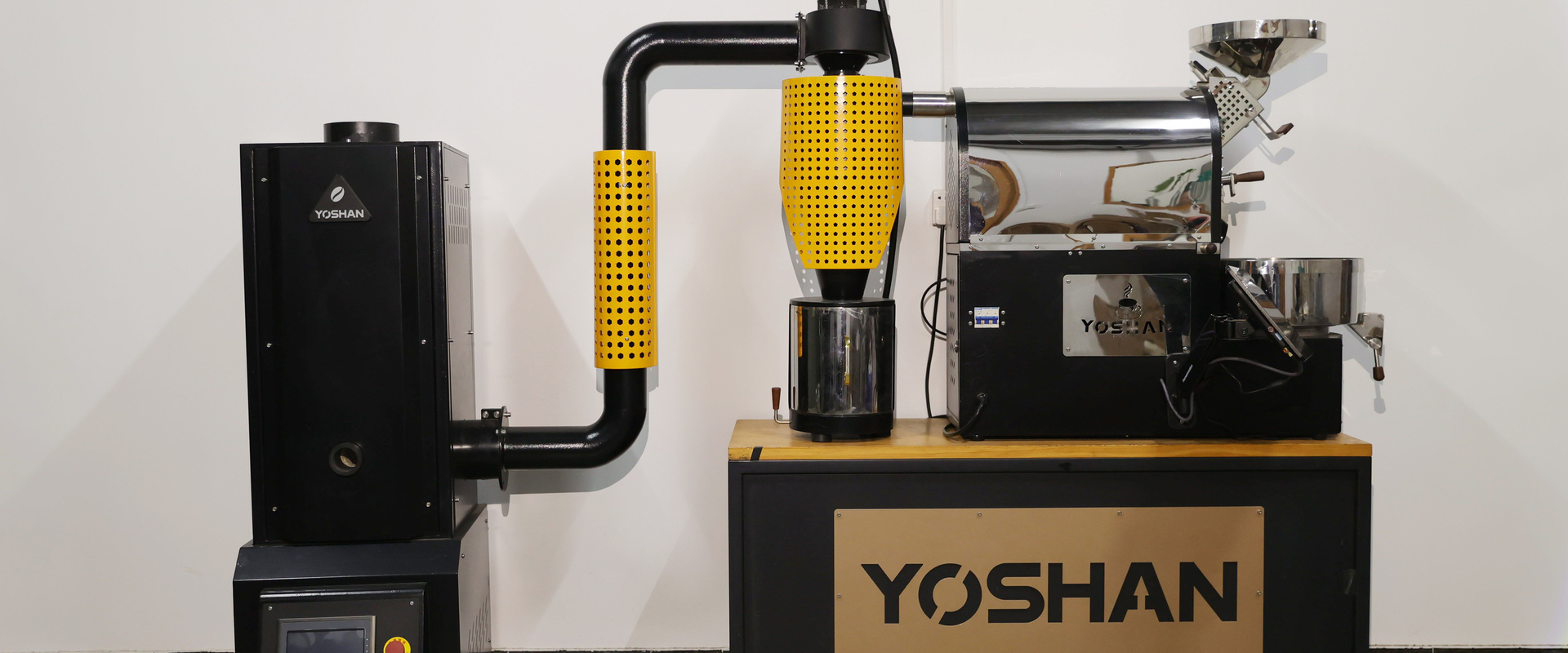
If you are drawing the mechanical plan for a roastery, coffee roaster ventilation requirements are the numbers your contractor will ask for before anything else: exhaust airflow, make-up air, whether an afterburner is required, and how your duct is built and cleaned. Get them right and the permit is a form; get them wrong and the machine sits idle. Here are the principles and benchmarks for gas drum roasters from 1 kg to 60 kg.
Why Coffee Roaster Ventilation Is More Complex Than Most Buyers Expect
Coffee roasting is a thermally intense, chemically active process. Green beans lose roughly 15–20% of their weight as water vapor, carbon dioxide, and organic compounds during roasting. A gas-fired drum roaster also generates combustion exhaust from its burner. The combined output—smoke, chaff particles, CO, CO₂, acrolein, and other VOCs—must be safely evacuated at a rate that keeps concentrations well below hazardous thresholds inside the building and meets emissions standards at the property boundary.
Beyond air quality, there is a direct fire dimension. Chaff—the dried silver skin that separates from beans during roasting—is highly combustible. It accumulates in ducting, cyclone separators, and chaff collectors. If exhaust velocity drops too low, chaff settles in the duct; if an afterburner temperature spikes unexpectedly, accumulated chaff can ignite. A properly engineered ventilation system controls both scenarios simultaneously. And increasingly, neighborhood relations and permit renewals hinge on documented emissions control—many municipalities now require afterburner documentation as a condition of a roastery’s operating permit, especially in mixed-use urban zones.
The Four Core Coffee Roaster Ventilation Requirements
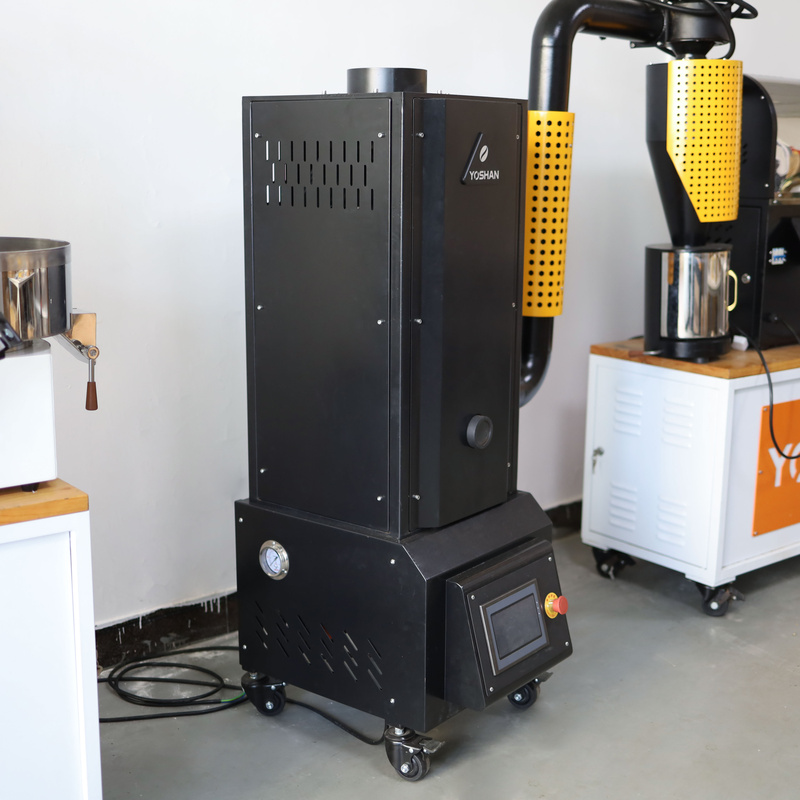
1. Exhaust Airflow Rate
Exhaust capacity is measured in cubic feet per minute (CFM) or, in metric markets, cubic meters per hour (m³/h). The required exhaust volume is a function of your roaster’s burner BTU rating, drum size, and roast throughput—not drum capacity alone. As a practical starting benchmark, most equipment suppliers and mechanical engineers work from roughly 150–250 CFM per kilogram of roaster capacity for a gas drum machine at full throughput, though your licensed mechanical engineer must calculate actual figures from the specific equipment data sheet.
Undersizing the exhaust fan creates back-pressure, which can starve the burner of combustion air, cause incomplete combustion, and allow smoke to migrate into the roasting room. Oversizing pulls excessive make-up air through your roaster drum, disrupting roast profiles and wasting energy. The correct design point is a balanced system matched to your roaster manufacturer’s specified static pressure and airflow range.
2. Make-Up Air Supply
For every cubic foot of air exhausted, a cubic foot of replacement (make-up) air must enter the building. Without dedicated make-up air supply, your roastery goes negative-pressure: doors become hard to open, combustion appliances backdraft, and the exhaust fan works harder than its rated capacity. Most codes require that make-up air supply be within 10–20% of the exhaust volume, delivered through a dedicated make-up air unit (MUA) or a motorized damper tied to the exhaust fan control circuit.
In cold climates, make-up air units must temper incoming air to avoid thermal shock to your roaster and occupant discomfort. In warm climates, MUA placement should avoid directing unconditioned air across your roaster drum, which can create unpredictable airflow through the bean mass and inconsistent roast development.
3. Afterburner and Thermal Oxidizer Requirements
An afterburner (also called a thermal oxidizer or secondary combustion chamber) incinerates the smoke, VOCs, and particulates leaving your roaster drum before they exit the exhaust stack. Many jurisdictions require afterburners for roasters above a certain throughput threshold—commonly above 3–6 kg capacity or above a defined VOC emission rate. Even where not legally mandated, afterburners are strongly recommended for urban or suburban locations because they eliminate visible smoke and substantially reduce odor.
A correctly sized afterburner maintains the exhaust stream at a sustained temperature—typically 650–760 °C (1,200–1,400 °F)—for a minimum residence time that ensures complete oxidation. Undersized afterburners that cycle on and off or fail to hold temperature are a frequent compliance failure. The afterburner must be interlocked with your roaster so your roaster cannot operate if your afterburner falls below its setpoint temperature—a requirement in most jurisdictions and a sensible operational safeguard regardless.
4. Chaff Collection and Duct Maintenance
Chaff management is inseparable from fire safety compliance. A chaff cyclone or collector should be installed between your roaster drum outlet and the main exhaust duct. Collected chaff must be emptied regularly—many high-production roasteries empty chaff trays every 1–3 roast cycles. The duct section between your roaster and afterburner should be inspected and cleaned on a schedule defined by your fire marshal or insurance carrier, typically every one to three months depending on throughput.
Ventilation Scale: How Requirements Change by Roaster Capacity
The table below shows general ventilation planning parameters by roaster capacity range. These are engineering starting points—your local mechanical engineer and authority having jurisdiction (AHJ) set the binding requirements for your specific installation.
| Roaster Capacity | Indicative Exhaust CFM Range | Afterburner Requirement | Approx. Duct Diameter | Make-Up Air Unit |
|---|---|---|---|---|
| 100 g – 500 g (sample) | 100–300 CFM | Optional / rarely required | 4–6 in | Not typically required |
| 1–3 kg | 300–700 CFM | Jurisdiction-dependent | 6–8 in | Recommended |
| 6–15 kg | 700–2,500 CFM | Required in most urban areas | 8–12 in | Required |
| 30–60 kg | 2,500–6,000+ CFM | Required; may need continuous monitoring | 12–18 in | Required, tempered |
CFM figures assume gas-fired drum roasters at full production throughput. Electric infrared sample roasters—such as Yoshan’s EC-500G electric sample roaster—produce lower exhaust volumes and simpler ventilation requirements. At 500 g capacity with electric heating, they often require no afterburner, and a well-positioned kitchen-grade exhaust fan may satisfy local code for commercial sample-roasting use.
Fire and Building Code Compliance
The reference standard most inspectors work from is NFPA 96: Standard for Ventilation Control and Fire Protection of Commercial Cooking Operations. While originally written for cooking equipment broadly, local authorities having jurisdiction (AHJ) routinely apply its duct construction, clearance, and hood requirements to coffee roasters. Some jurisdictions supplement NFPA 96 with specific air quality regulations—particularly California’s South Coast AQMD Rule 445 and comparable rules in other non-attainment air districts that limit VOC and particulate emissions from commercial roasting.
Outside the US, relevant standards include EN 16282 for kitchen ventilation in Europe and AS 1668 in Australia. In any jurisdiction, the practical compliance pathway follows these steps:
-
Obtain your roaster manufacturer’s exhaust specification sheet before engaging a mechanical engineer—burner BTU, exhaust collar size, static pressure requirements, and afterburner interlock wiring diagrams should all be in the package.
-
Submit a ventilation plan to the local building department and fire marshal as part of your occupancy or change-of-use permit application.
-
Coordinate with your local air quality management district if you are in an area with VOC emission thresholds for commercial roasting.
-
Incorporate afterburner documentation and interlock wiring diagrams into your permit package from the start.
One critical timing note: permit timelines for roastery ventilation systems routinely exceed equipment manufacturing lead times. Start the permit process before finalizing your roaster order—not after delivery.
Once your ductwork is installed, its first real test comes during commissioning and drum seasoning. The empty-drum burn-in cycles are exactly when an undersized run, a leaking joint or a reversed exhaust fan reveals itself — before there is coffee in the machine.
Ductwork Design Principles for Coffee Roaster Installations
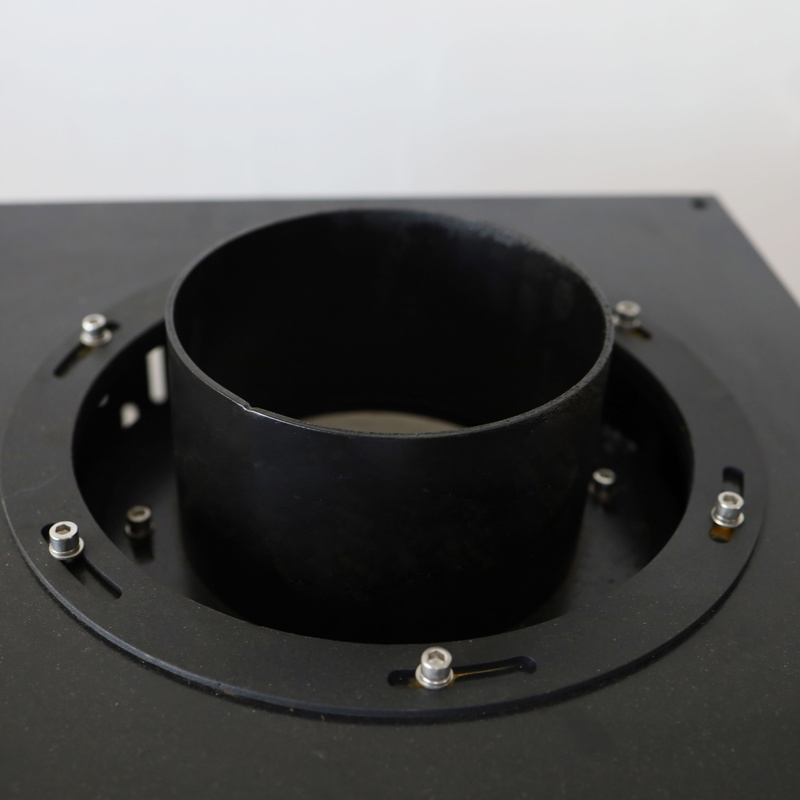
Material and Construction
Use welded or seamless steel ductwork rather than sectional slip-fit duct for the roaster exhaust run. Joints and seams are chaff accumulation points and potential leakage locations. Stainless steel adds corrosion resistance in the high-humidity condensation zone between the drum outlet and afterburner—a worthwhile upgrade for roasters running multiple shifts.
Slope, Cleanout Access, and Bends
Horizontal duct runs should slope toward the roaster (a minimum of ¼ inch per foot) so condensate drains back rather than pooling at low spots where it can trap chaff. Install cleanout access panels at every change of direction. Without them, duct inspection and cleaning requires section removal—a recurring maintenance cost most roasteries wish they had planned for at installation. Every 90-degree elbow adds resistance equivalent to several feet of straight duct; minimize bends and upsize the exhaust fan for long or complex duct runs.
Stack Termination
The exhaust stack must terminate above the roofline per applicable code—NFPA 96 requires at least 40 inches above the roof surface for grease-laden vapors, and most AHJs apply the same standard to coffee roaster exhaust. Stack caps should prevent rain ingress without creating backpressure. Standard residential rain caps are inadequate for commercial roaster exhaust velocity and tend to accumulate chaff at the opening.
How Your Roaster Choice Affects Ventilation System Complexity
Machine design choices meaningfully affect ventilation complexity and total installed cost. Understanding this relationship helps you budget for the complete system rather than the roaster purchase price alone—and select equipment whose documentation makes the permitting process straightforward.
Yoshan’s SD Series roasters—spanning the manual 1.5 kg and 3 kg models through the fully automatic 15 kg Pro—use a double-wall stainless drum and engineered airflow path that concentrates chaff evacuation at the chaff collector rather than distributing it through the full duct run. This simplifies duct cleaning and reduces fire risk at your duct level. The SD Pro fully automatic models include integrated airflow monitoring that alerts operators when exhaust pressure deviates from baseline—a practical early warning for duct blockage before it becomes a code violation or equipment damage event.
The YS Series smart roasters add Siemens PLC control with data logging that records exhaust fan speed and drum pressure differential across every roast. This log becomes valuable documentation during permit renewals and air quality inspections, giving regulators verifiable evidence that afterburner interlock and airflow parameters are maintained within design specifications throughout production.
At the industrial scale, Yoshan’s 30 kg and 60 kg full-set packages include a factory-matched afterburner as standard equipment, pre-wired with the required interlock. This reduces the on-site engineering burden and provides a single-source documentation package for the ventilation system. For buyers evaluating total installed cost against comparable European brands, Yoshan’s factory-direct model typically leaves more capital available for a properly engineered ventilation system—avoiding the budget pressure that leads some buyers to undersize the exhaust infrastructure. See the commercial coffee roaster price guide for full pricing context—final price depends on configuration, so request a quote for your specific requirements.
Frequently Asked Questions
Can you give my contractor the exact figures for a specific machine?
Yes — every model ships with its exhaust collar diameter, exhaust volume, burner rating and static pressure figures, plus your afterburner interlock wiring on the PLC models. Send us the model and your duct run you are planning and we return the sheet your mechanical engineer needs; the spec sheet guide explains what each line means. Ask before the lease, because the duct route often decides which room works.
Do I need a separate exhaust for the cooling tray?
On our machines from 3 kg up the cooling tray has its own fan, and its air carries chaff and fine dust rather than smoke. It can share your stack with the roaster exhaust after the cyclone, or vent separately through a filter, depending on your layout; what it must never do is discharge into the room. Tell your engineer there are two air streams so your fan and the duct are sized for both.
How much make-up air does a small roaster need?
As much as the exhaust removes: a 3–6 kg drum pulling a few hundred cubic metres an hour needs the same volume to come back in through a louvre or a ducted inlet, or the burner starves and the exhaust fan fights a vacuum. In a sealed, air-conditioned building this is the item most often missed, and it shows up as smoke at the drum door and a flame that lifts.
Which of your machines need an afterburner?
None require one by design; your local authority decides. The SD-30 Pro and SD-60 Pro full sets ship with an afterburner because plants of that size are almost always required to have one; below that we quote the afterburner or an electrostatic filter when your rules or your neighbours call for it, and we draw its position on every line from 15 kg up so your stack is right either way.
Can I run the duct horizontally through a wall instead of up through the roof?
Often, if the horizontal run is short, slopes back toward a cleanout, terminates away from windows and air intakes, and your fan is sized for the extra resistance of the elbows. A long horizontal run collects tar faster and is harder to clean, so where a vertical route exists it is the better one. Send us a sketch with lengths and elbows and we check it against the fan curve before you build.
Final Thoughts
Coffee roaster ventilation requirements come down to four things done properly: enough exhaust, enough make-up air, treatment where your rules demand it, and a duct that can be cleaned. Size them for the heaviest roast you will run, put your afterburner on the drawing early, and give your contractor the machine's real figures. Send us the model and the route and we will supply them. Talk to our engineers.
Get a Quote → WhatsApp +86 184 0771 4607Last updated: September 23, 2026
Pingback: Coffee Roastery Layout and Space Requirements by Capacity
Pingback: Coffee Roastery Startup Costs: Full Project Budget Guide
Pingback: Coffee Roastery Equipment: The Complete Line Guide
Pingback: 2 kg Coffee Roaster: Output, Specs and Why It Needs No Building Work | Yoshan
Pingback: Coffee Roaster Afterburner: Do You Need One, and Which Type | Yoshan
Pingback: How to Start a Coffee Roasting Business: Volume, Machine, First Roast
Pingback: Gas vs Electric Coffee Roasters: Your Building Decides | Yoshan
Pingback: How to Reduce Smoke from a Coffee Roaster: 4 Layers Before Buying Gear
Pingback: Coffee Roaster Airflow and Damper Control by Roast Phase
Pingback: Coffee Roast Defects: Tipping, Scorching, Baking and the Fix | Yoshan
Pingback: Coffee Roaster Cooling & Quenching: Why Fast Cooling Protects a Roast
Pingback: How to Read a Coffee Roaster Spec Sheet: Four Lines to Get in Writing
Pingback: Coffee Roastery Insurance: What Underwriters Ask
Pingback: Coffee Roaster Installation Checklist: 5 Deadlines to First Roast