
If you are choosing between two 2-group machines and one costs twice the other, the difference is usually not the badge — it is the boiler layout. Heat exchanger vs dual boiler is the specification that decides whether your barista can pull a shot and steam milk at the same time, how stable brew temperature stays through a rush, and how much power you need at the wall. Here is the whole picture, with the numbers.
The Three Espresso Machine Boiler Types, in Plain Terms
Single boiler (SB). One vessel, one heating element, one job at a time. It heats water to roughly 92–96 °C for brewing; to steam milk it must climb to 120–130 °C, which means flipping a switch and waiting 45–90 seconds, then waiting again — often 3–5 minutes with a cooling flush — to come back down for the next shot. Boiler size is typically 0.3–1.7 L. Fine if you run a low-volume bar, an office, a tasting counter or a roastery sample bar. Not viable if your customers order cappuccinos and espressos in the same breath.
Heat exchanger (HX). One large boiler, usually 4–12 L, held at steam temperature around 120–125 °C and 1.0–1.3 bar. Running through the middle of it is a narrow tube — the heat exchanger. Fresh cold water passes through that tube on demand, picking up heat in a few seconds on its way to the group. So the machine steams continuously from a big boiler and brews with fresh water, simultaneously, with only one heating element. This is the classic Italian cafe architecture and, paired with an E61 group head, it is still the most common commercial layout in the world.
Dual boiler (DB). Two separate vessels with independent elements and independent temperature control: a brew boiler typically 1–3.5 L held at 90–96 °C, and a steam boiler 3–7 L held at 120–130 °C. You set brew temperature directly on a PID rather than inferring it from steam pressure. Total power draw is higher because you are heating two vessels, but you get precise, repeatable brew temperature and full steam power at the same moment.
Side-by-Side Comparison
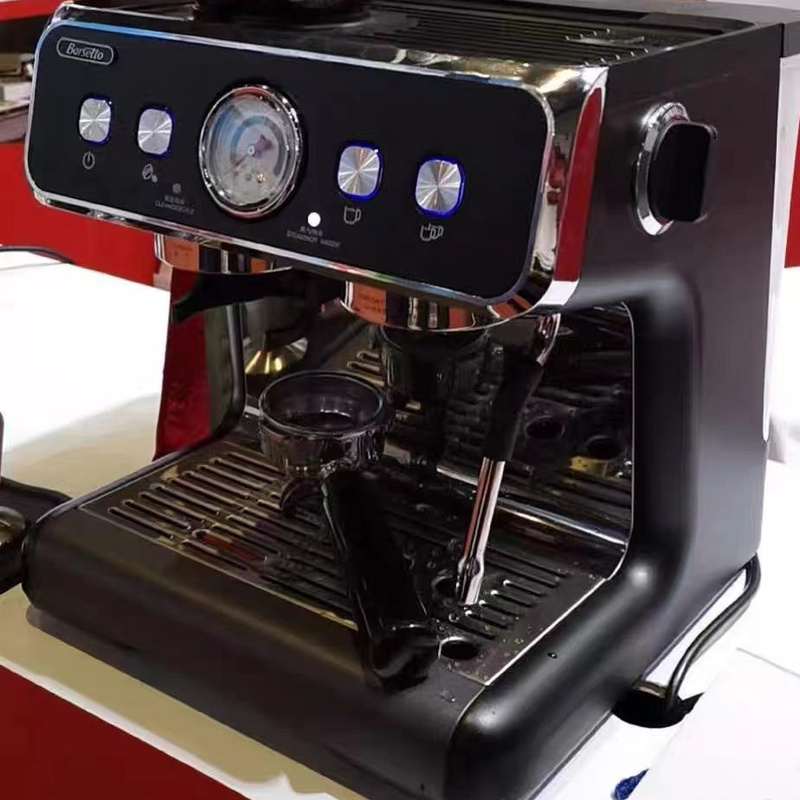
| Criterion | Single boiler | Heat exchanger (HX) | Dual boiler |
|---|---|---|---|
| Brew + steam simultaneously | No | Yes | Yes, both at full power |
| Brew temperature stability | ±1–3 °C, drifts as boiler cycles | ±1–2 °C once thermally settled; idle-time dependent | ±0.2–0.5 °C with PID |
| Brew temperature adjustable | Yes, but not while steaming | Indirectly, via steam pressure or an offset device | Directly, per degree, on the display |
| Warm-up from cold | 10–20 min | 25–45 min for full thermal soak | 20–35 min, brew boiler ready sooner |
| Typical power draw | 1.2–2.0 kW | 2.8–4.5 kW (2-group) | 4.0–6.5 kW (2-group) |
| Maintenance complexity | Lowest — one circuit | Moderate; HX tube scales if water is untreated | Highest — two boilers, two probes, more valves |
| Indicative market range (2-group) | n/a commercially | US$1,800–4,500 | US$4,000–12,000+ |
| Best fit | Under 40 drinks/day, offices, sample bars | 80–400 drinks/day, milk-heavy menus | Specialty bars, multi-roast menus, 150–600+ drinks/day |
Those price bands are general industry ranges for context, not our quotation. Landed cost depends on group count, voltage, options and quantity — ask us directly, and see what determines commercial espresso machine price for the full cost breakdown.
The Cooling Flush: What HX Machines Actually Require
Here is the one HX quirk you should understand before ordering. When an HX machine sits idle, the water resting inside the heat exchanger tube keeps absorbing heat from the surrounding steam boiler. After 5–10 minutes of no use, that trapped water can reach 105–115 °C — well above brewing temperature. Pull a shot on it and you get a scorched, ashy, bitter cup.
The fix is the cooling flush: run the group for 2–6 seconds to purge the overheated slug and pull fresh water through the exchanger. Your baristas learn to read it by sound and steam — the “screaming” flush that settles into a quiet stream. On a machine that is being used continuously the exchanger never overheats, so a busy bar rarely flushes at all; the ritual only matters in the gaps.
What this means commercially: HX is excellent for steady, high-volume trade and slightly awkward for irregular, low-volume trade where the machine sits for 20 minutes then does three drinks. It also wastes 30–80 ml of water per flush, which matters if your water treatment cartridge is sized tightly. If your rhythm is bursty and your staff turn over often, the training burden is a real argument for dual boiler. Volume-driven decisions are covered further in our guide to choosing an espresso machine for a busy cafe.
Dual Boiler, PID and Temperature Profiling
A PID controller holds the brew boiler to a set point instead of letting a pressurestat swing between limits. On a dual boiler that typically means ±0.2–0.5 °C at the group, and — critically — the ability to change brew temperature deliberately: 92 °C for a dense dark-roast blend, 94–95 °C for a light, dense Ethiopian, back again in a minute. Higher-end dual boilers add pressure profiling, where the pump ramps from 3 bar pre-infusion to 9 bar and back down over the shot.
Should you pay for it? Businesses whose product is the coffee itself: specialty bars rotating single origins, competition-minded cafes, roastery tasting rooms, hotel groups that need every branch to hit the same recipe. Businesses whose product is speed and milk — office coffee, high-street takeaway, canteen service — usually get more value from a bigger steam boiler and an extra group than from 0.3 °C of brew precision. If you roast your own beans, the pairing argument is strong: a stable brew temperature is what lets you actually taste roast changes coming off your commercial coffee roasters, and it is why our own roastery customers usually specify dual boiler on the bar.
How to Read Steam Capacity: Litres, kW and Bar
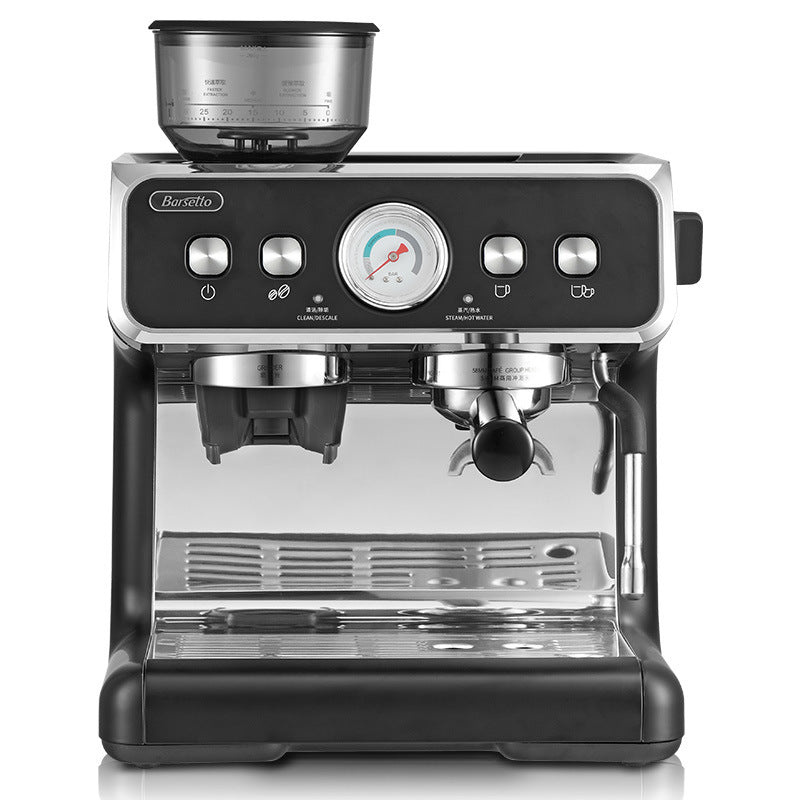
Steam power decides how your milk-heavy menu survives a rush, and three numbers describe it.
| Spec | Typical values | What it governs |
|---|---|---|
| Steam boiler volume | 5–7 L (1-group), 10–12 L (2-group), 17–20 L (3-group) | Reserve — how many jugs back-to-back before pressure sags |
| Element power | 3.0–3.5 kW (2-group), 4.5–6.0 kW (3-group) | Recovery — how fast pressure returns after the reserve is spent |
| Steam pressure | 1.0–1.3 bar (up to 1.5 bar on high-output builds) | Speed — a 600 ml jug in ~20 s at 1.2 bar vs ~35 s at 0.8 bar |
| Steam wand holes | 2 holes for small jugs, 4–5 for 1 L jugs | Texture control vs raw speed |
Rule of thumb: if more than 60% of your menu is milk-based, prioritise boiler litres and element kW over brew-side sophistication. If your menu is espresso, filter and a few flat whites, spend on brew stability instead.
Boiler Architecture, Group Count and Group Head
Architecture and group count are separate decisions that you should keep apart. A 2-group HX and a 2-group dual boiler pour the same number of shots per hour; what differs is temperature control and power. Choose group count from peak-hour throughput — roughly 60–80 drinks per hour per group with a trained barista — then choose architecture from menu style and staff skill. Our breakdown of 1 group vs 2 group vs 3 group espresso machines covers the throughput math in detail.
Group head design sits on top of both. The E61 thermosyphon group, found on many HX machines, circulates hot water through the group continuously so the metal mass stays at temperature and delivers passive pre-infusion — durable, serviceable, and the reason so many Italian-style commercial espresso machines still use it decades on. Saturated groups, more common on dual boilers, are plumbed directly into the brew boiler and offer the tightest thermal stability of all.
Power and Installation Reality
Dual boilers eat more electricity, and this stops deals more often than price does — check your wall before your budget. A 2-group HX at 3.2 kW runs from a single-phase 220–240 V supply at roughly 15 A. A 2-group dual boiler at 5.5 kW needs about 25 A on 220 V single phase, or three-phase wiring. On 110–120 V supplies the same 5.5 kW would demand about 46 A, which is why most 110 V commercial machines are limited to smaller boilers or ship as 1-group units. Note that a nominally “220 V” market is not automatically compatible: the Philippines runs 220 V at 60 Hz, which affects pump motor selection, while most of Europe and the Middle East is 220–240 V at 50 Hz. Confirm voltage, frequency, phase and available breaker amperage before you order — details in our guide to espresso machine voltage and power requirements.
One more installation point that applies to every architecture: both HX tubes and dual-boiler brew boilers scale from the inside out, and an HX tube is narrow enough that scale strangles flow rate long before you see a symptom elsewhere. Treated water and a scheduled service routine are not optional — see espresso machine maintenance and descaling.
How to Choose, and How to Order
Work in this order. First, count your peak hour honestly — not your daily total, your worst 60 minutes. Under 40 drinks/hour, one group is enough; 40–120, two groups; above that, three. Second, calculate your milk ratio; above 60% milk drinks, size the steam boiler and element up a step. Third, decide whether brew precision is part of your product; if yes, dual boiler, if no, HX. Fourth, check the wall — breaker amperage and phase decide what is actually installable. Fifth, budget the water system and a spare-parts kit (gaskets, shower screens, a steam valve seal set) in the same order.
Most distributors we work with order 1–2 sample units first, test them in a real bar for a few weeks, then move to a full container once the model proves itself. That is a sensible way to buy, and we support it: we can send working video of any model before shipment, and machines carry a 1-year warranty with spares held for the models we ship. Browse the commercial coffee machine range, plan the rest of the counter with our coffee shop equipment list, and if roasting is part of the plan, our factory-built YS series roasters are made in the same 1990-founded plant we own and operate.
Frequently Asked Questions
Can an HX machine be fitted with a PID?
Some can, and it helps less than you would expect: a PID on an HX controls the steam boiler, so brew temperature is still inferred through the exchanger and still depends on idle time and flushing. It tightens the band and gives you a readout, but it does not give you a set point per coffee the way a dual boiler's brew-boiler PID does. If you need that, buy the architecture, not the retrofit.
Which layout is easier for a new supplier's service network to support?
HX, by a margin. One boiler, one element, one pressurestat and the trade-standard E61 group mean your local technician has the parts in a drawer; the Italian-style guide lists which parts are universal. Dual boilers add a second element, a second probe, a PID board and more valves, so ask any supplier — us included — for the model-specific parts list and stock before you order a batch.
What about hotels and offices with no barista?
That is usually not an HX-or-dual-boiler question at all but a bean-to-cup one. A fully automatic machine such as the YS-EB2016 at USD 589 makes the drink at a button; a bean-to-cup semi-automatic such as the YS-BAE01 at USD 459 keeps hand-steamed milk. The semi vs fully automatic guide sorts that decision by who is behind the counter.
Does the choice change my water treatment?
Not the targets, but the exposure: an HX runs one large boiler at steam temperature all day, which is where scale deposits fastest, and its narrow exchanger tube is the first thing to choke. A dual boiler adds a second vessel to protect. Either way, size the cartridge to daily litres and change it on volume; the water treatment guide has the numbers, and we quote the set with the machine.
Which of your machines are which?
The SD-103 3-group semi-automatic at USD 1,999 is the classic large-boiler layout for a busy milk bar; the bean-to-cup and fully automatic models are single-boiler systems built for consistency rather than steam volume. Tell us your peak-hour drinks, your milk percentage and your voltage and frequency, and we match a layout from the range with a grinder and a spares kit.
Final Thoughts
Heat exchanger vs dual boiler comes down to three questions: is your trade steady or bursty, is the coffee itself your product or the milk and the queue, and what can your wall socket deliver. HX suits steady volume and milk-heavy menus at lower power; dual boiler buys brew precision for menus that need it. Send us your peak hour, your menu mix and your supply. Talk to us.
Get a Quote → WhatsApp +86 184 0771 4607Last updated: September 17, 2026
Pingback: Italian-Style Commercial Espresso Machines: What You Pay For | Yoshan
Pingback: Rotary Pump vs Vibration Pump Espresso Machine for Cafés