
The pump is one line on an espresso machine's spec sheet, and it quietly decides several things the rest of the sheet does not mention: whether the machine can be connected to mains water, how it sounds on the bar, how steady the pressure is during a shot, and how it holds up after a few hundred thousand cycles. This guide explains the two designs and what each commits you to.
What the two pumps are
A vibration pump — also called a vibratory or solenoid pump — is a small piston driven back and forth by an electromagnet at mains frequency. Each stroke pushes a little water forward. It is compact, cheap and self-priming, which is why it is the standard pump in domestic and small tank-fed machines. It draws from a reservoir and produces pressure in pulses that a small damper smooths out.
A rotary pump — a rotary vane pump — is a motor-driven pump with a rotor carrying sliding vanes inside an offset chamber. As it spins, the vanes trap water and push it through continuously. It is larger, costs more, and needs a supply of water under pressure at its inlet, which is why it is paired with a permanent mains connection. Output is smooth and adjustable by a bypass screw.
Almost every commercial machine built for a bar uses a rotary pump. The machines we supply for café use — the YS-3120 and YS-3201 two-group and the SD-103 three-group — all use American-made Procon rotary pumps, a standard commercial component that any service technician recognises and can replace.
The five things the pump decides
1. Whether the machine can be plumbed in. A rotary pump is designed to take water from a pressurised supply. A vibration pump is designed to lift water from a tank. This is the practical dividing line. If your bar will connect the machine to mains water — and for any real volume it should — the machine needs a rotary pump. The plumbing side is covered in our guide to commercial espresso machine installation requirements.
2. Pressure stability. A vibration pump delivers pressure in rapid pulses. Dampers reduce the ripple, but the pressure profile through a shot is never perfectly smooth, and it drifts as the pump warms and as the tank level changes. A rotary pump delivers continuous flow at a set pressure and holds it shot after shot. On a machine with PID temperature control, that stability is what lets the temperature control show in the cup; a pulsing pump undoes some of the work the PID is doing.
3. Noise. The vibration pump's buzz is the sound most people associate with espresso machines, and it is loud. On a small counter at home it is background; on a bar it carries. A rotary pump hums quietly under the machine. In an open café where the bar is part of the room, this difference is noticed by customers and staff alike.
4. Duty cycle and lifespan. A vibration pump is rated for intermittent use with rest between shots. Run it continuously through a rush and it heats, its output falls, and it wears. A rotary pump is a continuously rated industrial component built to run all day. On a bar doing a few hundred drinks, this is the difference between a pump that is replaced every couple of years and one that outlives most of the machine.
5. Adjustability. Rotary pumps have a bypass adjustment that sets brew pressure precisely — nine bar, or whatever the recipe wants — and it stays there. Vibration pump pressure is set by an over-pressure valve and is less precise and less stable.
The honest case for a vibration pump
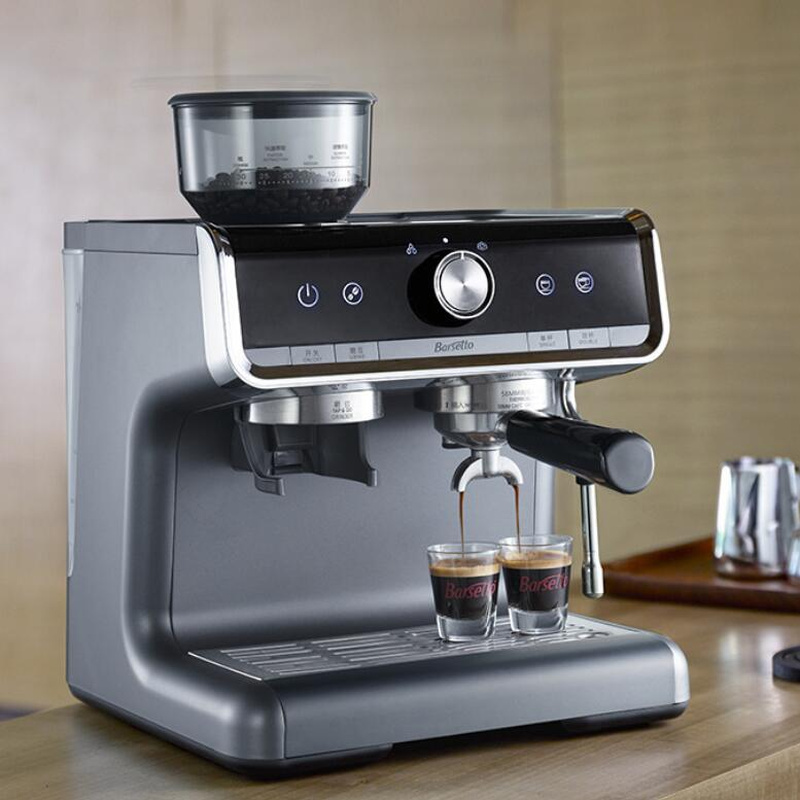
There is one: cost and portability. A vibration-pump machine is cheaper, lighter, and works anywhere there is a power socket and a jug of water. For a mobile cart, an event bar, a very small kiosk with no plumbing, or a single-group machine in an office, that flexibility is real and the volume is low enough that the pump's limits never show.
The mistake is carrying that choice into a fixed bar with a queue. The moment a café is plumbing in a machine — which it should be, for drain and water treatment reasons as much as for the pump — the case for the vibration pump disappears.
Reading the spec sheet
Look for the pump line, and for what surrounds it. A commercial machine will name the pump type and often the make. It will also list a direct water connection, a boiler size in litres rather than millilitres for the steam boiler, and a power rating in the 3–4.5 kW range for a two-group. Those four lines together describe a machine built for a bar.
On our own listings the pattern reads like this: YS-3120, Procon rotary pump, 9 bar, 550 ml coffee boiler and 7 L steam boiler, 4,200 W, direct connection. The SD-103 three-group carries a 14 L boiler with the same rotary pump. Compare against a small machine listing a vibration pump, a 2-litre tank and 1.2 kW, and the difference in intended use is obvious before you read the price.
Pump type also interacts with the boiler layout. A dual-boiler or heat-exchanger machine needs steady flow to hold brew temperature through back-to-back shots, which is why those designs almost always pair with a rotary pump. That comparison is in heat exchanger vs dual boiler.
What a rotary pump commits you to
Choosing the rotary pump — that is, choosing a commercial machine — brings three obligations with it:
- A plumbed water supply with a shut-off valve and regulated inlet pressure. The pump needs it.
- Water treatment on that supply. A plumbed machine drinks whatever the mains delivers, so filtration for scale and chlorine is part of the installation. See espresso machine water treatment.
- A drain, because a plumbed machine is used harder and produces more waste water.
None of these is a drawback of the pump. They are the infrastructure of a bar that takes espresso seriously, and the pump is simply the component that assumes it exists.
FAQ
Is a rotary pump better than a vibration pump for espresso?
For a fixed bar with volume, yes without much argument: it can be plumbed in, holds pressure steadily, runs quietly, and is rated for continuous use. A vibration pump is the right choice only where there is no plumbing or the machine must be portable and volume is low.
Can a vibration pump espresso machine be plumbed in?
Generally no. Vibration pumps are built to draw from a tank at atmospheric pressure, not from a pressurised supply. Some machines offer a plumbing kit with a pressure-reducing arrangement, but this is a workaround rather than a design. Machines intended for mains connection use rotary pumps.
Why are rotary pump machines quieter?
A rotary vane pump is driven by a motor and moves water continuously, producing a low hum. A vibration pump is an electromagnet snapping a piston back and forth fifty or sixty times a second, which produces the familiar loud buzz. On an open bar the difference is clearly audible to customers.
How long does a rotary pump last?
Under normal café use with clean, treated water, a commercial rotary pump typically outlasts most other components and runs for many years. It is a standard industrial part — ours are Procon units — so when it eventually needs service, replacement is routine and parts are available worldwide.
Does the pump affect espresso taste?
Indirectly. A rotary pump holds brew pressure constant through the shot and from shot to shot, which makes extraction more consistent and lets temperature control do its job. A pulsing or drifting pressure from a vibration pump adds variability that shows up as inconsistency between drinks rather than as a specific flavour.
What pressure should a commercial espresso machine pump deliver?
Nine bar at the group is the conventional setting, and a rotary pump's bypass adjustment lets a technician set and hold it precisely. Some cafés run slightly lower for certain coffees. The point is that the pressure is chosen and stays put, which a rotary pump makes possible.
Do all commercial espresso machines have rotary pumps?
Nearly all machines built for bar use do, including every two- and three-group machine we supply. Some compact one-group or "professional home" machines use vibration pumps to keep size and cost down. If a machine is marketed as commercial but lists a vibration pump and a tank, it is intended for very light duty.
Final Thoughts
For a café bar the pump question answers itself: a rotary pump, plumbed in, with treated water and a drain. That is how the YS-3120 and every other bar machine we supply is built. As a wholesale supplier of commercial coffee machines, we can confirm the pump, boiler and connection details for any model before you order.
Request a quote or message us on WhatsApp at +86 184 0771 4607.
Get a Quote → WhatsApp +86 184 0771 4607Last updated: September 17, 2026
Pingback: Espresso Brew Pressure: What 9 Bar Means & How to Check It
Pingback: PID Temperature Control on Commercial Espresso Machines
Pingback: Espresso Machines for Coffee Carts and Food Trucks