
"PID" appears on almost every commercial espresso machine's spec sheet, usually as three letters and nothing else. It refers to how the machine holds its brew water at temperature, and the difference is measurable in the cup — but only when the rest of the machine lets it work. This guide explains what a PID does, what it replaces, why it matters more on some machines than others, and how to use it.
What the machine is trying to do
Espresso extraction is sensitive to water temperature. A few degrees either way changes the balance of acidity, sweetness and bitterness in the cup, and a machine whose brew temperature wanders from shot to shot produces shots that taste different for no reason the barista can see. Temperature stability is therefore the foundation of consistency; grind and dose are adjusted against it.
The machine has to hold a boiler of water at a set temperature while shots draw hot water out and cold water flows in. How well it does that is decided by the controller.
Pressurestat: the older way
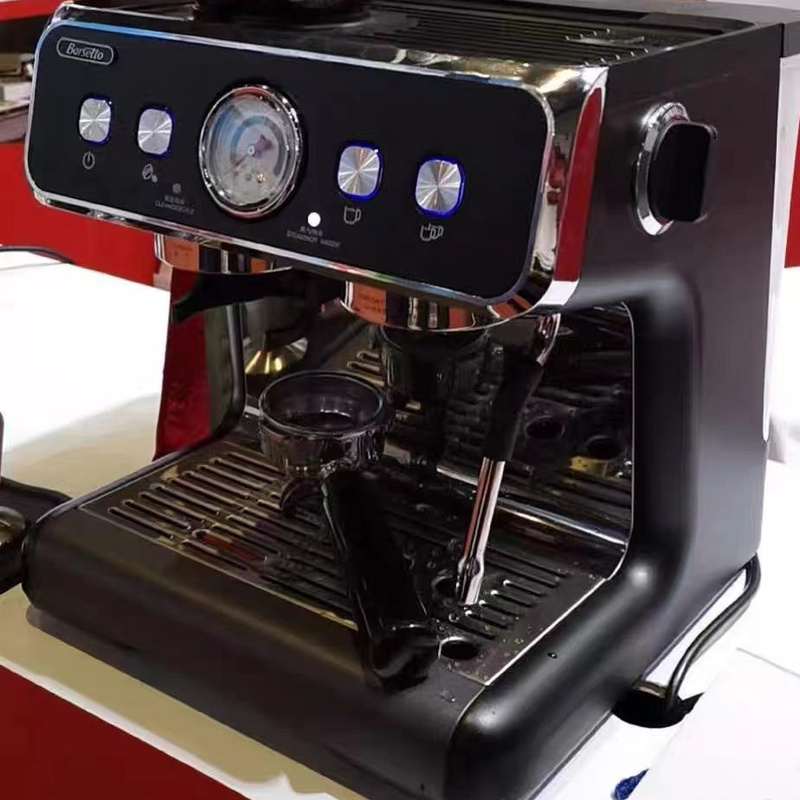
A pressurestat is a mechanical switch that reads boiler pressure — which in a sealed boiler corresponds to temperature — and turns the heating element fully on when pressure drops below a threshold and fully off when it rises above another. It is simple and robust, and it has controlled espresso boilers for decades.
Its limitation is the gap between the two thresholds. The element is either flat out or off, so the boiler overshoots the upper limit, coasts, falls to the lower limit, and repeats. On a brew boiler that translates to a temperature swing of several degrees across a heating cycle. A shot pulled at the top of the cycle and one at the bottom are different shots. The barista does not know where in the cycle they are.
PID: the current way
A PID controller reads temperature directly with a probe and adjusts the element continuously — not on or off, but a varying proportion of power — based on how far the boiler is from the set-point, how long it has been there and how fast it is moving. The three letters stand for those three terms. The effect is that the boiler settles on the set-point and stays within a degree or so of it, instead of oscillating around it.
Two things follow for the bar. The temperature at the group is the same for the first shot and the twentieth. And the set-point is adjustable from a display, so the bar can choose 92 °C for one coffee and 94 °C for another and know it is getting it.
Published comparisons put the improvement in shot-to-shot repeatability from PID over pressurestat control in the range of a meaningful fraction of shots that would otherwise have fallen outside the target — enough to be tasted on a bar that cares, and enough to make dialling in a coffee a shorter job, because temperature stops being a moving variable.
Where PID actually pays off — and where it does not
This is the part spec sheets skip.
On a dual-boiler machine, PID does the whole job. The brew boiler has its own element and its own PID, so brew temperature is controlled directly and independently of the steam boiler. Heavy steaming does not disturb it. This is the layout on the machines we supply — the YS-3120 and YS-3201 two-groups and the SD-103 three-group all pair PID with separate brew and steam boilers — and it is the configuration in which "PID" on the sheet means what buyers expect.
On a heat-exchanger machine, PID does half the job. There is one boiler making steam, and brew water is heated by passing through a tube inside it. A PID on that machine controls the steam boiler's temperature, which sets the brew water only indirectly. Brew temperature still varies with how long since the last shot and how hard the steam wand has been used; baristas manage it with a cooling flush. PID helps, but it is not the same thing as PID on a brew boiler, and a heat-exchanger machine advertising PID should be understood that way. The layouts are compared in heat exchanger vs dual boiler.
PID needs stable pressure to show in the cup. Temperature stability is one half of extraction consistency; pressure stability is the other. A rotary pump holds brew pressure steady through the shot; a vibration pump pulses. On a vibration-pump machine, some of what the PID has stabilised is undone by the pump. Which is why commercial machines pair PID with a rotary pump — see rotary pump vs vibration pump espresso machines.
PID cannot fix the group. The group head is a large piece of brass or steel between the boiler and the coffee, and its temperature drifts with use. Machines with well-designed thermally stable groups deliver the PID's stability to the coffee; machines with poorly designed groups lose some of it. A PID on the boiler is necessary, not sufficient.
Using the PID on a café machine
Having one is only useful if the bar uses it.
Set the temperature for the coffee, not by default. Lighter roasts generally extract better a degree or two higher; darker roasts a degree or two lower. Most machines ship in the low nineties Celsius; dial in from there by taste rather than accepting the factory figure as correct for every coffee.
Change one variable at a time. With temperature fixed, grind and dose are the variables. Set the temperature first, then dial in grind, then leave the temperature alone until the coffee changes.
Note it on the recipe card. A bar with a PID and no record of the set-point has thrown away half the benefit. Temperature belongs on the card beside dose, yield and time.
Watch for drift after a service. Probes age and elements scale. If a set-point that made good shots now makes sour or bitter ones with nothing else changed, the probe may be reading off or the boiler may be scaling; both are maintenance, not recipe. Water treatment protects the boiler and the probe, as set out in espresso machine water treatment.
Reading the spec sheet
Look for three things together: PID, dual boiler (or separate brew boiler), and rotary pump. That combination is a machine built to hold temperature and pressure through a shot. PID with a heat exchanger is a good machine with a smaller stability advantage. PID with a vibration pump is a machine whose temperature stability is partly wasted. And a machine listing none of the three is controlled by a pressurestat, which is fine for a bar that does not chase consistency and less fine for one that does.
For the wider choice among machine types, our commercial espresso machine buyer's guide sets out the categories.
FAQ
What does PID mean on an espresso machine?
It is a controller that reads boiler temperature and adjusts the heating element continuously to hold a set-point within about a degree, instead of switching the element fully on and off around a pressure threshold. The letters refer to the proportional, integral and derivative terms in the control calculation.
Is a PID worth it on a commercial espresso machine?
On a dual-boiler machine with a rotary pump, yes: it removes brew temperature as a variable, makes shots repeatable across the day and shortens dialling in. On a heat-exchanger machine it helps less, because it controls the steam boiler and only indirectly the brew water.
What is the difference between a pressurestat and a PID?
A pressurestat is a mechanical switch that turns the element on and off between two pressure thresholds, so temperature swings several degrees each cycle. A PID measures temperature and modulates the element continuously, holding it within a degree or so. The swing is what a pressurestat machine's shots vary with.
Does PID work on a heat exchanger machine?
Partly. The PID controls the single steam boiler; brew water is heated indirectly through a tube in that boiler, so brew temperature still varies with recent use and steaming. Baristas manage it with a cooling flush. Full PID benefit needs a separate brew boiler with its own controller.
What brew temperature should I set?
Start in the low nineties Celsius and adjust by taste for the coffee: lighter roasts often a degree or two higher, darker roasts a degree or two lower. Set the temperature first, then dial in grind, and record the set-point on the recipe card so it is repeatable.
Why does my PID machine still pull inconsistent shots?
Check the other variables: a vibration pump pulsing pressure, a group head that drifts with use, a scaled boiler or an ageing probe reading off, or grind and dose changing with the coffee's age. PID holds boiler temperature; it does not control pressure, the group, or the grinder.
Do the machines you supply have PID?
Yes. The YS-3120 and YS-3201 two-groups and the SD-103 three-group all combine PID temperature control with separate brew and steam boilers and a rotary pump — the configuration in which PID delivers its full benefit to the cup.
Final Thoughts
A PID holds brew temperature within a degree; a pressurestat lets it swing by several. The difference reaches the cup fully only on a dual-boiler machine with a rotary pump, which is how the bar machines we supply are built — the YS-3120 and its siblings in our commercial coffee machine range. Set it for the coffee, write it on the card, and let grind do the rest.
Request a quote or message us on WhatsApp at +86 184 0771 4607.
Get a Quote → WhatsApp +86 184 0771 4607Last updated: September 17, 2026
Pingback: Espresso Machine Steam Boiler Pressure: Gauge & Faults