
A commercial espresso machine has two pressure gauges and most of the questions we get confuse them. The brew gauge climbs to about 9 bar during a shot; the steam gauge sits around 1 bar all day and moves slowly. This guide is about the second one: what the reading means, why the needle swings within a band, how to tell that cycling from a failing pressurestat, when the safety valve opens, and how PID steam control behaves differently.
What the steam gauge is telling you
The steam boiler holds water heated past boiling. The pressure above it is saturated steam pressure, and pressure and temperature move together: roughly 1.0 bar on the gauge corresponds to about 120 °C in the boiler, 1.2 bar to about 123 °C, and 1.5 bar to about 127 °C. The gauge is therefore a thermometer in disguise. Most commercial machines are set at the factory somewhere between 1.0 and 1.3 bar — 1.1–1.2 is the common band — which delivers dry, energetic steam for milk without pushing the boiler toward its limits. Steam boilers are built for that band; they are not designed to run at 2 bar, and the safety valve is usually rated to open before that.
The brew-pressure gauge is a different instrument answering a different question; the distinction and the blind-basket test are in espresso brew pressure explained.
Why the needle swings: the pressurestat and its deadband
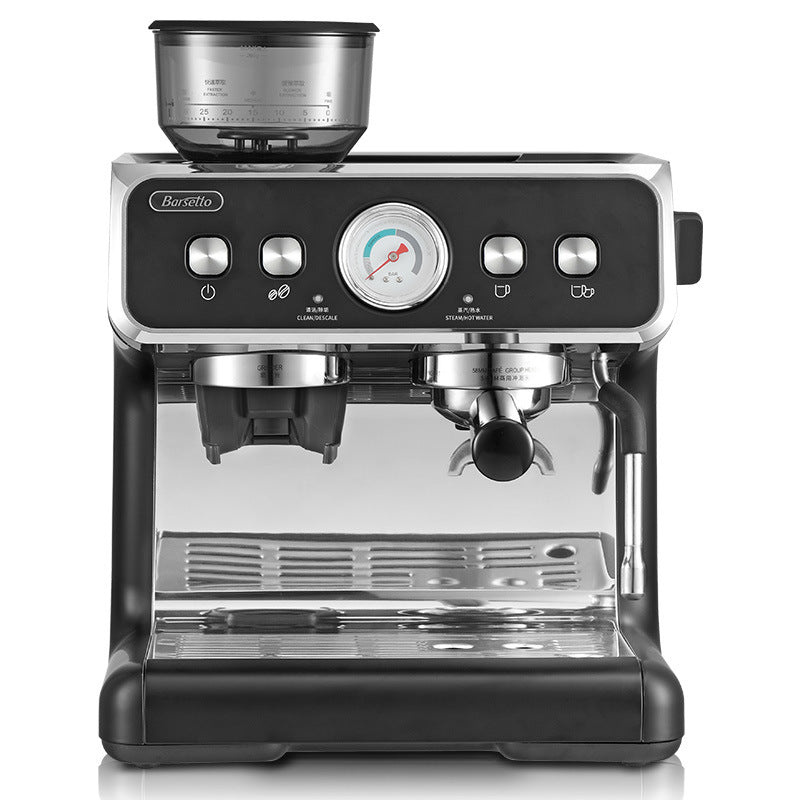
On many commercial machines a pressurestat — a mechanical pressure switch — controls the steam boiler. A diaphragm or bellows senses boiler pressure; at the cut-out point it opens the contacts and the heating element switches off; pressure falls as steam is drawn and heat is lost; at the cut-in point the contacts close and heating resumes. The gap between the two is the deadband, and it is why the needle cycles rather than holding still. A healthy industrial pressurestat has a deadband of about 0.2 bar; the needle on a machine set to 1.2 swings between roughly 1.1 and 1.3.
Three makes cover most commercial machines. The heavy industrial type — the one in most two- and three-group machines — has a single adjustment screw and a diaphragm that hardens with age, widening the deadband; it can be rebuilt with a kit. Smaller sealed units with a metal membrane are more precise, some with a second screw for the deadband, and are replaced rather than repaired.
Reading the gauge as a manager
| What you see | What it means | What to do |
|---|---|---|
| Needle cycles within about 0.1–0.3 bar around the set point | Normal deadband | Nothing |
| Swing has widened to 0.5 bar or more | Pressurestat diaphragm hardening | Plan a rebuild or replacement; steam quality will vary through the day |
| Pressure climbs past the usual cut-out and keeps going | Pressurestat contacts stuck closed, or scale in its sensing tube | Switch off at the machine; call — the safety valve is the next line |
| Safety valve hissing loudly, gauge near 1.8–2 bar | Over-pressure; safety valve doing its job | Switch off; do not adjust or block anything; call |
| Pressure never reaches the band | Element, contactor, pressurestat contacts stuck open, or level control keeping the element off | Check the boiler-level indicator and water supply first; then call |
| Very frequent clicking and short cycles | Contact chatter; deadband collapsed | Replace |
| Steam weak but gauge normal | Not the boiler — a blocked tip, or recovery after heavy use | Clean the tip; check boiler size against demand |
The last row is the common one: a normal gauge with weak steam is a wand or a sizing problem, covered in espresso machine steam boiler size, not a pressure problem.
Adjusting the pressurestat — and why you mostly should not
Technicians adjust a pressurestat with the machine off and cold, the panel removed, turning the adjustment screw a quarter-turn at a time — clockwise raises pressure on most units — then reheating and reading the gauge, repeating until the cut-out sits where the manual says. Two cautions come with every guide. Do not chase steam power by raising the pressure: above about 1.4–1.5 bar the water is hotter than the boiler and the hot-water outlet are meant for, and on heat-exchanger machines brew temperature rises with it. And do not exceed the safety valve's opening pressure — commonly 1.8 bar on commercial machines — or it will lift, which is loud, wet and a sign that the adjustment has gone too far. A pressurestat that no longer holds a setting after adjustment is worn and should be rebuilt or replaced, not re-adjusted weekly. Over-adjustment is also a warranty issue on most machines.
The realistic answer for a café is that the pressurestat is set at commissioning and then left alone until its behaviour on the gauge says it is wearing.
The safety valve is the last line, not a control
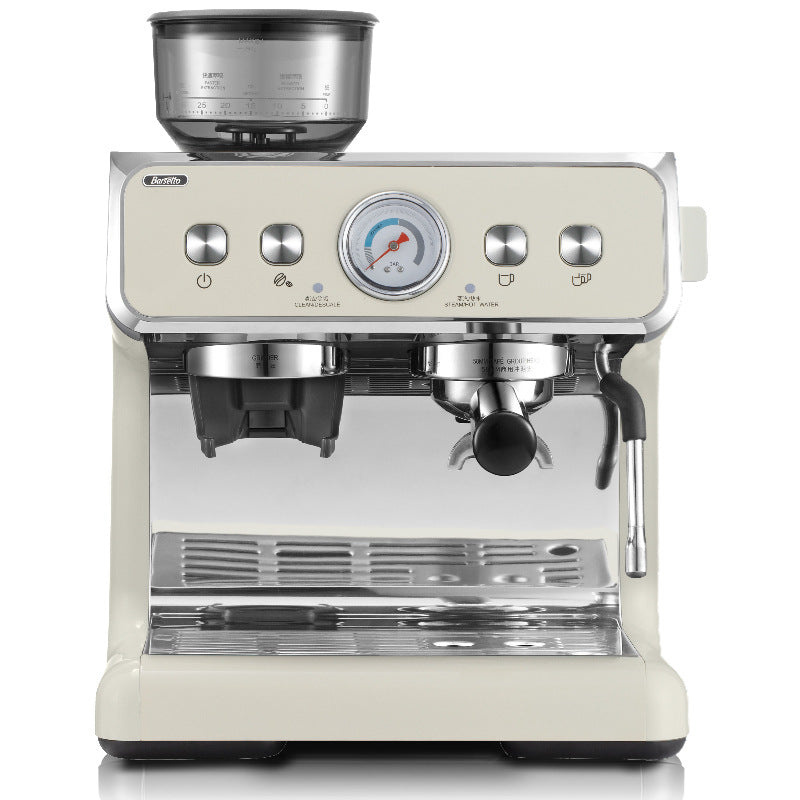
Every steam boiler carries a spring-loaded safety valve that opens at a fixed pressure — 1.8 bar is a common rating on commercial machines — and dumps steam if the pressurestat or its controller fails closed. It is a certified pressure component, inexpensive, and replaced on a schedule rather than when it fails; service technicians commonly change it yearly. If it opens, the machine is switched off and the cause found; it must never be adjusted, blocked or wired around. The valve's partner, the anti-vacuum valve that hisses briefly during warm-up, is explained in espresso machine safety valve and anti-vacuum valve.
PID-controlled steam boilers
Machines whose steam boiler is under PID control hold it by temperature rather than by a mechanical pressure switch. (The two-group YS-3120 and YS-3201 and the three-group SD-103 we supply carry PID temperature control; ask us, for a given model, which boilers the PID holds and whether a pressurestat is fitted alongside it.) The controller reads a sensor and modulates the element to a set temperature, so the pressure the gauge shows follows from that temperature with a much smaller swing than a pressurestat's deadband. On such a machine the steam gauge is a display, not a control: a stable reading is normal, a reading that drifts or climbs is a sensor or controller fault rather than a switch, and the set point is changed in the controller, not with a screwdriver. The safety valve is the same and does the same job. What PID adds on the brew side is in PID on commercial espresso machines.
Boiler level and the gauge
Steam boiler pressure depends on the boiler being filled to its probe. A boiler over-filled because the level probe is scaled reads normal pressure but spits water from the wand; a boiler under-filled because the supply is closed or the fill valve has failed shows an element working hard and pressure that will not come up, and on most machines a level warning. Check the level indicator and the water supply before suspecting the pressurestat — the sequence is in commercial espresso machine troubleshooting.
FAQ
What pressure should an espresso machine steam boiler be?
Most commercial machines are set between 1.0 and 1.3 bar, with 1.1–1.2 bar the common band — about 120–125 °C in the boiler. That delivers dry steam for milk without stressing the boiler. Higher settings raise hot-water temperature, affect brew temperature on heat-exchanger machines, and approach the safety valve's opening pressure.
Why does the steam pressure gauge go up and down?
Because a mechanical pressurestat switches the element off at a cut-out pressure and on again at a lower cut-in pressure; the gap — the deadband — is about 0.2 bar on a healthy unit. A swing of 0.5 bar or more means the diaphragm is hardening and the switch needs rebuilding or replacing.
What is a pressurestat on an espresso machine?
A pressure-operated switch that cycles the steam boiler's heating element on and off to hold pressure within a band. It is adjusted by a screw, wears with age as its diaphragm stiffens, and is the usual cause of steam pressure that drifts, overshoots or cycles erratically.
Is steam pressure the same as pump pressure?
No. Steam pressure is the boiler at about 1–1.3 bar all day; pump or brew pressure is about 9 bar only while a shot is pulled. They have separate gauges, and weak steam or poor crema are almost never fixed by changing either pressure.
What happens if the safety valve opens?
It vents steam loudly because boiler pressure has reached its rating — commonly around 1.8 bar — usually because the pressurestat or controller failed with the element on. Switch the machine off, do not touch the valve, and have the control fault found. Safety valves are replaced on a schedule, often yearly.
Do PID espresso machines have a pressurestat?
Machines with PID steam control hold the boiler by temperature through an electronic controller instead of a mechanical pressure switch, so the gauge is a display and the swing is small. The set point is changed in the controller. The safety valve is the same on both types.
Final Thoughts
Read the steam gauge as a temperature, expect a small cycle from a pressurestat and almost none from PID control, treat a widening swing as wear and a rising needle as a fault, and never touch the safety valve. As a wholesale supplier of commercial coffee machines, we supply PID-controlled two-groups such as the YS-3201 and confirm the gauge targets for each model with its manual.
Get a quote or message Leon on WhatsApp at +86 184 0771 4607.
Get a Quote → WhatsApp +86 184 0771 4607Last updated: September 23, 2026
Pingback: Espresso Machine Safety Valve & Anti-Vacuum Valve: Hiss, Leak or Stop