
If you are fitting out a cafe and looking at Italian-style commercial espresso machines, you are weighing a name against a number. The Italian brands cost two or three times more than an Italian-style machine from a wholesale supplier, and the sales pitch on both sides is unhelpful — one says heritage, the other says value. Here is what the name actually buys you, and the three things that decide reliability on any machine.
What the Italian Name Actually Buys You
Be fair to it. The established Italian makers have decades of accumulated knowledge in three areas that genuinely matter: boiler metallurgy, pump calibration and the thermal stability of the group head — the part your barista locks the portafilter into. That knowledge shows up as consistency shot after shot, and as machines that are still running after fifteen years.
Two things the name does not buy you, which the marketing implies it does:
- Exclusively Italian components. Much of the global espresso supply chain — including many Italian brands — already sources parts from the same factories in China. The valves, pumps, electronics and often the boilers overlap.
- Better technology. On flow profiling, pressure control, dual-boiler layouts and app-connected recipes, Chinese-built machines have moved faster than most traditional Italian ranges. Australian cafe-equipment reviewers who have stripped both down describe the choice as tradition versus digital precision, not good versus bad.
So the honest version is: the name buys you a track record and a service network in your country. Whether that is worth two to three times the price depends on what you can verify on the alternative.
The Real Question: Three Things You Can Check
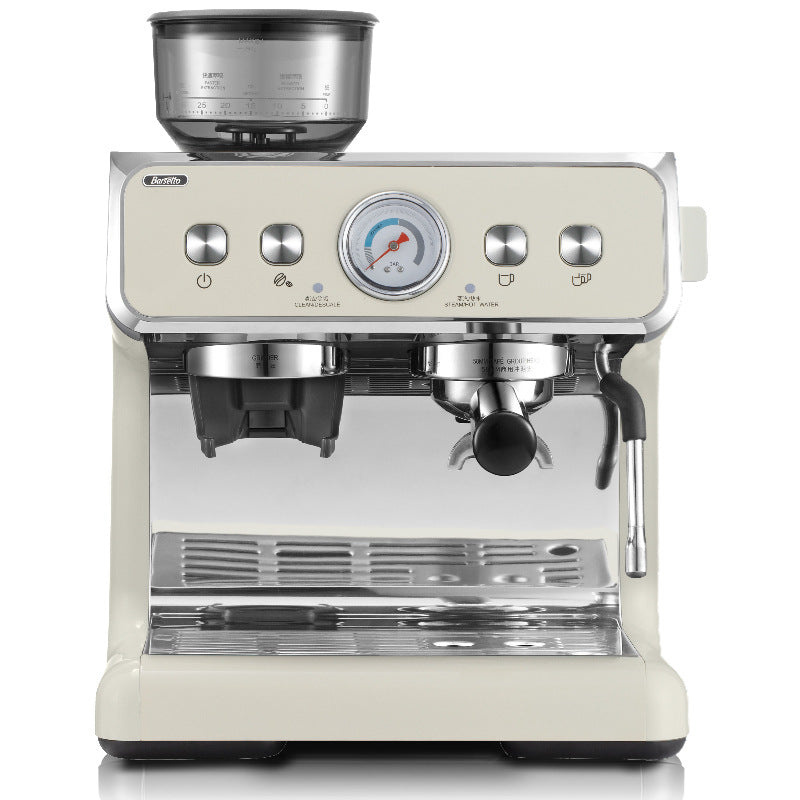
For a cafe owner, "Italian or Chinese" is the wrong question. The right one is whether the machine in front of you passes on these three:
1. Boiler material and size. Copper or stainless steel, and how many litres. A 2-group machine with an undersized boiler runs out of steam on a Saturday morning, whatever the badge says. Ask for the boiler capacity in litres and the material, in writing.
2. Heating element and recovery. The element wattage against the boiler size tells you how fast the machine comes back after a rush. Ask for the element rating, and whether the machine is a heat-exchanger or a dual-boiler design — our heat exchanger vs dual boiler guide explains which suits which cafe.
3. Parts and service in your country. Group gaskets, solenoid valves, pump seals and heating elements are the parts that fail. Where do they come from, how long do they take to arrive, and who in your city can fit them? This, not the badge, is what keeps a machine earning.
A supplier who answers all three in writing — brand or not — is one you can buy from.
How Italian-Style Machines Measure Up
Italian-style machines built in China follow the same layouts the Italian makers established: E61-type group heads, heat-exchanger or dual-boiler systems, rotary pumps, and the classic proportions cafes expect on the counter. On the three checks above:
- Boilers are commonly stainless steel at comparable capacities to the equivalent Italian class. Check the litres.
- Elements are typically rated for fast recovery; check wattage against boiler size.
- Parts are the variable. Many components are standard across the industry — E61 gaskets, for instance, are interchangeable — but you need to know your supplier's spares route before you buy, not after.
Our E61 group head article covers what that standard actually gives you, and why it matters for parts.
Which Parts Are Universal — the Concrete Answer to the Parts Question
"Where will I get parts?" has a more precise answer than "from the supplier", because the espresso trade standardised its wear parts decades ago and an Italian-style machine, wherever it is built, is assembled from them.
Parts that are the same across the industry — and that any espresso technician in your city has in a drawer:
- E61 group gaskets (the 8.5 mm × 73 mm ring), shower screens and the screws that hold them
- 58 mm baskets, portafilters and tamper fit
- Three-way solenoid valves in the standard coil sizes
- Rotary pumps and their motors, from the two or three makers that supply the whole trade
- Pressurestats, vacuum-breaker valves, safety valves and the standard boiler fittings
- Steam and hot-water wand tips and valve seals
If a machine is built on those, it does not matter much whose badge is on the front for the first five years of gaskets and valves.
Parts that are specific to the model — and that must come from the supplier:
- Control boards, touch panels and the PLC on volumetric or automatic machines
- Heating elements, which are made to the boiler's size and flange
- Boilers themselves, group bodies on non-E61 designs, body panels
So the question to ask, of an Italian brand or of us, is: which of your parts are trade-standard, and for the model-specific ones, what is on the shelf and how does it travel? For the machines we supply, the wear parts are the standard items above; the model-specific parts ship by courier from stock, and the wholesale guide sets out how a dealer keeps a shelf of both.
What We Supply
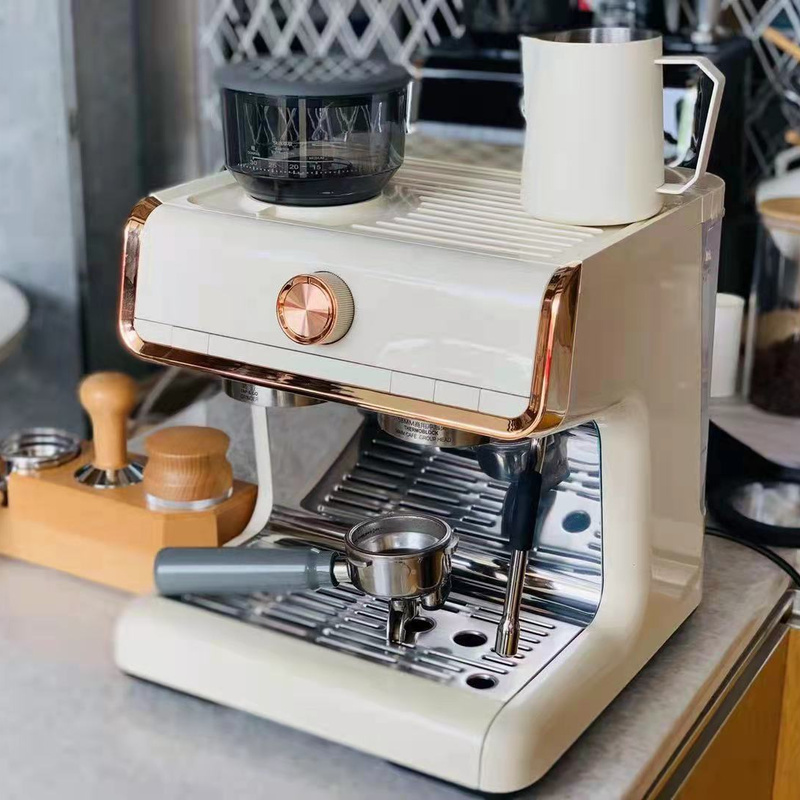
We are a wholesale supplier of commercial espresso machines, not the manufacturer — so we specify against the three checks above and put them on the quote. Our current range, all on the commercial coffee machine page (the SD-103 and YS-3120 have their own pages):
| Machine | Type | Where it fits |
|---|---|---|
| SD-103 | 3-group semi-automatic | High-volume cafe, two baristas — USD 1,999 ex-works |
| YS-3120 / YS-3201 (Gemilai) | 2-group semi-automatic, Italian layout, Procon rotary pump | The standard busy-cafe machine, our best seller — USD 1,299 / 1,499 ex-works; available as package deals with grinder |
| YS-GM3200 | 1-group semi-automatic, Ulka vibration pump | Small counter, up to 120 cups an hour — USD 549 |
| YS-Tank | 2-group semi-automatic, tank-fed (1.7 L on the single-group GM3200; 9 L steam boiler on the Tank) | Sites without a plumbed water line — USD 1,399 |
| YS-BAE01 / BAE02 | Bean-to-cup semi-automatic | Cafes with untrained staff or self-service — USD 459 / 609 |
| YS-EB2016 | Bean-to-cup fully automatic | Offices, hotels, high-turnover with no barista — USD 589 (250 g hopper) / 659 (750 g hopper) |
| EM-650 | 2-in-1 compact | Small counters, kiosks |
Tell us your daily cup count, your water supply and your voltage, and we will point you at one — the busy cafe guide explains how group count and boiler size map to throughput.
When the Name Is Worth It — and When It Is Not
Buy the Italian brand if you are in a market where its service network is strong and a machine down for a day costs you more than the price difference — a high-volume city cafe with one machine and no backup.
Buy Italian-style if you can verify the three checks, you have a spares route, and the price difference funds a second machine, a better grinder or three months of rent. For a new cafe, a franchise rollout or a multi-site operator, that is usually the better use of the money.
The worst outcome is the one in between: paying brand money for a machine you cannot get serviced, or buying cheap without checking the boiler and the spares.
If You Are Reselling
Dealers ask us a different question: can they build a range on Italian-style machines? The answer depends on the same three checks, plus two more — whether you can hold spares locally, and whether the supplier will build to your voltage and, if needed, your branding. We supply on wholesale terms with those points on the quote; the wholesale guide covers how the trade side works.
Frequently Asked Questions
How do I tell an Italian-style machine built well from one built cheaply, before it arrives?
Ask for three photographs, not a brochure: the boiler with its rating plate showing litres and material, the group head from underneath showing the gasket seat, and the inside of the body showing the wiring and the pump. Copper or stainless boiler at the litres the class needs, a machined group, tidy looms and a rotary pump on a 2-group — those four are what the Italian makers get right, and they are visible in a photo.
Will my customers care that it is not made in Italy?
Your barista might; your customers judge the cup and the queue. Where the badge matters commercially is in a specialty bar whose customers know equipment, and in resale value — an Italian brand holds its price used. For a neighbourhood cafe, a hotel or a chain, the machine that recovers on a Saturday and has gaskets in the technician's drawer matters more than the country on the front.
Can I brand an Italian-style machine as my own for my dealership?
Yes, from small quantities: panels in your colour, your logo on the body and the manual, and the document pack issued with your name. What does not change is the boiler, group and pump, which is the point — you brand a proven layout. The wholesale guide covers sample-first ordering and what a dealer keeps on the shelf.
What does the first year of ownership look like on one of these machines?
A daily backflush, a wand wipe, gaskets and shower screens every three to six months, a water filter changed on litres, and — if you followed the water advice — no scale. The parts for all of that are the universal ones above. The failure we actually see in year one is untreated water, not the machine's origin; the water treatment guide is the page that protects it.
How do the bean-to-cup and fully automatic models fit alongside?
As different tools for different counters, not as a lower tier: the YS-BAE01 bean-to-cup semi-automatic at USD 459 keeps hand-steamed milk for a cafe with rotating staff, and the YS-EB2016 fully automatic at USD 589 serves a hotel breakfast with no barista. A dealer's range usually carries the Italian-style semi-automatic for the specialty bar and one of each of these for everyone else.
Final Thoughts
An Italian name buys you a track record and a service network; an Italian-style machine buys you the same layout at a fraction of the price, provided the boiler, the element and the spares route check out. We supply commercial espresso machines on wholesale terms with those three points written on the quote. Send us your daily cup count and your voltage and we will match a machine. Get a wholesale quote.
Get a Quote → WhatsApp +86 184 0771 4607Last updated: September 17, 2026
Pingback: Commercial Espresso Machine Buyer's Guide for Coffee Shops
Pingback: E61 Espresso Machine: What the Group Does, When to Specify It | Yoshan
Pingback: Heat Exchanger vs Dual Boiler: Which One Your Menu Needs | Yoshan