
Every roaster spec sheet names the drum material, and every manufacturer argues that theirs is the right one. Strip the marketing away and the material decides two physical things: how much heat the drum stores, and how quickly it responds when you change the burner. Those two properties shape how the machine behaves across a roasting day. This guide explains them, and which suits which kind of production.
Two numbers behind every drum argument
Thermal mass is how much heat the drum holds. A heavy, thick drum stores a lot of it. That stored heat is released into every batch charged, so consecutive batches see a very similar environment even if the burner is a little late or early. The cost is that a high-mass drum takes longer to preheat, and longer to come back down if it overshoots.
Response is how fast the drum's surface temperature follows the burner. A thin, conductive drum reacts within seconds to a gas change; a thick one lags. High response gives a roaster who is developing a profile fine control. It also means the drum tracks every disturbance — a cold batch of beans, a draught, an open door.
The two properties trade against each other. Nothing in the material debate escapes that trade, so the useful question is which side of it your operation sits on.
Cast iron: mass, stability, and patience
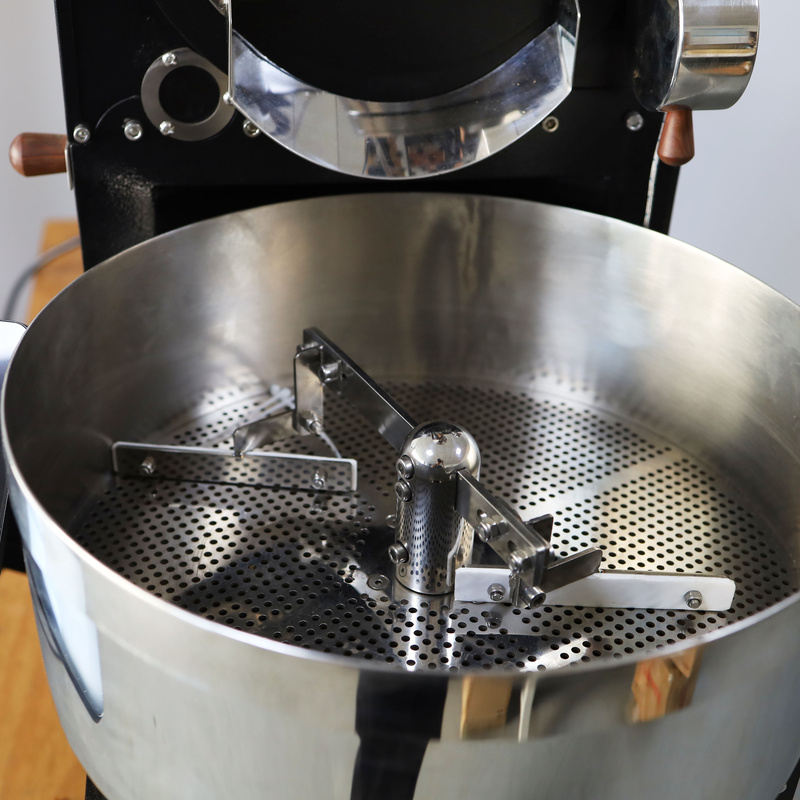
Cast iron is the traditional drum material in production roasters, and for a reason that has nothing to do with tradition. It is heavy and it stores heat. Charge the third batch of the day into a cast iron drum and it behaves like the second, because the drum, not the burner, is doing much of the work of bringing the beans up to temperature.
That stability is why our production machines — the SD series and the YS series — use cast iron drums. When a roastery is running ten, twenty, thirty batches in a shift with more than one person at the controls, batch-to-batch consistency is worth more than a fast response curve.
The costs are real and worth stating plainly:
- Preheat takes longer. A cast iron drum needs a proper warm-up before the first charge and a between-batch routine after it. Skip that and the first two batches of the day will not match the rest.
- It does not forgive haste. Overshoot the charge temperature and the drum will hold that excess into the next batch.
- It should not be shocked. Cast iron tolerates heat cycling well but not cold water on a hot drum. Fire-suppression routines and cleaning procedures need to respect that.
For continuous production, those are small prices. For an operator roasting three batches on a Saturday, they are most of the day.
Stainless steel: light, clean, responsive
Stainless steel drums are lighter and thinner, and the food-grade 304 alloy is easy to keep clean and does not corrode. Thermal mass is low and the drum follows the burner quickly, which makes a stainless machine feel direct in the hand: change the gas and the bean temperature curve bends within a short time.
That is exactly what a small-batch or development environment wants, which is why our DY series 1 and 2 kg machines and the EC-500G sample roaster use 304 stainless drums. Preheat is short, the machine is ready quickly, and a roaster can explore a new coffee with fine control.
The trade-off is that a low-mass drum offers less buffering. Batch consistency depends more on the operator and on a disciplined routine between batches, and at larger sizes a plain stainless drum needs help — a second wall, or heavier construction — to give the stability production work needs. That is why stainless is common in small machines and rarer in large ones, not because it is a lesser material.
Single wall or double wall: the second decision
Wall construction matters as much as alloy, and it is often listed in the same line of the spec sheet.
A single-wall drum has one layer between the flame and the beans. Heat transfers directly into the bean pile by conduction from the drum surface, plus convection from the air moving through. Response is high; so is the risk of scorching the bean surface if the drum runs hotter than the profile needs.
A double-wall drum adds a second shell with an air gap. The outer wall takes the flame, the inner wall — the one the beans touch — runs cooler and more evenly, and the air gap acts as insulation. Three things follow. Conductive scorching on the drum face drops. Heat retention improves, so the burner works less to hold temperature between batches. And response slows a little, because there is more mass and an insulating layer between the burner and the beans.
Our SD Pro machines use a double-layer cast iron drum, which stacks the two stability-giving choices: high thermal mass and an insulated inner wall. That combination is built for one job — repeating the same profile many times a day with minimal drift — and it is the reason the SD Pro line is the one we recommend for wholesale and private-label production.
Which drum for which operation
| Your operation | Drum to look for | Why |
|---|---|---|
| Sample roasting, profile development, 200 g–2 kg | Stainless, single wall | Fast preheat, direct response, easy cleaning |
| Café roasting a few batches a day, 1–3 kg | Stainless or cast iron single wall | Either works; stainless is faster to start, cast iron holds better between batches |
| Daily production, 6–15 kg, several operators | Cast iron | Batch-to-batch stability outweighs response |
| Wholesale and private label, 15 kg and above, continuous | Cast iron, double wall | Maximum stability, less surface scorching, lower burner duty between batches |
The pattern is simple: the more batches you roast per day, and the more people who roast them, the more thermal mass you want. Response is a development tool; mass is a production tool.
What the drum does not decide
Two things are often attributed to drum material that belong elsewhere.
Roast flavour "character" — body, brightness, cleanliness — comes far more from the balance of conductive and convective heat, which is set by the heating method and airflow design, than from whether the drum is iron or steel. That comparison is in our guide to how a drum roaster is heated.
Longevity, likewise, depends mostly on how the machine is run. A stainless drum will outlast careless treatment better; a cast iron drum will outlast heavy use better. Neither wears out in normal service across the life of the machine if it is preheated properly, cleaned on schedule and never quenched. The routine is in our commercial coffee roaster maintenance schedule.
FAQ
Is a cast iron drum better than stainless steel for coffee roasting?
Better for production, not universally. Cast iron stores more heat, so consecutive batches behave consistently with less operator correction. Stainless steel responds faster and preheats sooner, which suits sample and small-batch work. Choose by how many batches you roast per day and how many people roast them.
What does a double-wall drum do?
It puts an insulating air gap between the flame-side wall and the bean-side wall. The inner surface runs cooler and more evenly, so conductive scorching falls, heat retention rises and the burner works less between batches. Response slows slightly. It is a production feature rather than a development one.
Why do small roasters use stainless steel drums?
Because at small batch sizes the drum's job is to respond, not to buffer. A light 304 stainless drum preheats quickly, follows the burner closely and cleans easily, which is what a 1–2 kg machine or a sample roaster needs. At larger sizes the same low mass becomes a liability for consistency.
Does drum material affect how the coffee tastes?
Less than the heating method and airflow do. The drum sets stability and response; the balance of conduction and convection sets most of what people describe as roast character. Two machines with different drums but the same heating design and profile taste closer than two with the same drum and different airflow.
How long does a cast iron drum take to preheat?
Longer than a stainless one, and it should not be rushed. Plan for a full warm-up before the first charge and a consistent between-batch routine afterwards. The first batches of the day match the rest only if the drum has reached a stable temperature before charging.
Will a cast iron drum crack?
Not in normal service. Cast iron handles repeated heating and cooling well; what it dislikes is thermal shock — cold water on a hot drum. Keep quench and cleaning procedures away from a hot drum and the drum will outlast the rest of the machine.
Can I get the same model with different drum materials?
Within our range the drum is matched to the machine's purpose: stainless on the DY and sample machines, cast iron on the SD and YS production lines, double-layer cast iron on the SD Pro. Ask us about your batch size and daily volume and we will point you to the right construction.
Final Thoughts
Pick the drum by your production rhythm. Three batches a day rewards response; thirty batches a day rewards mass. Our stainless DY series covers the first case, and the cast iron SD series — double-layer on the Pro models — covers the second. Tell us how you roast and we will recommend the construction to match.
Request a factory-direct quote or message us on WhatsApp at +86 184 0771 4607.
Get a Quote → WhatsApp +86 184 0771 4607Last updated: September 17, 2026
Pingback: 3 kg Coffee Roaster: Output, Gas or Electric, Which Model | Yoshan
Pingback: Roasting Robusta vs Arabica: What Changes in the Drum & on the Line
Pingback: Roasting for Espresso vs Filter: Two Profiles, Two SKUs, Capacity Cost
Pingback: Coffee Roaster Drum Bearings: When to Replace & How to Source Abroad
Pingback: Parts of a Commercial Coffee Roaster: What Each Component Decides
Pingback: Rate of Rise in Production Roasting: RoR for Machine & Consistency