
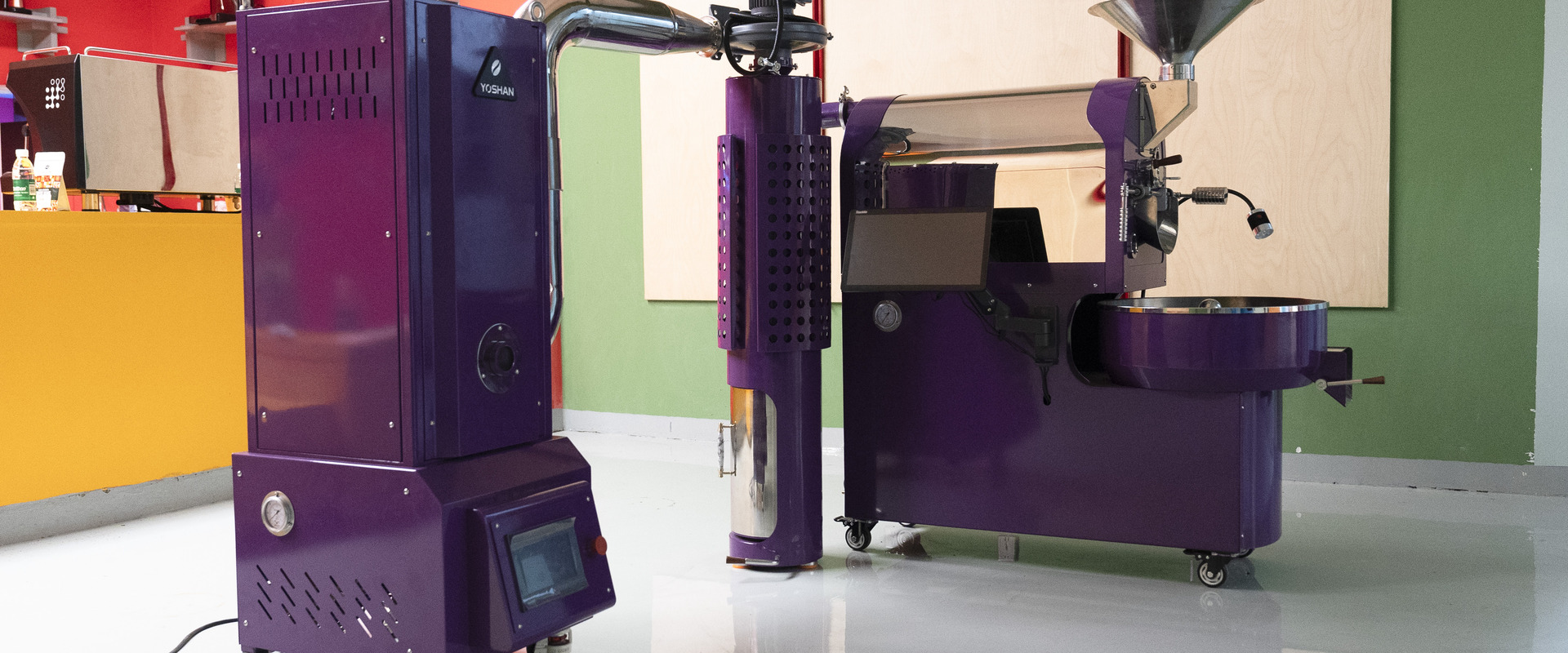
Most "parts of a coffee roaster" guides name the pieces and stop. If you are buying or running a machine, your question is different: which line on the specification does this part control, and what happens to your roasting day when it wears? This guide follows the beans through twelve components of a drum roaster, and for each one tells you what it does, what it decides, and how it fails.
Following the beans: twelve parts in order
| # | Part | What it decides on the spec sheet | Common failure sign |
|---|---|---|---|
| 1 | Hopper and charge gate | Batch size, charge timing | Gate seal leaks heat |
| 2 | Drum | Batch range, heat transfer style, mass | Bearing noise, drum sag |
| 3 | Drum drive motor | Drum speed (rpm), speed control | Belt slip, chain stretch |
| 4 | Burner or heating elements | Heating power, fuel type, gas pressure | Uneven flame, slow ramps |
| 5 | Bean and air probes | Data accuracy, control precision | Readings drift low |
| 6 | Airflow fan and damper | Airflow range, smoke handling | Falling airflow as ducts foul |
| 7 | Trier and sight glass | Manual roast checks | Fogging, jammed trier |
| 8 | Discharge door | Drop time | Sticking, slow drop |
| 9 | Cooling tray and cooling fan | Cooling time, batches per hour | Longer cooling, oily dust |
| 10 | Cyclone and chaff collector | Chaff capture, cleaning interval | Chaff carry-over, fire risk |
| 11 | Control panel | Manual / PLC / software logging | Sensor faults, screen errors |
| 12 | Frame and shell | Footprint, weight, corrosion resistance | Corrosion in humid sites |
Keep that middle column beside any quotation you are comparing. Twelve parts, twelve lines you can actually check — and the fourth column tells you what your maintenance year will look like.
1. Hopper and charge gate
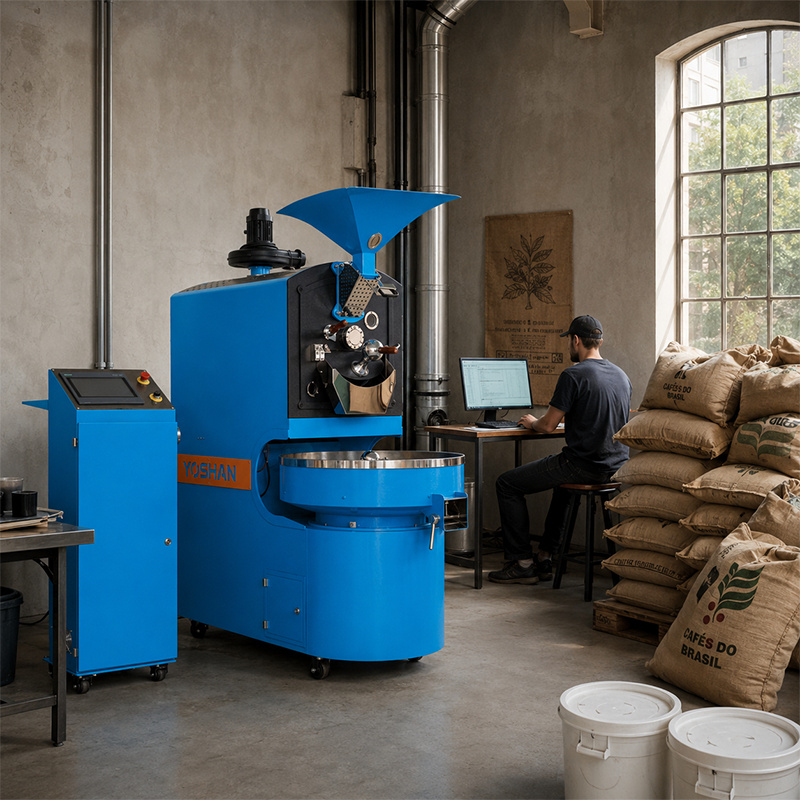
The hopper holds your weighed green batch above the drum; the charge gate drops it in when the drum reaches charge temperature. It decides nothing on the spec sheet directly, but a gate that does not seal lets heat escape between batches and lengthens every recovery you make. On production machines the hopper is fed by a vacuum loader; our YS-20 and larger machines ship with the loader included. Below that size you lift sacks by hand, so think about where your green sits relative to the hopper before the machine arrives.
2. Drum
The drum is the machine, and it is the part you are really choosing when you pick a series. Its diameter and length set the batch range; its wall material and thickness set how heat is stored and handed to your beans. Our SD and YS series use cast-iron drums, which hold heat and steady the roast between batches; the DY series and the sample machines use 304 stainless steel, which is lighter and responds faster. Double-walled drums, standard on the SD Pro machines, keep the flame from scorching the beans that touch the wall. The material trade-off is covered in cast iron vs stainless steel drums.
What this means for you: cast iron if you roast back-to-back batches all day and want each one to behave like the last; stainless if you roast a few small lots and want the machine to answer your hand quickly. Failure shows as a drum that drops slightly on its shaft, rubs the front plate, or grinds at the bearings — see part 3.
3. Drum drive motor and bearings
A geared motor turns the drum through a chain or belt; bearings at both ends of the shaft carry the weight. The spec-sheet line is drum speed: our SD 100G sample machine turns at 50 rpm, and production machines run in the same general band, with the YS series using four independent motors so you can adjust drum speed separately from the fans. Speed matters to you because faster tumbling exposes beans more evenly but shortens their contact with the hot wall.
Bearings are the wear item, and the one that will interrupt your production week if you ignore it. Grinding, squealing, heat at the housing and a rising motor current are the sequence to watch for; put a bearing set and a spare belt on your shelf before you need them — spare parts to keep on the shelf is a short list.
4. Burner or heating elements
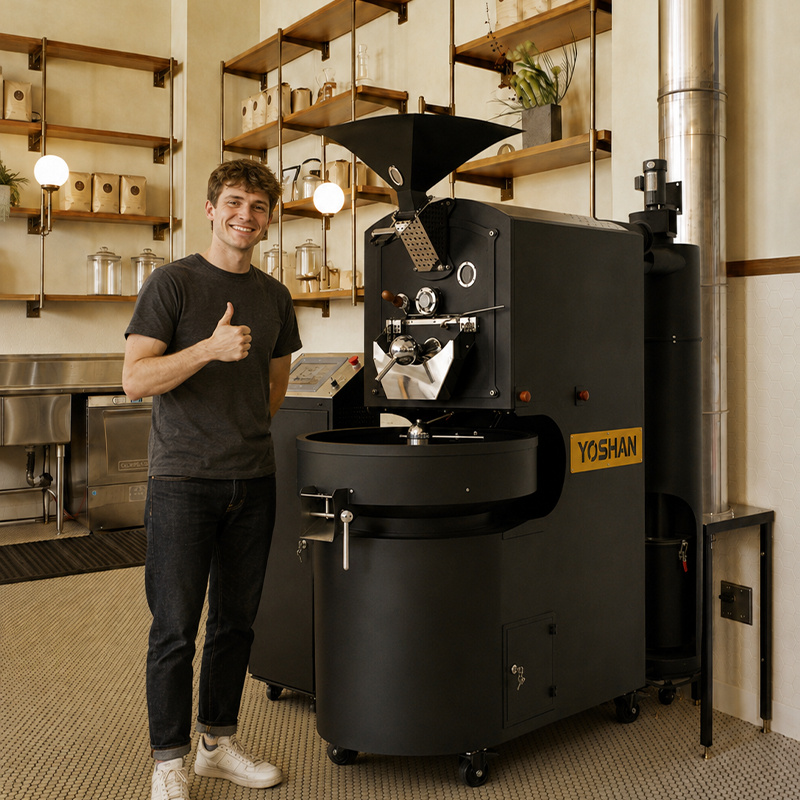
The burner supplies the energy, and its rating is what your gas or electricity supplier has to be able to deliver. On the spec sheet it appears as heating power and fuel: the gas-fired YS-6 lists LNG consumption of 1.9 m³/h and LPG of 0.68 m³/h; the electric DY-2 lists 4.42 kW of element power. Burner design decides how finely you can modulate heat — a simple atmospheric burner with a needle valve, a premix burner with a wider turndown, or an industrial burner with an integrated blower on our SD-20 Pro and larger machines.
Gas burners fail slowly: a blocked jet gives an uneven flame, low supply pressure gives slow ramps. Our natural-gas machines need at least 3 kPa supply pressure; the SD-3 Pro specifies 6 kPa on LNG and 5 kPa on LPG. Check what your regulator and cylinder actually deliver before the crate ships — a starved burner looks exactly like a faulty machine. Fuel choice itself is a separate decision, covered in LPG vs natural gas.
5. Bean probe and air probe
Two thermocouples: one buried in the bean mass, one in the exhaust or drum air. They decide how much you can trust the numbers on your screen and how tightly a PLC can hold your profile. The YS series carries a German-made pair; the DY and SD series feed the same two readings to Artisan or to the PLC.
Probes fail by drifting, not breaking — which is why they cost people whole batches. A coating of oil and chaff insulates the tip and makes it read low, several degrees after a hundred or so batches, and a thin probe reacts faster than a thick one. Wipe the tip every few dozen batches; it is cheaper than chasing a "wrong" profile for a week. How to read your two probes together is in bean temperature vs exhaust temperature.
6. Airflow fan and damper
The exhaust fan pulls air through the drum; the damper sets how much. Together they decide how much convective heat your beans get and how quickly smoke and moisture leave your room. On the spec sheet this is the airflow figure and, on our YS machines, an independently controlled fan motor.
Airflow fails by shrinking, and it does it so slowly that you will blame the coffee first. As chaff and oil narrow your ducts the same fan setting moves less air — the loss scales with the square of the duct radius — and roasts get smokier and slower without anyone touching a control. Put duct cleaning in your calendar, not in your memory; intervals are in the maintenance schedule.
7. Trier and sight glass
The trier is your sampling spoon; the sight glass shows you the drum. Neither appears on a spec sheet, and both matter more than their size suggests: if you can see colour and smell development, you catch a stalled roast the probes have not yet shown. A trier that jams or a glass that fogs is a maintenance issue, not a design one — but it takes away the only check you can make with your own senses, so fix it the day it happens.
8. Discharge door
It opens to drop your batch into the cooling tray. The line it decides is drop time: our SD series discharges a batch in under 13 seconds, and a slow door adds development to every roast you make without appearing in the profile. Doors fail by sticking as oil builds on the seal, so wipe it when you empty the chaff.
9. Cooling tray and cooling fan
The tray receives your hot batch; a fan pulls room air down through it while stirring arms turn the beans. The spec-sheet line is cooling time — 1–2 minutes on our DY and YS machines, 2–2.5 minutes on the SD series depending on the coffee, 3–5 minutes on the 15 kg and larger SD Pro.
Cooling time is also your capacity number. A roaster with an independent cooling motor lets you charge the next batch while the previous one cools, which is what "four independent motors" on the YS series buys you in batches per hour; a shared motor means your drum waits. Cooling fails slowly as oily dust clogs the tray perforations and the fan intake — your batch takes longer to cool and carries more residual development than the profile says.
10. Cyclone and chaff collector
The cyclone spins chaff out of the exhaust stream before it reaches the flue; the collector below it holds the chaff. Nothing on the spec sheet, everything in your safety file: chaff is dry, light and flammable, and a full collector next to a hot flue is how roastery fires start. Our YS series mounts the collector separate from the machine body so you can empty and cool it without stopping the roast. Empty it every few batches on a production day, and site the machine so you can pull the bin without moving anything.
11. Control panel
The control layer decides how you run the machine: manual gas valve and switches, a PID button panel, a PLC touch screen with stored profiles, or a USB/Bluetooth link to Artisan on your laptop. Our DY series connects to Artisan; the SD Pro series runs on a PLC touch screen with a manual override; the YS series uses a Siemens touch screen. The difference between the levels is not "better coffee" but who has to be standing at the machine and how exactly a profile repeats when that person is someone you hired — the comparison is in manual vs automatic coffee roasters.
Electronics fail at the sensors and connectors first, which is why a spare thermocouple and a fuse set belong in your drawer rather than on a three-week courier flight.
12. Frame and shell
The frame carries the weight and sets the footprint you have to find room for: our YS-6 stands 2151 × 720 × 2000 mm and weighs 600 kg; the YS-12 and YS-15 share a 2290 × 1881 × 2279 mm frame at 758 kg. Check those figures against your door width and your floor before you order, not after. The shell keeps heat in and, in a humid roastery, keeps rust out — the YS series uses an electroplated 304 steel shell for that reason. Frames do not fail; shells corrode where your climate is salty or wet.
FAQ
Can I add parts later — a loader, a smoke filter, a bigger cooling tray?
Loader and smoke treatment, yes: both bolt onto the exhaust or the hopper side and are usually added when your volume or your neighbours change. Tell us before the machine ships so the duct and the connections are sized for it. The cooling tray is part of the machine and is not upgraded later, so size that one now. When a roastery needs a destoner, loader or afterburner sets out when each pays.
Should I be able to change drum speed, or is a fixed speed fine?
Fixed is fine for most buyers. Speed is set for the drum diameter at the factory, and you will change it perhaps twice in a machine's life. Adjustable speed earns its keep if you roast very different densities in the same day, or if you want to tune tumbling as batch size changes. If your supplier offers it, ask whether it is a separate motor or a shared one — that answer matters more to your output.
Do I need two probes, or is one enough?
One bean probe is the minimum and the one that steers your roast. The second, in the exhaust air, is what tells you whether the machine or the coffee changed: when exhaust temperature climbs while bean temperature stalls, your airflow is the problem. If you plan to hand roasting to staff, buy two — the pair is what makes a curve readable by someone who did not develop it.
How much room do the parts outside the machine need?
More than people budget for. Beyond the machine footprint you need the cyclone and its duct run to the outside wall, clearance to pull the chaff bin, space for a filter or afterburner if your site needs one, and a path for green sacks to the hopper. Plan it with roastery layout and space requirements before you sign a lease.
Which parts should already be in the crate when the machine arrives?
The trier, the chaff bin, the duct flange, the manual and the certification file, plus the loose spares your quotation lists. Check them against the packing list while the crate is still open and the forwarder is still there — a missing trier is trivial to replace, a missing certificate is not. What is in the crate is the full unboxing list.
Which parts wear out first?
Drum bearings, drive belts or chains, thermocouples, fuses and door seals. None of them stops you for weeks if the spares are already on your shelf. Parts that fail without human damage in the first year are sent to you by air express at our cost, but the shelf is still faster than any courier.
Final Thoughts
Read a roaster's spec sheet as a list of parts and it stops being abstract: batch range is the drum, kilowatts or cubic metres per hour are the burner, cooling time is the tray, and the control level is the panel. We build all twelve components into the DY series, SD series and YS series, and we can walk you through any part on a video call before you order.
Get a quote or message Leon on WhatsApp at +86 184 0771 4607.
Get a Quote → WhatsApp +86 184 0771 4607Last updated: September 23, 2026
Pingback: How a Commercial Coffee Roaster Works, Charge to Cooling | Yoshan