
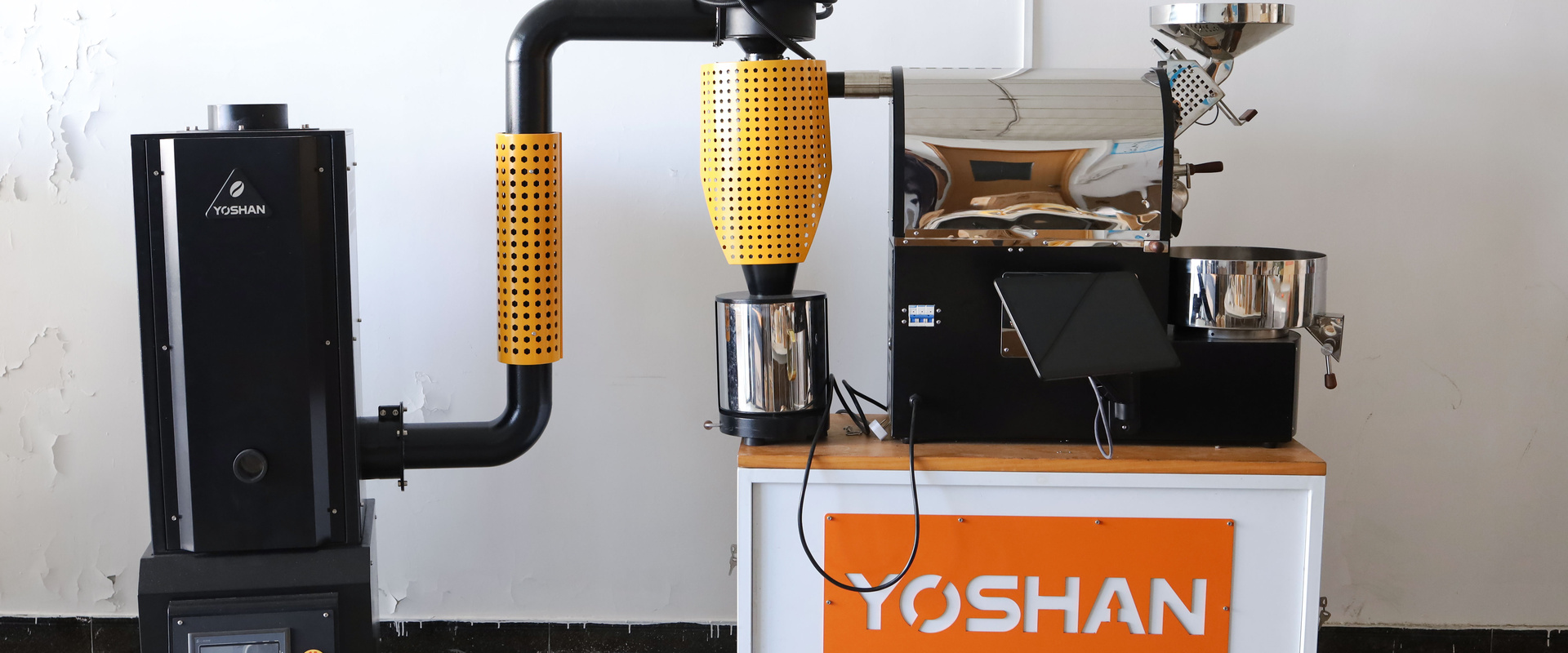
Ask about the types of commercial coffee roasters and you get three different answers, because the industry sorts machines three ways at once: by how heat reaches the bean, by where that heat comes from, and by how much coffee goes in per batch. Most buying mistakes come from mixing the three. This guide keeps them separate, then shows how the combination you choose changes your installation, your running cost and your price.
The three questions behind every "type"
Every roaster you look at has to do the same three jobs: heat the beans, keep them moving, and remove smoke, chaff and moisture. What differs is the engineering behind each job — and that is where the labels you are reading come from.
| Question | The categories | What it mostly decides for you |
|---|---|---|
| How does heat reach the bean? | Drum (conduction + convection), indirect hot-air drum, fluid bed | Flavour style, batch flexibility, how forgiving the machine is |
| Where does the heat come from? | Gas burner (LPG or natural gas), electric heating elements, electric hot air | Installation, running cost, permits, what energy your site actually has |
| How much per batch? | Sample, shop, production, industrial | Floor space, staff, exhaust treatment, capital |
A single machine sits in one box in each row. If you can say "a gas drum roaster for 12 kg batches", you have described what you need; "a drum roaster" on its own leaves your supplier guessing.
By heat transfer: drum, indirect drum and fluid bed
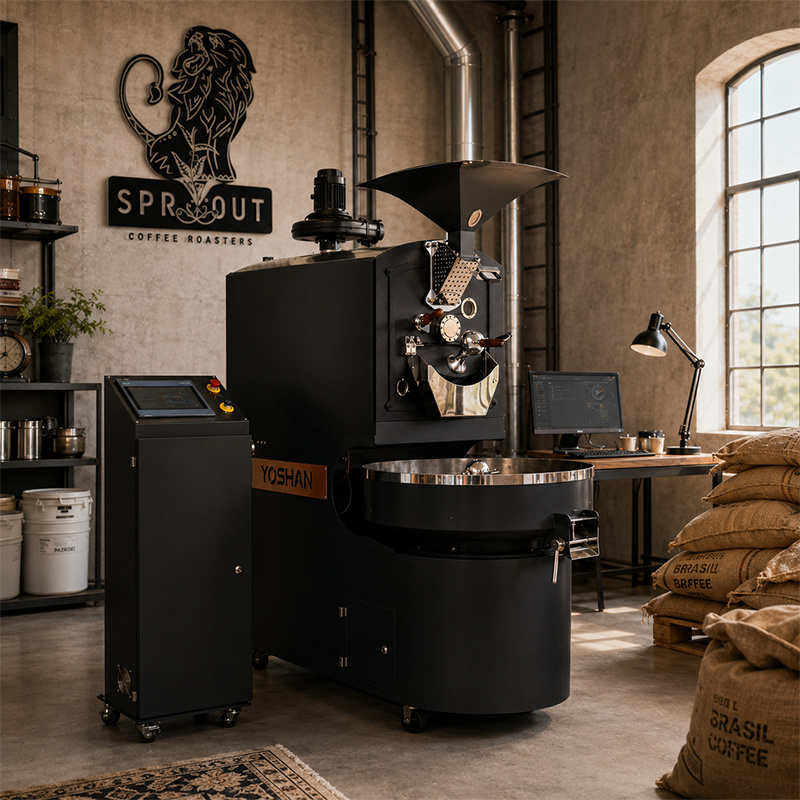
Classic drum. Beans tumble inside a rotating drum. Heat reaches them by conduction from the drum wall and by convection from hot air drawn through the drum. Roasters call the balance between the two "direct fire" when the burner flame heats the drum directly, and "semi hot air" when more of the heat arrives with the air stream. This is the layout of most café and wholesale roasters and of all the drum machines we build, because it gives you two independent controls — burner and airflow — over one roast. Double-walled drums reduce your risk of scorching; single-walled drums transfer heat faster but punish a careless hand.
Indirect hot-air drum. The drum still turns, but the burner sits outside the drum chamber and only heated air enters. Conduction is minimal, which makes your roast cleaner and easier to repeat batch to batch, at the cost of some body in the cup. Our SD Pro machines from 20 kg upward, and the YS series from 120 kg, use this fully-hot-air layout with an industrial burner; the 1–15 kg machines and the YS-20 to YS-60 are semi-hot-air drums. You meet this type when your volume moves you into plant territory.
Fluid bed. No drum at all: a column of hot air lifts and tumbles the beans. Roasts are fast and even, energy use is low, but batch sizes are small and the method tolerates less variation in bean density. We do not build fluid-bed roasters; we mention them so you can place them correctly, not because we recommend against them. If you are weighing one up, the trade-offs are compared in drum roaster vs fluid bed.
A fourth label, recirculation, describes drum machines that route part of the exhaust back through the burner to save fuel and reduce smoke. Treat it as an option on a drum machine rather than a fourth type — and if a supplier quotes it, ask what it does to your exhaust treatment, because that is where it pays or does not. It is not something our range includes.
By heat source: gas, electric elements, electric hot air
Gas. LPG or natural gas fires a burner under or beside the drum. Gas responds instantly when you move a setting, costs less per kilo roasted in most countries, and is what production roasters run on almost everywhere. It needs a gas line or bottles, a flue, and often a burner document your inspector will want to see — tell us your country at quotation and we confirm which burner documentation applies to you.
Electric heating elements. Elements heat the drum chamber. No gas line, no combustion inside your room, simpler permits. The limit is power draw: our 1 kg DY-1 pulls 4.19 kW on electric and the 2 kg DY-2 pulls 4.42 kW, which means a dedicated single-phase circuit; our 3 kg SD-3 on electric needs 220 V or 380 V three-phase. Above a few kilos per batch, element heating becomes impractical, which is why our electric option stops at the small end of the range. Check what your building can supply before you fall in love with a model.
Electric hot air. An electric heater warms the air stream rather than the drum. This is how our fully-automatic SD Pro machines work when you order the electric version — the same machine as the gas model, at the same price, with a 380 V three-phase supply instead of a gas line. If your landlord will not allow gas, this is the route that keeps you at production scale. The choice between fuels, including cost per kilo, is worked through in gas vs electric commercial coffee roasters.
By scale: sample, shop, production, industrial
The capacity label is the one you see first, and the one most often misread. A roaster's nameplate capacity is the maximum green weight per batch; the range you will actually roast in is lower, and our catalogue states the range rather than a single number.
| Tier | Batch range on our machines | Typical use | Heat source options |
|---|---|---|---|
| Sample | 100–120 g (SD 100G), 200–500 g (EC-500G) | Green buying, QC, profile trials | Gas / electric |
| Shop | 0.2–1.5 kg (DY-1), 0.3–2.5 kg (DY-2), 1–1.8 kg (SD-1.5), 2–3 kg (SD-3) | Café roasting in-house, micro-brands | Gas or electric |
| Production | 1–7 kg (YS-6), 3.5–7 kg (SD-6 Pro), 1–13 kg (YS-12), 3.5–13 kg (SD-12 Pro), 1–15 kg (YS-15) | Wholesale to cafés, multi-outlet chains | Gas; electric on YS-6/12 and SD Pro |
| Industrial | 15–22 kg (SD-20 Pro) up to 100–200 kg (SD-120 Pro); YS-20 to YS-360 | Plant lines, private label, export | Gas only |
Every model in that table is listed with its own ex-works price on its product page, and the whole range is set out in the commercial coffee roaster price guide — worth opening beside this table when you shortlist.
Two practical rules follow. First, roast below nameplate: an industry rule of thumb puts real working capacity at 50–75% of the maximum, and our stated ranges already reflect where the machine roasts well, so read the range and not the headline number. Second, your tier decides more than your machine — above roughly 11–16 kg per batch some regions will require an afterburner from you, and industrial lines need loaders, destoners and exhaust treatment as a matter of course. Sizing the batch to your weekly demand is covered in the coffee roaster batch size guide.
How the three axes combine in practice
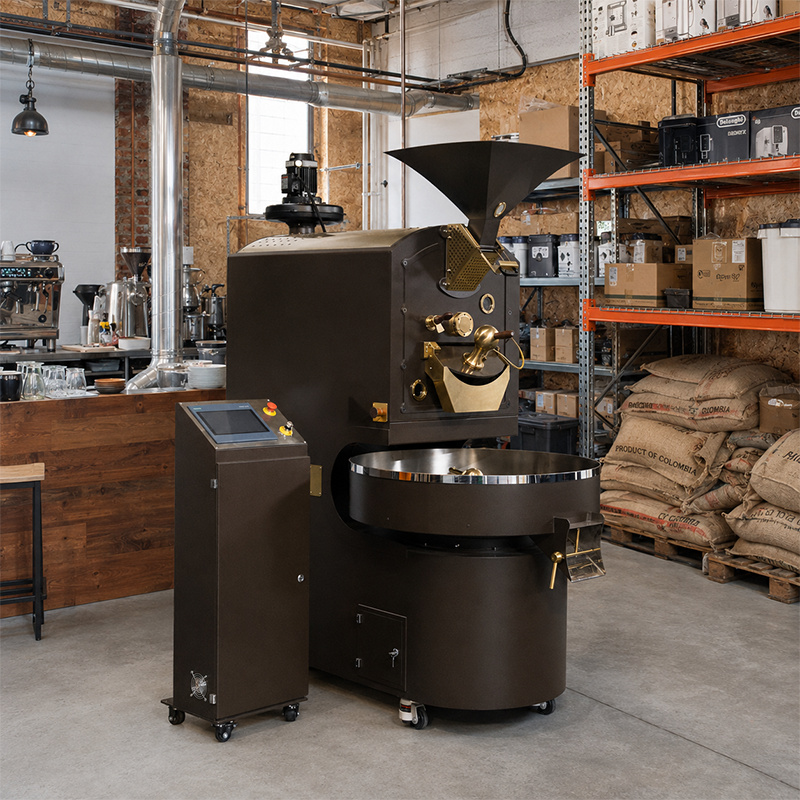
A few combinations cover most real purchases. Find your own case below:
- You roast for your own counter: shop tier, electric or gas drum, semi hot air. DY-1 or DY-2 on electric if you have no gas line; SD-3 on gas if you do.
- You are starting a wholesale roastery with one operator: production tier, gas drum with PLC control so your profiles repeat when you are not standing there. YS-6 or SD-6 Pro, depending on whether you want a Siemens touch screen with four independent motors or a fully-automatic cast-iron machine with the loader included.
- You supply supermarkets or private label: industrial tier, gas, fully hot air with an industrial burner, plus loader, destoner and afterburner specified together rather than added later.
Three combinations do not work, so do not spend your time on them: electric heating at production scale (power draw), fluid bed at industrial scale (batch size), and gas at sample scale if your building has no gas supply.
FAQ
Which type should I put in a shop where customers can see and smell the roaster?
A shop-tier drum machine, electric if you have no gas line, with smoke treatment planned from the start. The machine itself is the easy part: what decides whether roasting in front of customers works is the exhaust. An electrostatic filter handles the visible smoke but not the smell, so check your lease and your neighbours before you commit — how to reduce smoke from a coffee roaster sets out the layers in order.
Can I start at shop tier and move up later, or should I buy the bigger machine now?
Buy for the volume you expect in about two years, not the volume you have. Moving up means a second installation, a second exhaust job and often a second permit, and the resale market for small roasters is thin in most countries. If your weekly figure is near a tier boundary, take the larger machine and roast smaller batches in it — that direction always works, the other does not.
Does the type of roaster change how long a batch takes?
Less than most buyers expect. A drum batch runs roughly ten to fifteen minutes whether it is 1 kg or 30 kg; fluid bed is faster. What actually changes your output per hour is whether the machine can cool one batch while the drum takes the next, which is a question about motors, not about type — ask for the cooling time and the motor count alongside the batch size.
Which type do I have to tell my landlord or inspector about?
The heat source and the exhaust, in that order. Gas brings a gas connection, a flue and usually a burner document; electric brings a three-phase supply for anything above the small machines. Both bring a duct through your wall or roof. Get those three answers into your lease conversation early — coffee roastery permits and inspections lists the five reviews you will face.
Are there fully automatic commercial coffee roasters?
Yes, and automation is a control layer rather than a fourth type. Our SD Pro series runs your profile on a PLC touch screen with switchable manual control; the YS series uses a Siemens touch screen with four independent motors. The question to ask yourself is who will stand at the machine: if that is you every batch, manual plus curve software is enough; if it is staff, buy the machine that repeats the profile on its own.
What should I send a supplier so the quotation comes back right the first time?
Four lines: weekly roasted kilos, the energy your site has (gas type and pressure, or voltage and phase), whether the machine sits in a back room or in public view, and your ceiling height and door width. With those we can name the tier, the heat source and the exhaust package in one reply instead of three.
Final Thoughts
Describe a roaster by all three axes — heat transfer, heat source, batch size — and your choice narrows itself. We build drum roasters from 100 g sample machines to 300 kg industrial lines, in gas and electric versions, with the SD series and YS series covering production scale. Send us your weekly volume and your site energy and we will name the combination.
Get a quote or message Leon on WhatsApp at +86 184 0771 4607.
Get a Quote → WhatsApp +86 184 0771 4607Last updated: September 23, 2026
Pingback: Drum Roaster vs Fluid Bed: Which Fits a Growing Business | Yoshan
Pingback: Commercial Coffee Roaster Price 2026: Every Yoshan Model, Ex-Works