
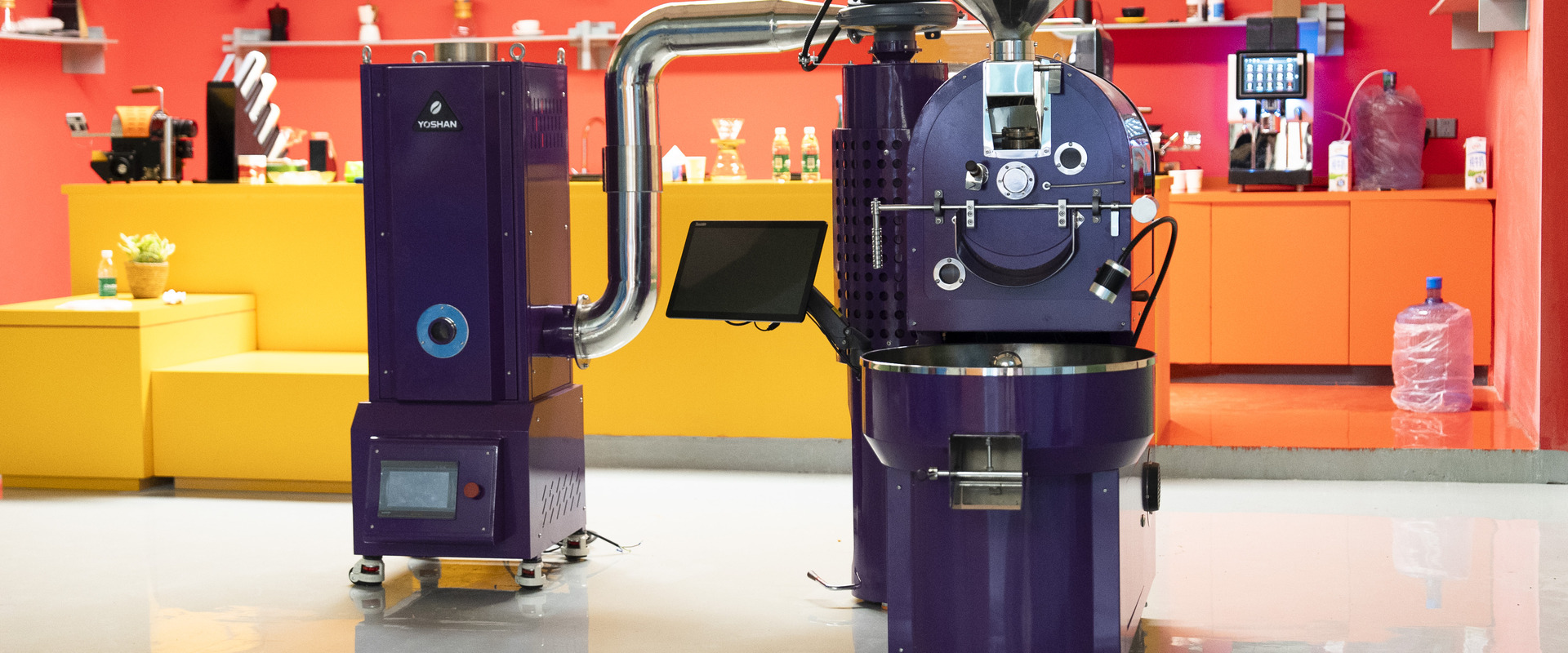
Search how to reduce smoke from a coffee roaster and you get a shopping list: afterburner, electrostatic filter, water scrubber. Equipment is the third of four layers, and buying it first is how roasteries end up with a filter that clears the visible smoke while the neighbour still complains about the smell. This guide is for commercial drum roasters and works through the four layers in order: make less smoke, move it out, remove it, and meet the rule that applies to your address.
What roaster smoke actually is
The exhaust from a drum roaster carries three different things, and each layer of control addresses a different one.
| Component | Where it comes from | What you notice | What removes it |
|---|---|---|---|
| Chaff and particulate | Dry skin flaking off the bean, oil droplets | Visible smoke, dust on the roof | Cyclone, electrostatic filter |
| Volatile organic compounds (VOCs) | Compounds released as the bean develops — more in darker roasts and at water quench | Smell, blue haze | Thermal or catalytic afterburner |
| Combustion gases | The burner itself (CO, CO₂, NOx) | Nothing, at normal levels | Correct burner setting, flue to outside |
Visible smoke and smell are separate problems. A filter that captures 95% of particulate can leave the smell almost untouched; an afterburner deals with both. Which one your site needs depends on whether the complaint — or the regulation — is about what people see or what they smell.
Layer 1 — make less smoke in the first place
Cheapest layer, and the one no equipment guide mentions.
- Roast level. Smoke rises steeply past the end of first crack and again toward second. A roastery whose whole range is medium produces a fraction of the VOCs of one roasting dark for espresso blends. If the product allows it, this is the biggest lever you have.
- Airflow. A drum that is under-ventilated keeps smoke in contact with the beans, which shows up as ashy flavour and as heavier exhaust at the end. Keeping the damper open enough through development moves smoke out steadily instead of in a burst at drop; the mechanics are in coffee roaster airflow and damper control.
- Quench. Water quenching at drop flashes a cloud of steam and volatiles. Air cooling alone — our machines cool a batch in 1–2 minutes on the DY and YS series and 2–2.5 minutes on the SD — avoids it.
- Cleanliness. Chaff and oil in the drum, cyclone and duct smoulder and add their own smoke to every batch. A cyclone emptied every few batches and a duct cleaned on schedule smokes less at the cap.
Layer 2 — move it out of the room
Before treating the exhaust, make sure all of it leaves the building. A roaster with a short, mostly vertical, insulated stainless flue and a low-resistance cap moves its full airflow; the same machine on a long horizontal run with elbows and a decorative cap moves less, and the shortfall leaks into the roastery as smoke and smell. Airflow through a duct falls with the square of any narrowing, so a duct half fouled with chaff has lost most of its capacity. Sizing and materials are in coffee roaster ventilation requirements.
Where the cooling tray has its own fan, as on our YS series with its four independent motors, routing that cooler, dustier air separately keeps chaff from the tray out of the hot roaster flue — ask how your machine is ducted before the flue is built.
Layer 3 — remove it from the exhaust
Three technologies, each removing a different share of the three components.
Electrostatic precipitator (ESP). Charged plates pull particulate and oil droplets out of the exhaust stream. Removes 95% or more of visible smoke and dust, draws very little power — our units run 300–650 W — and costs a fraction of an afterburner. It does not remove VOCs, so smell is largely unchanged, and the plates need washing every few weeks. Right for a roastery whose problem is visible smoke and whose neighbours are close.
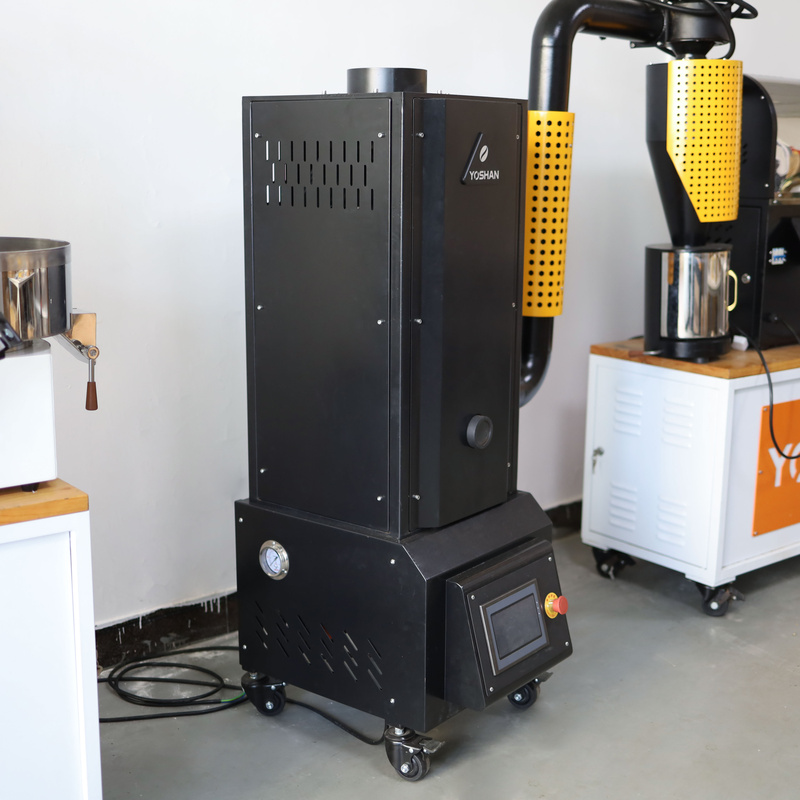
Thermal afterburner. Burns the exhaust at high temperature so both particulate and VOCs are oxidised. Removes smoke and smell together, at the cost of a second gas burner running whenever you roast — our HB3 for 1–3 kg roasters consumes 0.27 m³/h of LPG or 0.76 m³/h of natural gas; the HR12 for 6–15 kg machines 0.6–1.1 m³/h of LPG. Required by some air authorities above a batch-size threshold regardless of complaints.
Catalytic afterburner. A catalyst lets oxidation happen at a lower temperature, so gas consumption falls. Same result as thermal with a smaller fuel bill; higher unit cost and a catalyst that needs replacing. Not currently in our range.
Wet scrubber / water-mist cyclone. Sprays water into the exhaust to capture particulate. Uses no gas but produces contaminated water that needs disposal, and does little for smell. Some suppliers offer it up to mid-size roasters; we do not.
| Method | Visible smoke | Smell (VOCs) | Running cost | Our range, EXW Shenzhen, USD, 2026 |
|---|---|---|---|---|
| ESP | Yes, ≥95% | No | Very low | JD-3K 1,500 (1–3 kg), JD-Q4 1,700 (3–6 kg), JD-Q6 2,390 (12–30 kg), JD-Q8 2,950 (60 kg), JD-Q10 3,450 (120–300 kg) |
| Thermal afterburner | Yes | Yes | Gas, continuous | HB3 4,300 (1–3 kg), HR12 5,800 (6–15 kg), HB40 7,300 (20–40 kg), HB60 9,500 (40–60 kg) |
| Catalytic afterburner | Yes | Yes | Gas, reduced | Not supplied |
| Wet scrubber | Partly | Little | Water, disposal | Not supplied |
ESP units are sized by airflow, so match the unit to the roaster's exhaust volume rather than its batch size alone — the table shows the pairings we build to. A comparison of the two main options is in the coffee roaster smoke filter guide.
Layer 4 — find out which rule you are meeting
The rule decides the layer. Three situations are common:
- No regulation, neighbours nearby. The problem is visible smoke and smell at the fence. Layers 1 and 2 first; an ESP if smoke is the complaint, an afterburner if smell is.
- Air authority with a batch-size threshold. Many regions require thermal treatment somewhere in the 11–16 kg per batch range, some at lower sizes, some only above a permit threshold around 5 kg. Above the threshold an afterburner is not a choice, and the permit usually asks for its temperature log.
- Visible-emission standard only. Some authorities regulate opacity — "no visible smoke" — rather than VOCs. An ESP often satisfies this at a fraction of the running cost.
Ask in writing before you order the roaster, because the answer changes the gas supply, the flue and the electrical load. Where the rule is unclear, our approach is the one in when a roastery needs a destoner, loader or afterburner: decide by hours roasted per day and by whether the complaint is sight or smell.
Putting the layers together by roastery size
- 1–3 kg café roaster in a retail street: medium roasts, air cooling, short flue, JD-3K ESP. Add the HB3 afterburner only if smell complaints or a permit require it.
- 6–15 kg wholesale roastery in a light-industrial unit: clean ducting on schedule, JD-Q4 or JD-Q6 ESP for visible smoke, HR12 afterburner if the authority requires thermal treatment at your batch size — often the case from about 12 kg.
- 20 kg and larger production line: afterburner as standard — our SD-30 Pro and SD-60 Pro ship as complete sets with the afterburner included at USD 51,499 and 61,999 — plus an ESP where the site also has a visible-smoke standard.
FAQ
How do I stop my coffee roaster smoking so much?
Start before equipment: roast lighter where the product allows, keep the damper open enough through development, cool with air rather than water, and clean the cyclone and duct on schedule. Then make sure the flue moves the full exhaust outside. Only then choose between an electrostatic filter and an afterburner.
Afterburner or electrostatic filter for a coffee roaster?
An electrostatic filter removes visible smoke and particulate — 95% or more — at very low running cost but leaves the smell. An afterburner burns both smoke and smell away but consumes gas continuously. Choose by the complaint or the rule: sight, ESP; smell or a regulatory threshold, afterburner.
Do I need an afterburner for a 5 kg coffee roaster?
Usually not by regulation — most thresholds for thermal treatment sit higher, often around 11–16 kg per batch — but some authorities require a permit from about 5 kg. Check in writing. For a 5 kg machine with neighbours, an ESP such as our JD-Q4 at USD 1,700 EXW is the common first step.
What is a catalytic afterburner?
An afterburner that uses a catalyst to oxidise smoke and smell at a lower temperature than a thermal unit, so it burns less gas. The trade-off is a higher purchase price and a catalyst that eventually needs replacing. We supply thermal afterburners; catalytic units are not in our range.
Does roast level affect smoke?
Strongly. Smoke and volatile compounds rise sharply after first crack and again toward second crack, so a dark espresso roast produces several times the emissions of a medium filter roast on the same machine. It is the largest lever a roastery controls without buying anything.
How much gas does an afterburner use?
Our HB3 for 1–3 kg roasters uses about 0.27 m³/h of LPG or 0.76 m³/h of natural gas; the HR12 for 6–15 kg machines uses 0.6–1.1 m³/h of LPG or 1.9–3.3 m³/h of natural gas, running whenever the roaster runs. Budget it as a second burner.
Final Thoughts
Reduce smoke in order: roast and ventilate so there is less of it, then remove what remains with the equipment the rule requires. We pair each roaster with the matching electrostatic filter or afterburner, and every commercial coffee roaster and fully automatic roaster can ship with exhaust treatment specified and priced in the same quote.
Get a quote or message Leon on WhatsApp at +86 184 0771 4607.
Get a Quote → WhatsApp +86 184 0771 4607Last updated: September 23, 2026
Pingback: Coffee Roaster Afterburner: Do You Need One, and Which Type | Yoshan
Pingback: Roasting Coffee Inside a Café: Roaster on the Shop Floor
Pingback: Types of Commercial Coffee Roasters: Heat Transfer, Source & Scale