
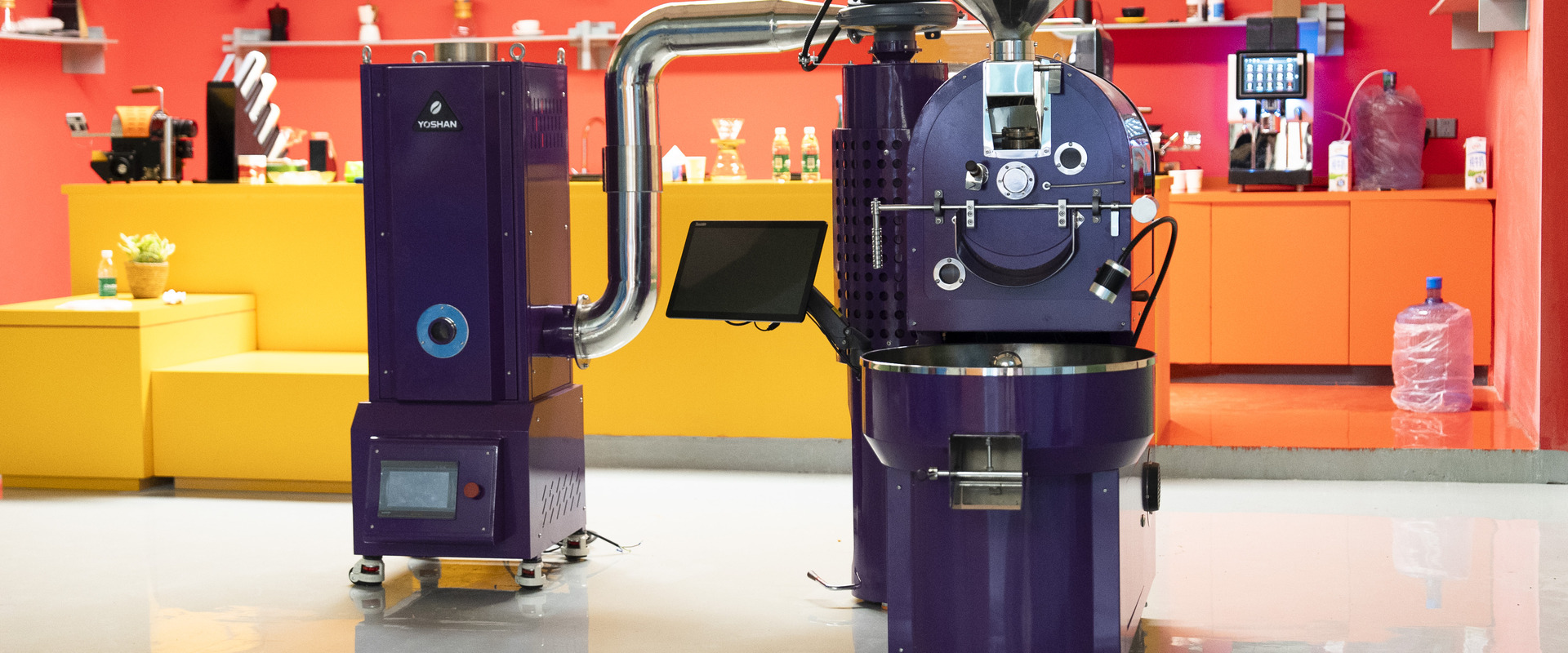
If you are asking whether you need a coffee roaster afterburner, the honest answer is: it depends on three things, and none of them is the machine. It is what your local rules regulate, how close your neighbours are, and how much you roast. Answer those and the choice between a thermal afterburner, a catalytic unit and an electrostatic filter — or nothing at all — makes itself. Here is how.
What Is Actually in the Smoke
Roasting exhaust carries three different things, and each device deals with a different one:
- Particles — chaff fragments, and fine oil droplets that make the smoke visible and leave the film on nearby surfaces.
- VOCs — volatile organic compounds released as the beans roast. Invisible, and the thing that air-quality rules measure.
- Odour — what your neighbours notice. Pleasant for the first week.
A device that removes particles does not necessarily remove VOCs, and the other way round. That is why the "afterburner or filter?" question has no single answer.
What Each Device Removes
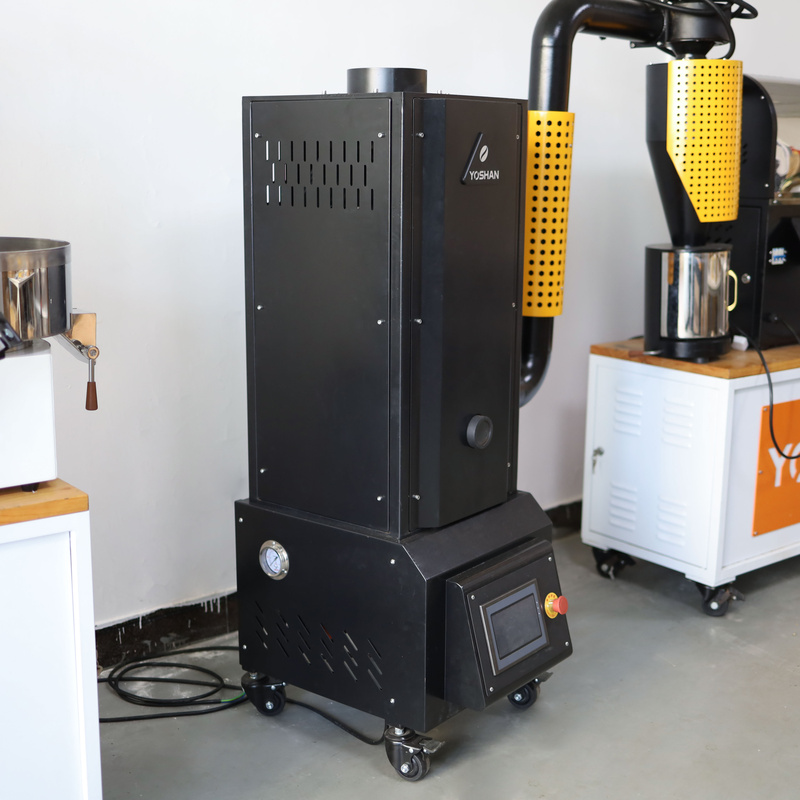
Thermal afterburner. A second burner in the exhaust heats the smoke to over 600°C, burning the particles, the VOCs and the odour to carbon dioxide and water. It removes everything. It also burns fuel continuously while you roast — the running cost is the trade-off — and it needs a proper stack.
Catalytic afterburner. The same oxidation, but a catalyst lets it happen at 250–400°C, so it uses much less gas, produces fewer nitrogen oxides and wears more slowly. The catalyst costs more up front and needs periodic replacement. It is the choice where you must destroy VOCs and you roast enough hours for the fuel saving to matter.
Electrostatic smoke filter (ESP). Charges the smoke and pulls the particles and oil onto collection plates. It removes 95–99% of particles — the visible smoke and the film — and only a fraction of the VOCs. It uses very little energy, and it needs the plates cleaned every few weeks. It is the choice where the problem is visible smoke and neighbours rather than a measured VOC limit. Our ESP filter guide covers it in detail.
These are not substitutes for each other. Larger plants often run an ESP to catch oil and particles before a catalytic afterburner, which protects the catalyst.
The Three Questions
| Question | If the answer is… | Then |
|---|---|---|
| 1. What do your local rules regulate? | A measured VOC or emissions limit for roasting | You need an afterburner — thermal or catalytic. An ESP alone will not pass |
| Only visible smoke, odour or general nuisance | An ESP is usually enough; an afterburner is optional | |
| Nothing specific to roasting | Decide on questions 2 and 3 | |
| 2. How close are your neighbours? | Shared building, residential above, a restaurant next door | Treat as a nuisance case: ESP at minimum, afterburner if odour complaints are likely |
| Industrial unit, open site, tall stack possible | You can often run on a cyclone and duct, and add treatment later | |
| 3. How much do you roast? | Under about 6 kg per batch, a few sessions a week | Treatment is rarely required by rules; buy it only for question 2 |
| 12–30 kg per batch, daily | Plan for an ESP now and a stack that can take an afterburner later | |
| 60 kg and up | Afterburner is included in the SD-60, SD-120 and SD-360 Pro full sets (the SD-240 Pro ships without it); ESP ahead of it is common |
Work through the three in order. Most small roasteries outside the strictest cities end up at "cyclone and duct, ESP if the neighbours are close". Most production plants end up with both devices.
The Numbers an Inspector Will Ask For
Where an afterburner is required, the authority does not ask "do you have one"; it asks for two figures, and the unit has to meet both.
Operating temperature. A thermal afterburner is expected to hold its chamber at roughly 650–760 °C (1,200–1,400 °F) while you roast; a catalytic unit does the same job at 250–400 °C across the catalyst. Both figures are read from a temperature probe in the unit, and the inspector may ask to see the reading — and the interlock that stops the roaster if the chamber is not at temperature before you charge.
Residence time. How long the smoke stays at that temperature. Air-quality authorities that publish standard permits for coffee roasters typically want 0.3–0.5 seconds for a thermal unit and a fraction of that for a catalytic one. Residence time is chamber volume divided by exhaust flow, which is why the afterburner is sized to your roaster's exhaust volume: the same unit that gives half a second behind a 6 kg drum gives far less behind a 30 kg one.
So when you apply, have three numbers ready from the equipment sheets — the roaster's burner rating, its exhaust volume, and the afterburner's chamber temperature and residence time at that volume — and the application is a form rather than a negotiation. Ask us for all three on the same sheet; the afterburners on our equipment page are specified against each roaster size for exactly this reason.
Which Unit Fits Which Roaster
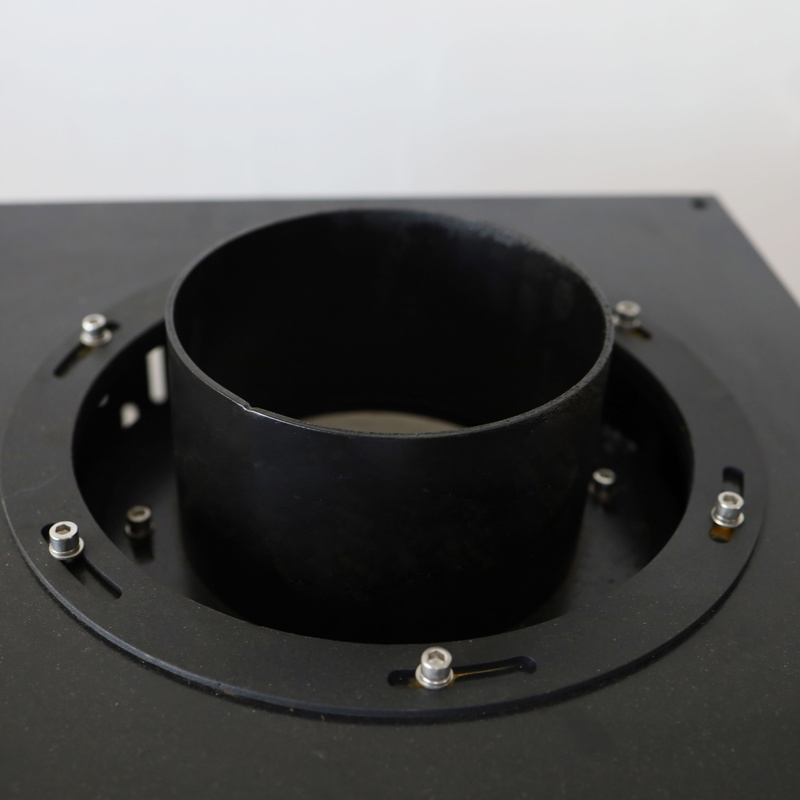
We build both the filters and the afterburners — on the equipment page — sized to our own SD and YS machines:
| Your roaster | ESP filter | Afterburner |
|---|---|---|
| 1–3 kg (DY-1, DY-2, SD-1.5, SD-3) | JD-3K — USD 1,500 | YS-HB3 — USD 4,300; rarely needed at this size |
| 3–6 kg (SD-6 Pro, YS-6) | JD-Q4 | Available; usually a neighbour or rules decision |
| 12–30 kg (SD-12 to SD-30 Pro, YS-12 to YS-30) | JD-Q6 | Included in the full SD-30 Pro line; optional below |
| 60 kg (SD-60 Pro, YS-60) | JD-Q8 | Standard on the line |
| 120–300 kg (SD-120 to SD-360 Pro) | JD-Q10 | Included in the SD-120 Pro and SD-360 Pro full sets; a separate line on the SD-240 Pro |
The afterburner is sized to the roaster's exhaust volume, so it is specified with the machine, not bought separately later — tell us at enquiry if your rules require one and it goes on the same drawing. On the largest lines the afterburner is a five-figure item, which is why it is worth knowing early whether you actually need it.
What It Costs to Run
- Thermal afterburner: gas consumption roughly comparable to a second burner while roasting. On a production line it is a real line in the monthly bill.
- Catalytic: a fraction of the thermal unit's fuel, plus catalyst replacement on a schedule.
- ESP: electricity for the high-voltage supply — small — plus cleaning every three to four weeks with water; the oil and tar residue is disposed of as industrial waste, not down the drain.
Our running costs guide puts these alongside the roaster's own gas and power.
Before You Install
- Get the rule in writing from your local authority — "is roasting exhaust regulated, and for what?" — before you buy anything.
- Plan the stack height and route at the same time as the roaster; an afterburner adds weight and heat at the top of the duct.
- Size the duct for the treated exhaust, not the roaster alone.
- Put the ESP where you can open it — you will be cleaning it monthly.
- Keep the cyclone. Neither device replaces chaff collection.
The ventilation requirements article covers duct sizing and stack routing, and the fire safety guide covers what chaff does near a second burner.
Frequently Asked Questions
Does the afterburner run during the whole session or only while the drum is hot?
Only while there is exhaust to treat, and it should be interlocked so the roaster cannot charge until the chamber is at temperature — which means lighting the afterburner ten to twenty minutes before the first batch and letting it cycle down after the last. That warm-up is part of the gas bill and part of the routine; a unit switched on with the first charge treats nothing for the first batch.
Can an afterburner be shared between two roasters?
Yes on a production floor, if it is sized for both exhausts running at once and the ducts are balanced so one drum's fan does not starve the other's — a job for a mechanical engineer, not an adaptor. On a small roastery with two machines it is usually cheaper and safer to give each its own unit, because a shared unit means neither roaster runs when it is down for cleaning.
What maintenance does an afterburner need?
Less than an ESP and more than nothing: the chamber and the entry duct collect tar and need inspection and a scrape on a schedule, the burner and its flame sensor want the same annual check as the roaster's own, and a catalytic unit's catalyst has a life — sooner behind dark roasts — after which emissions creep up before you notice. Put the afterburner on the maintenance schedule beside the roaster.
Will the neighbours still smell coffee with an afterburner fitted?
Faintly, when the wind is wrong, because no unit destroys every molecule and the cooling tray's air is often untreated. What disappears is the smoke and the heavy roast odour that generate complaints. If odour from the cooling tray becomes the issue, route that exhaust through the unit too; on lines from 30 kg up we specify it that way from the start.
How do I explain the choice to a landlord who just wants "no smoke"?
Show them the three-question table and say which cell you are in. "No visible smoke" is an electrostatic filter at a fraction of the running cost; "no smell" is an afterburner and a gas bill; "the council requires it" is a permit with numbers on it. Most landlords are asking the first question, and a JD-3K at USD 1,500 answers it — put the answer in the lease so it does not come back as a complaint.
Final Thoughts
You need a coffee roaster afterburner if your rules measure VOCs or your neighbours are close; you need an ESP if the problem is visible smoke; at production scale you probably need both. Answer the three questions before you buy. We build the filters and afterburners to match our roasters, so tell us your rules and your site and we will put the right one on the drawing. Talk to our engineers.
Get a Quote → WhatsApp +86 184 0771 4607Last updated: September 23, 2026
Pingback: Coffee Roastery Equipment: The Complete Line Guide
Pingback: Best Coffee Roaster for Small Business: 2026 Sizing Guide | Yoshan
Pingback: Industrial Coffee Roaster: Sizing a Production Line | Yoshan
Pingback: 20 kg Coffee Roaster: What Changes Stepping Up From 12 kg | Yoshan
Pingback: Coffee Roaster Running Costs: Per Hour, Per Kilo, Per Year | Yoshan
Pingback: Import a Coffee Roaster to the UK or Europe: Six Gates | Yoshan
Pingback: Coffee Roaster Smoke Filter (ESP): What It Removes, Sizing | Yoshan
Pingback: 5 kg Coffee Roaster: Output, Specs, Price and What to Check | Yoshan
Pingback: Commercial Coffee Roaster Price 2026: Every Yoshan Model, Ex-Works