
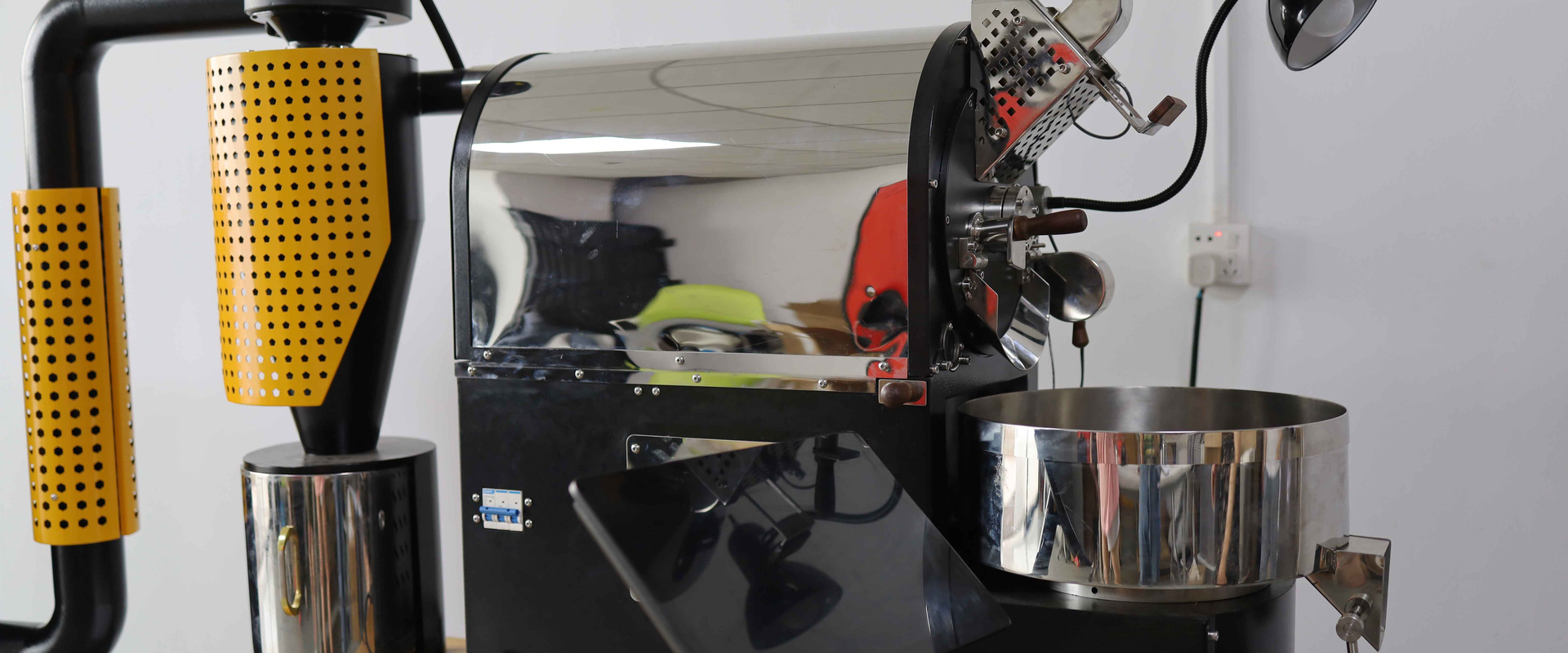
A roaster running behind the counter sells coffee before a word is said. Customers see it, smell it, and take a bag home. The reason more cafés do not do it is not the machine — it is the three approvals that have to come first, and the smoke, heat and noise that have to be managed once it is in. This guide covers both, and which roaster sizes fit the job.
Start with three approvals, not a catalogue
In-café roasting projects fail at the paperwork stage far more often than at the equipment stage. Settle these before you price a machine.
1. The landlord and the flue. A drum roaster exhausts hot air, chaff and smoke, and that has to leave the building through a duct — up through the roof or out through a wall. If the lease does not allow a penetration, or the building above you is not yours, that is the end of the traditional-roaster route in that unit. Ask before anything else, and get the answer in the lease.
2. Fire and gas approval. A gas roaster is a combustion appliance in a room open to the public. Most authorities will want to see clearances from combustible surfaces, a gas shut-off, extraction that runs whenever the burner does, and cleanout access on the duct. Some require the roaster to sit in a separate fire-rated enclosure; many do not. Ask in writing, with your batch size stated. Our guide to coffee roaster fire safety covers what inspectors typically look for.
3. Air quality. Roasting smoke and smell are regulated in most towns and enforced by neighbours. A café is by definition surrounded by neighbours. Small machines under a few kilograms often fall under permit thresholds, but "often" is not "always" — confirm the threshold locally. The context is in our afterburner guide.
If all three come back positive, you are building a roastery in a café. If any comes back negative, you are looking for a different unit, or for a different way to offer fresh coffee.
Smoke: the solvable problem
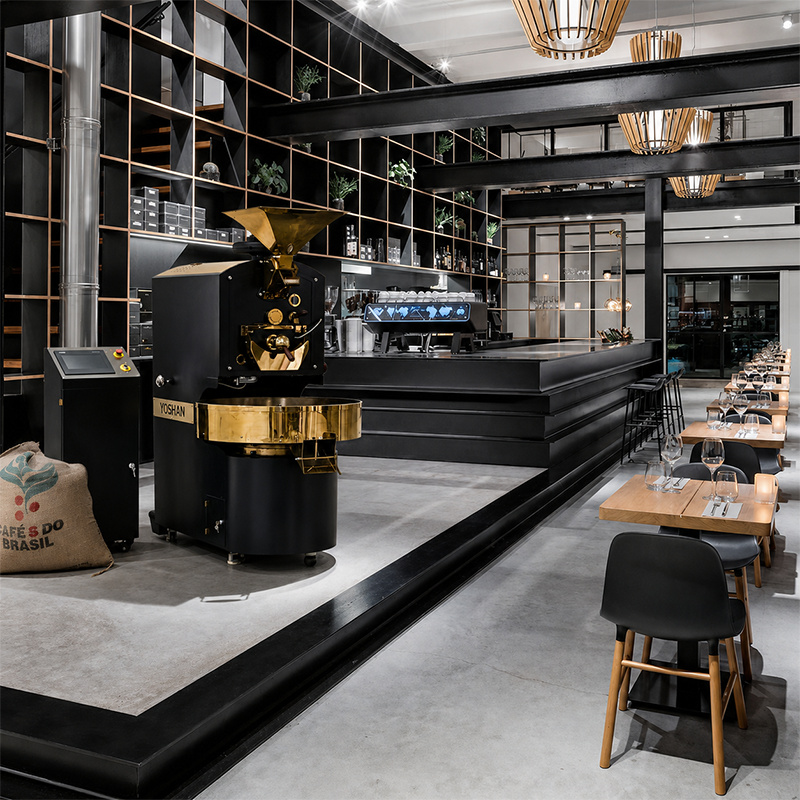
Smoke is the concern everyone raises first and it is the easiest of the three to handle at café scale.
On a small drum roaster, the exhaust carries chaff, fine particulate and roasting smell. Chaff is caught in the cyclone that comes with the machine. Particulate — the visible smoke — is what an electrostatic smoke filter removes, and at 1–3 kg batch sizes a single unit handles it comfortably. We build a filter specifically for this scenario: the JD-3K combines a display bench and an electrostatic filter in one unit for 1–3 kg roasters, so the machine sits on it, the exhaust passes through it, and visible smoke leaving the flue is largely gone. Details are in our article on the coffee roaster smoke filter.
What a filter does not remove is smell, which is gaseous rather than particulate. For a café, that is usually the point — customers come for the smell — but a neighbouring business may not agree, and if the authority requires odour treatment, that is an afterburner, which is a larger piece of equipment and a second gas appliance. At café volumes it is rarely required. Confirm rather than assume.
Either way, the exhaust still needs a duct to outside. A filter cleans the stream; it does not eliminate the need to move it.
Heat and noise: the problems nobody plans for
These are the two that appear after the roaster is installed.
A roaster in a small room raises the room temperature. The drum, the flue and the cooling tray all shed heat, and in summer a roaster running four batches on a Saturday morning can make the front of house uncomfortable. Plan its position with that in mind — against a back wall, not beside the seating — and make sure the extraction and the café's ventilation are sized together, not separately.
Noise comes from the drum drive, the exhaust fan and the cooling fan, and the cooling fan is the loudest part. Behind a glass partition it is a feature. Next to a table it is a complaint. The best in-café layouts put the roaster where it can be seen but not heard: a glass-fronted alcove, a back-of-bar position with a partition, or a corner with the cooling side facing away from customers.
Our coffee roastery layout guide is written for full roasteries, but the sections on clearances and flue routing apply directly to a café installation.
How much coffee a café actually needs to roast
This is where buyers over-specify. A café using its own roasted coffee for its bar and retail bags typically needs somewhere between fifteen and forty kilograms of roasted coffee a week. That is a few hours of roasting on a small machine, two or three days a week. The roaster is idle — and on display — most of the time.
So the right machine for in-café roasting is small, good-looking and easy to keep clean, not high-capacity. A 1 kg machine roasting six batches produces around five kilograms of roasted coffee in an afternoon. A 3 kg machine does the same in a couple of hours. Neither is a production roaster and neither needs to be.
If the café also supplies other cafés or sells online at volume, the arithmetic changes and so does the answer — a larger machine in a back room, or a separate roastery. Our batch size guide turns weekly demand into a machine size.
Which machines fit a café floor
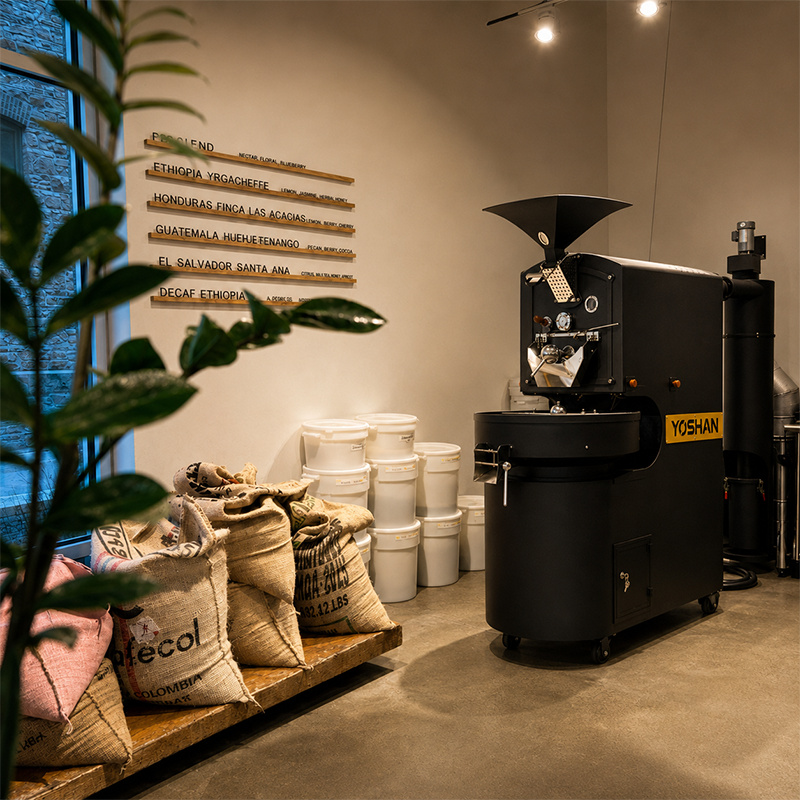
Three configurations from our range suit in-café roasting, and they differ mainly in how the machine looks and how it is fuelled.
| Configuration | Roaster | Heating | Why it suits a café |
|---|---|---|---|
| Classic showpiece | DY-1 kg or DY-2 kg | Gas or electric | Traditional design, 304 stainless drum, compact footprint (1200 × 800 × 1100 mm for the 1 kg), Artisan-ready |
| Compact production | SD-3 kg | Gas or electric heating element | Cast iron drum, enough capacity to supply a second site, manual or PLC versions |
| No-gas site | DY electric or EC-500G | Electric only | Where gas is not permitted; the sample roaster covers very small retail volumes |
Two accessories complete the set-up: the JD-3K display bench with built-in smoke filter, and the ZX-1 or ZX-2 mobile display stand for 1–2 kg machines, which puts the roaster at eye level on lockable wheels. A DY-2 on a display stand with the filter behind it is the configuration most of our café customers end up with.
On fuel: electric versions of the 1–3 kg machines avoid the gas approval entirely, at the cost of higher running cost per batch and a dedicated circuit. For many high-street sites that trade is worth making. The comparison is in gas vs electric commercial coffee roasters.
The mistakes we see most
- Choosing the roaster before the flue route. The machine is ordered, then the landlord says no to the roof.
- Putting the roaster where customers sit. The cooling fan and the summer heat move it within a year.
- Buying capacity instead of appearance. A 6 kg machine in a café runs one day a week and looks industrial doing it.
- No cleaning routine. Chaff and oil build up fast in a small duct; a café roaster needs the same maintenance discipline as a big one, in a room where customers are watching.
- Treating the filter as optional. Visible smoke from a shopfront is the fastest way to a complaint. Fit it from day one.
FAQ
Can you legally roast coffee inside a coffee shop?
In most places, yes, subject to three approvals: the landlord permitting a flue penetration, fire and gas authorities accepting the installation, and air-quality rules for your batch size. Small machines often fall under emission thresholds, but confirm locally in writing before ordering equipment.
Does an in-café roaster need to be vented outside?
Yes, for any drum roaster. A smoke filter removes the visible particulate from the exhaust, but the hot air, remaining gases and smell still need a duct to the outside. The filter makes what leaves the flue cleaner; it does not remove the flue.
What size roaster does a café need?
Usually 1 to 3 kg per batch. A café using its own coffee for the bar and retail typically needs 15–40 kg of roasted coffee a week, which a small machine produces in a few hours across two or three days. Buy for appearance and ease of cleaning rather than throughput.
Will roasting make my café smell of smoke?
It will smell of roasting coffee, which most cafés want. Visible smoke is removed by an electrostatic filter; the aroma is not, because it is gaseous. If a neighbour or authority objects to the smell itself, the solution is an afterburner, which is rarely required at café volumes.
How much space does a small roaster take in a café?
A 1 kg machine occupies roughly 1.2 by 0.8 metres of floor and stands about 1.1 metres tall; add clearance for the operator, the cooling tray and the flue connection above. On a display stand it becomes a feature about the size of a large display fridge.
Gas or electric for a café roaster?
Electric avoids the gas approval and the LPG cylinders, and suits sites where gas is not allowed, at a higher running cost per batch. Gas is cheaper to run and the traditional choice where the building already has a supply and the authority accepts a combustion appliance in the room.
Is roasting in the café worth it for a single site?
Commercially, the margin on retail bags of your own coffee is the strongest argument, followed by the draw of the machine itself. Against that sit the three approvals, the installation and a few hours of labour a week. Where the approvals come easily, most single-site cafés that do it keep doing it.
Final Thoughts
An in-café roaster works when the flue, the fire approval and the air rules are settled first, the machine is chosen for the floor rather than for capacity, and the smoke is filtered from day one. Our DY series 1–2 kg roasters and the 3 kg SD are the machines we build for exactly this. Tell us about the site and we will put together the roaster, stand and filter to fit it.
Request a factory-direct quote or message us on WhatsApp at +86 184 0771 4607.
Get a Quote → WhatsApp +86 184 0771 4607Last updated: September 17, 2026
Pingback: Coffee Roastery Permits & Inspections: The Five Reviews to Pass
Pingback: Buy a Coffee Roaster or Use a Contract Roaster? Break-Even Guide