
Most wholesale pricing guides multiply the green price by two or three and stop. The multiplier hides the two lines that decide whether a roastery survives its second year: the weight the coffee loses in the drum, and the cost of the machine spread across every kilo it roasts. This guide builds the price from the bottom in per-kilo terms that work in any currency, then adds margin, volume tiers and the three price points a roastery holds at once.
Start from cost per roasted kilo, not green price
Green coffee is bought per green kilo and sold per roasted kilo, and 11–20% of the weight leaves as water and chaff in between. A costing that uses the green price as the cost of coffee in the bag understates it before anything else is added.
Step 1 — landed green cost per green kilo. Purchase price plus freight, insurance, customs and warehouse fees to your door.
Step 2 — divide by your yield. At 15% loss the yield is 0.85, so green cost per roasted kilo = landed price ÷ 0.85 — about 18% higher than the green price. At 20% loss it is 25% higher. Use the loss your own machine produces at your own roast level; the arithmetic is in coffee roasting weight loss and yield.
Step 3 — add the direct costs per roasted kilo.
| Cost line | How to get the number | Typical scale |
|---|---|---|
| Energy | Fuel or power per roasting hour ÷ kilos roasted per hour | A few cents per kilo on a drum roaster |
| Labour | Roaster operator wage per hour ÷ kilos per hour, plus packing time | Falls sharply with batch size |
| Packaging | Bag, valve, label, carton per kilo | Fixed per bag, so cheaper per kilo in 1 kg bags |
| Quality loss | Sample roasts, cupping, rejected batches | Usually 1–3% of green |
Energy is the line buyers over-estimate. A gas drum roaster averages well below its rated burner output over a batch; on our machines it works out at roughly USD 0.06–0.10 per green kilo on LPG and about USD 0.08–0.15 on electric heating at ordinary fuel prices, and the running-cost tables let you substitute your own prices.
Put the roaster into the price
The line most guides leave out. A machine bought outright is capital, but every kilo it roasts should carry a share of its cost, or the price will look fine until the machine needs replacing.
Machine cost per kilo = (purchase price + installation) ÷ (kilos roasted over its costing life).
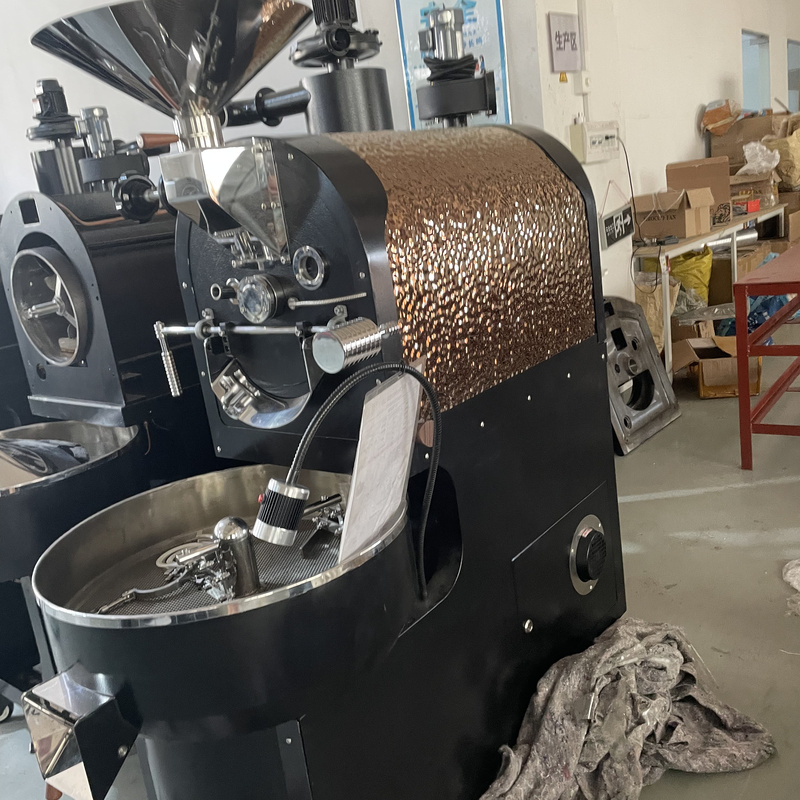
Take a 6 kg production machine: our YS-6 is USD 7,499 EXW Shenzhen, USD, 2026, roasting 1–7 kg per batch. Add installation and freight — say a further USD 3,000 for flue, gas and shipping — and cost it over five years.
| Weekly roasted output | Kilos over 5 years | Machine cost per roasted kilo |
|---|---|---|
| 50 kg | 13,000 | USD 0.81 |
| 150 kg | 39,000 | USD 0.27 |
| 300 kg | 78,000 | USD 0.13 |
| 500 kg (near the machine's ceiling at 30 h/week) | 130,000 | USD 0.08 |
The same machine costs a roastery about ten times more per kilo at 50 kg a week than at full utilisation. That is why a start-up roasting 50 kg a week cannot match the wholesale price of an established roastery on the same equipment, and why the choice of batch size and the plan to fill it belong in the pricing model. The trade-off between buying a roaster and paying someone else to roast is worked through in buy a coffee roaster vs contract roasting.
Add overhead the same way — rent, insurance, utilities other than roasting energy, software — divided by monthly roasted kilos. Together, steps 1–3 plus machine and overhead give full cost per roasted kilo.
Choose a margin method and stick to it
Three methods are in common use; all three should land in a similar place if the cost base is honest.
Cost plus. Full cost per kilo × a multiplier. The multiplier roasters quote for wholesale is usually 2–3 on the green-based cost, but once machine and overhead are already inside the cost figure, a multiplier of about 1.6–2 gives the same result.
Target gross margin. Price = full cost ÷ (1 − target margin). Wholesale roasters commonly run 40–60% gross margin on café accounts; retail through your own counter or website runs higher, 60–70%, but carries its own costs. At a full cost of 14 per kilo and a 45% target: 14 ÷ 0.55 ≈ 25.5 per kilo.
Value pricing. Start from what the café can pay — the retail price of a cup, the grams per cup, the margin the café needs — and work back. Useful as a ceiling check on the first two, dangerous as the only method.
Whichever you use, price wholesale first and set retail from it, not the other way round. A roastery that sets a retail price it likes and then discounts to wholesale usually discovers the wholesale price sits below full cost.
Build volume tiers on real cost differences
Cafés buy 5–25 kg a week; a tier structure rewards the larger accounts. Tiers should track your actual cost curve — packing, delivery and invoicing cost roughly the same per order whether it is 5 kg or 25 kg, so the per-kilo saving on a larger order is real, not a gift.
A working template, expressed in steps rather than currency:
| Weekly volume per account | Price relative to base |
|---|---|
| Up to 5 kg | Base |
| 5–20 kg | Base minus one step (about 5–8%) |
| 20–50 kg | Base minus two steps |
| Over 50 kg | Negotiated, with a written minimum |
Keep the steps small enough that the largest tier still clears your target margin, and keep any single account below about a quarter of your volume so one lost customer does not break the model. How to find and keep those accounts is in selling wholesale coffee to cafés.
The three prices every roastery holds at once
- Wholesale to cafés and offices — the base built above, on tiers, with delivery terms.
- Retail through your own counter or shop — typically 30–60% above wholesale, because you carry the retail cost and the customer pays for the brand.
- Online direct — retail level, less the platform's fee and shipping, which usually leaves a similar margin to wholesale for more work.
Review all three every six months against green prices — the market moved double digits in some recent years — and pass increases through in small steps rather than one large one.
A worked example in per-kilo units
Assume, in your currency per roasted kilo: green landed 9.00 ÷ 0.85 = 10.59; energy 0.10; labour 1.20; packaging 0.90; quality loss 0.20; machine 0.27 (150 kg a week on a YS-6); overhead 1.50. Full cost = 14.76. At a 45% target margin, base wholesale = 14.76 ÷ 0.55 = 26.84; round to 27. Tier two at 25, tier three at 23.50 — the last still clears 37%. Retail at 27 × 1.45 ≈ 39.
Now rerun the same sheet at 50 kg a week: the machine line becomes 0.81 and overhead per kilo triples, full cost climbs past 19, and the same 45% target puts base wholesale near 35 — above what most cafés will pay. The price is not the problem; utilisation is.
FAQ
How do you calculate the cost of roasted coffee per kilo?
Landed green price ÷ yield (0.85 at 15% loss) gives green cost per roasted kilo; add energy, labour, packaging and quality loss per kilo, then the machine's cost spread over the kilos it will roast, then overhead per kilo. That total is full cost, and the price is built on it.
What is a typical wholesale coffee profit margin?
Wholesale roasters commonly run 40–60% gross margin on café accounts, with retail through their own channels at 60–70%. Net margin after overhead is much thinner — single digits is common in the first years — which is why utilisation of the roaster matters as much as the markup.
How much should I mark up green coffee for wholesale?
The traditional rule is two to three times the green price, but that only works if the multiplier is hiding weight loss, labour, packaging and machine cost. Build the full cost per roasted kilo instead and apply a 40–60% gross margin; the result usually lands in the same range for a well-utilised roastery.
Should wholesale coffee prices be tiered by volume?
Yes, because packing, delivery and invoicing cost about the same per order at any size, so a larger order genuinely costs less per kilo. Keep steps at roughly 5–8% and make sure the largest tier still clears your target margin.
How does roaster size affect coffee pricing?
Through cost per kilo. A 6 kg machine at 50 kg a week costs around ten times more per kilo than the same machine near full utilisation. Choose a batch size you can fill within a year and price from the utilisation you will actually reach.
How often should a roastery review wholesale prices?
Every six months against landed green cost, and immediately after any large green-market move. Small, regular adjustments are easier for café accounts to absorb than one large correction.
Final Thoughts
Price from full cost per roasted kilo — green after weight loss, direct costs, the machine spread over its output, and overhead — then apply a margin and tiers you can defend. The machine line is the one you control at purchase: a 6 kg roaster or 12 kg roaster from our factory, sized to the volume you will reach, keeps that line small.
Get a quote or message Leon on WhatsApp at +86 184 0771 4607.
Get a Quote → WhatsApp +86 184 0771 4607Last updated: September 23, 2026
Pingback: Financing a Coffee Roaster: Cash, Loan, Lease or L/C
Pingback: Coffee Roaster ROI and Payback: Fill In Your Own Four Numbers | Yoshan
Pingback: How to Sell Wholesale Coffee to Cafés: Accounts to Roaster Capacity