
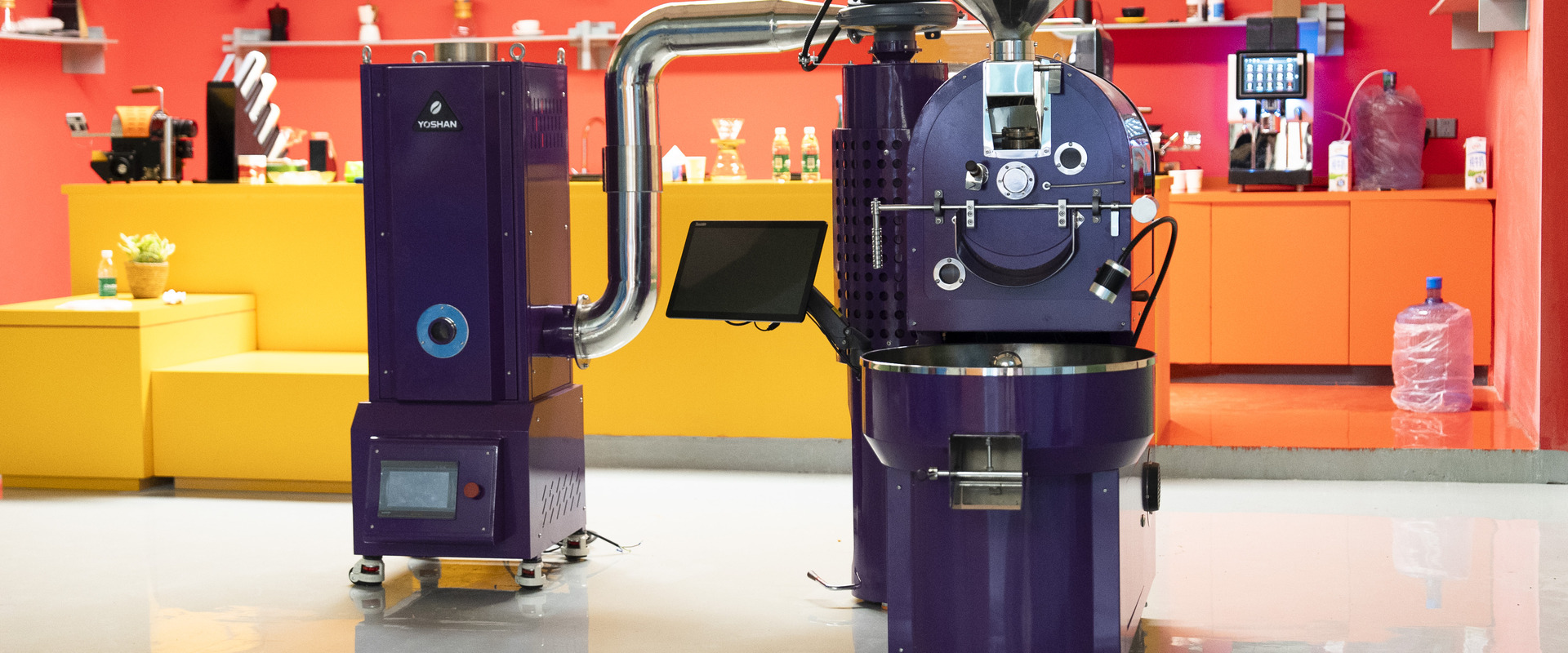
"My neighbours are complaining about the smoke" is how most of these conversations start, usually months after the roaster went in. A coffee roaster smoke filter — an electrostatic precipitator, or ESP — is the middle option between doing nothing and fitting a gas-hungry afterburner. We build both the roasters and the matched filters, so here is what an ESP actually removes, when it is enough, and how to size it.
How an Electrostatic Smoke Filter Works
Your roaster's exhaust passes through a high-voltage field that charges the smoke particles, oil droplets and fine chaff dust; the charged particles stick to collector plates and the cleaned air carries on up the stack. Three things follow:
- 95% or more of visible smoke and particulate is removed — the plume from your stack largely disappears.
- The running cost is electric and small — a mid-size unit draws about 300 W, against an afterburner burning gas every minute you roast.
- The plates need washing — the captured oil builds up, so cleaning every one to four weeks is the maintenance trade-off.
What It Removes, and What It Does Not
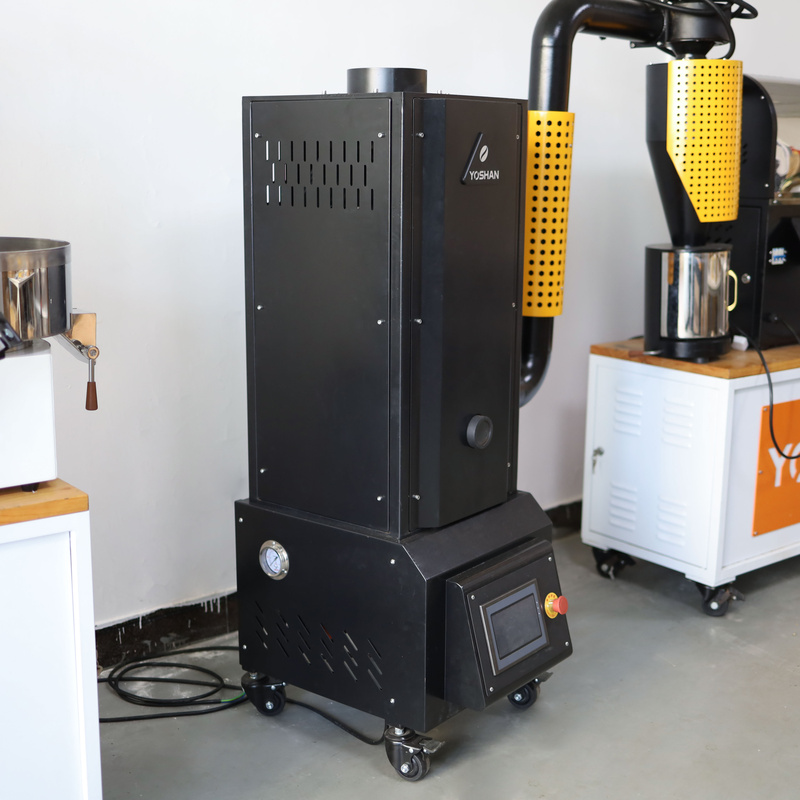
Roasting exhaust carries three different things: particles (chaff and oil droplets — the visible smoke and the film on nearby surfaces), VOCs (invisible gases, the thing air-quality rules measure) and odour. An ESP removes the first almost completely and the oil droplets that carry part of the smell; it removes only a fraction of the VOCs and does not destroy odour. So the rule from our installations is simple: if the complaint is what people see, an ESP; if the complaint is what people smell, or your permit measures VOCs, an afterburner. The afterburner guide covers that side.
Three Questions That Decide It
| Question | If the answer is… | Then |
|---|---|---|
| What do your local rules regulate? | A measured VOC or emissions limit | Afterburner — an ESP alone will not pass |
| Visible smoke, nuisance, or nothing specific | An ESP is usually enough | |
| How close are your neighbours? | Shared building, homes above, a restaurant next door | ESP at minimum; afterburner if odour complaints are likely |
| Industrial unit, open site, tall stack possible | Cyclone and duct; add an ESP if anyone notices | |
| How much do you roast? | Under 6 kg a batch, a few sessions a week | An ESP settles most complaints |
| 12–30 kg daily | ESP now, and a stack that can take an afterburner later | |
| 60 kg and up | Afterburner standard; ESP ahead of it |
Work down the table in order. Most small urban roasteries land on "ESP"; most production plants end up with both.
Sizing: Match the Airflow, Not the Roaster
An ESP is sized by exhaust airflow in m³/h, which must exceed your roaster's output — an undersized filter chokes the draft and changes your roast profiles. Our matched pairs:
| Roaster | Filter | Price, ex-works |
|---|---|---|
| 1–3 kg (DY-1, DY-2, SD-1.5, SD-3) | JD-3K, compact class, ~2,000 m³/h | USD 1,500 |
| 3–6 kg (SD-6 Pro, YS-6) | JD-Q4, ~4,000 m³/h | On the quote |
| 12–30 kg | JD-Q6 | On the quote |
| 60 kg | JD-Q8 | On the quote |
| 120–300 kg | JD-Q10 | On the quote |
Because we build the roasters, the filter is matched at the factory — flange diameter, airflow, mounting — and ships in the same crate; the equipment page lists the units. Retrofitting to a roaster we did not build works too: send the exhaust duct diameter, the roaster capacity and the space you have, and we quote a unit with adaptors.
Installing It
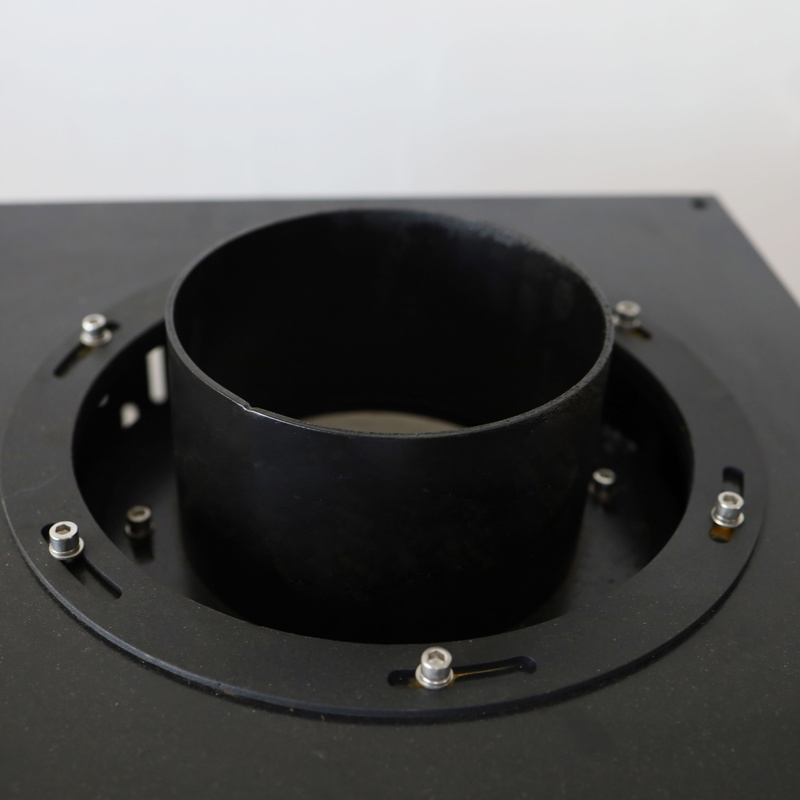
- After the cyclone, before the stack. The cyclone catches coarse chaff so the plates stay effective longer.
- A straight run into the unit where you can; sharp elbows just before the filter cause turbulence and uneven collection.
- Its own circuit. Small load, but never shared with the roaster.
- A wash station nearby. The plates come out and get degreased; make that easy or it will not happen. The ventilation guide covers the duct around it.
Cleaning, and Where the Oil Goes
Wash the plates every one to four weeks — sooner if you roast dark, which deposits more oil — with hot water and a degreaser, and let them dry fully before refitting; a wet plate arcs. A collection tray under the unit catches the drip. The residue is tar and coffee oil, and it goes out as industrial waste, not down the drain: keep a labelled drum and use whatever collection your municipality provides. Skipped cleaning shows up as a plume returning and, eventually, the high-voltage supply tripping.
If You Also Need an Afterburner
On production lines an ESP earns its place even where an afterburner is required, because it sits in front of it: the oil and particulate the ESP catches would otherwise coat a catalytic afterburner's catalyst and shorten its life, and they add to a thermal unit's fuel load. Specify the pair together so the flanges and the duct match; on our full sets from the SD-30 Pro up the afterburner is included and the ESP is quoted with it.
Frequently Asked Questions
Does an ESP filter remove roasting odour?
Partly. It captures the oil droplets that carry a good share of the smell, so most neighbours notice a difference, but it does not touch the gaseous compounds that make up the rest, and it does not destroy anything — it collects it. If the complaint is odour from homes close by, or your permit sets a VOC figure, an afterburner is the reliable answer and the ESP becomes its pre-filter.
How much does a smoke filter cost to run?
Almost nothing in energy — around 300 W while the roaster runs, a fraction of a kilowatt-hour per session — plus your time washing the plates and a degreaser. Compare that with a thermal afterburner, which burns gas comparable to a second roaster burner every minute you roast; the running costs guide puts numbers on both. The ESP's cost is the purchase, not the bill.
Can I add a filter to a roaster you did not build?
Yes. Send the exhaust duct diameter, the roaster's batch size and a photo of where the unit would sit, and we quote a matched ESP with the adaptors to your flange. The one thing to check first is the draft: your roaster's fan has to push the exhaust through the plates, so an old or undersized fan may need attention at the same time.
Do the rules require one?
That depends entirely on your city; many urban authorities require smoke treatment above roughly 5 kg, others regulate only nuisance, and some require an afterburner regardless of batch size. Ask before you buy, in writing, and keep the filter's specification with the permit file — the afterburner guide lists the three questions to put to the authority.
Will it change my roast profiles?
Only if it is undersized. A correctly sized ESP adds little resistance and your fan handles it; one rated below your exhaust volume restricts airflow, which shows up as smoky cups and later first cracks. That is why we size by m³/h rather than by roaster model, and why a plate that is overdue for cleaning has the same effect as an undersized unit.
Final Thoughts
A coffee roaster smoke filter removes what people see for the cost of a light bulb, and not what they smell — which is the whole decision. Answer the three questions, size the unit by airflow, put a wash station next to it, and pair it with an afterburner where your rules demand one. Send us your roaster and your duct diameter. Talk to our engineers.
Get a Quote → WhatsApp +86 184 0771 4607Last updated: September 23, 2026
Pingback: Coffee Roaster Afterburner: Do You Need One, and Which Type | Yoshan
Pingback: Sizing an Industrial Coffee Roasting Line: 30–300 kg | Yoshan
Pingback: 3 kg Coffee Roaster: Output, Gas or Electric, Which Model | Yoshan
Pingback: Coffee Roaster Fire Safety: Where Fires Start and the First 60 Seconds
Pingback: How to Reduce Smoke from a Coffee Roaster: 4 Layers Before Buying Gear
Pingback: Roasting Coffee Inside a Café: Roaster on the Shop Floor
Pingback: When a Roastery Needs a Destoner, Loader or Afterburner