
If you roast and need to grind a couple of hundred kilos a week for retail bags, or you run a shop grinding customers' beans at the till, you need a different machine from the espresso grinder on a cafe counter — and buying the wrong one is one of the more expensive mistakes we see. Here is what separates a bulk coffee grinder that survives three years of daily work from one that burns out in six months.
1. What a Bulk Grinder Does That an Espresso Grinder Cannot
Four jobs drive almost every enquiry:
- Roastery retail packing — you roast, rest, and grind part of each batch into 250 g or 1 kg valve bags.
- Grind-at-the-till retail — a grocery, deli or shop grinds a customer's beans to their brew method while they wait; twenty runs of thirty seconds a day, or two of twenty minutes.
- Hotel, office and catering — filter-grind volume for urns and batch brewers, coarser and by the kilo.
- Pre-ground private label — the highest-volume version, which eventually needs an industrial mill rather than a shop grinder.
An espresso grinder is built for fine, precise, repeatable single doses. A bulk grinder is built for kilos per hour across the medium-to-coarse range, running continuously without overheating. Ask one to do the other's job and you get a burnt-out motor or hopeless espresso; for bar-side grinding, the buyer's guide is the right page.
2. Throughput: The Spec That Decides It
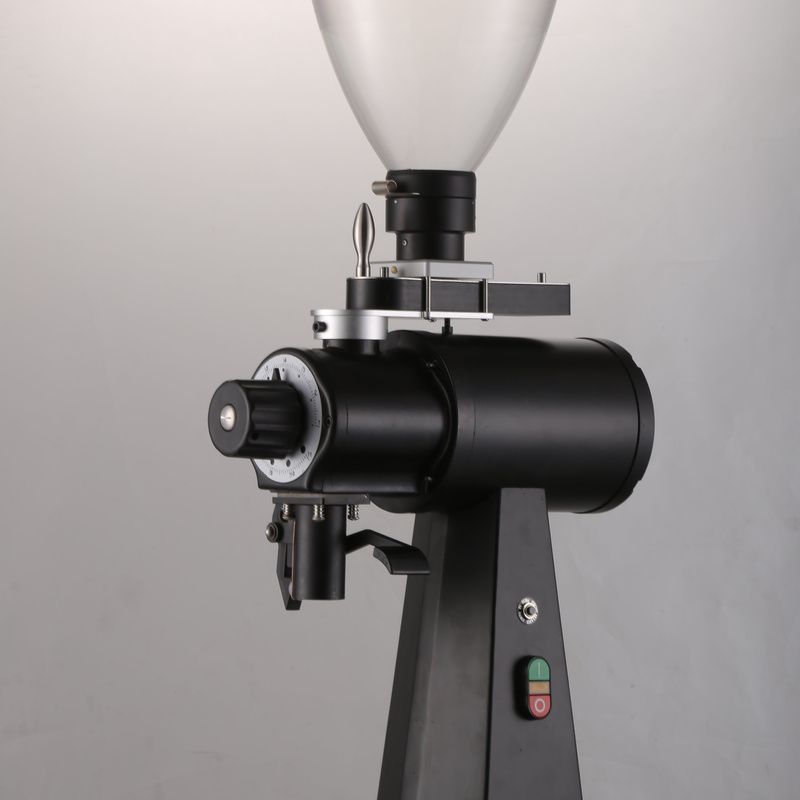
Work backwards from your kilos. If you grind 200 kg a week in one afternoon, you need roughly 50 kg/h with headroom — not a 20 kg/h counter machine run to death.
| Class | Motor and burrs | Indicative throughput | Right for |
|---|---|---|---|
| Counter shop grinder | 0.8–1.5 kW, 64–75 mm flat | 20–40 kg/h | Grind-at-till retail, small cafe bagging |
| Heavy shop grinder | 1.5–3 kW, 90–120 mm flat | 60–120 kg/h | Roastery packing 200 kg–1 t a week |
| Industrial disc mill | 3–7.5 kW | 150–500 kg/h | Regional roaster, private-label lines |
| Roller mill | 7.5 kW and up, multi-stage rollers | 500 kg/h to several tonnes | Factory-scale pre-ground |
Two cautions. Quoted throughput is nearly always at a medium filter setting — grind finer and real output falls by a third or more, so discount the headline if you pack espresso-grind bags. And above about 300 kg/h the trade moves to roller mills, because rollers give a narrower particle spread with fewer fines and less heat; the industrial grinder range starts there.
3. Duty Cycle: The Number Suppliers Will Not Volunteer
This is where cheap machines fail, and we have replaced burnt-out grinders for customers who bought elsewhere on price. A motor rated S1 continuous can run all day. Many shop-grinder motors are rated intermittent — thirty minutes on, thirty off — and the spec sheet says so quietly or not at all. A roastery that grinds for three hours every Thursday destroys an intermittent motor within a year, and the failure is not a warranty defect because the machine ran outside its rating.
Get written answers before you order: is the motor S1 or intermittent, and if intermittent, what cycle? Is there a thermal cut-out, and does it reset automatically? Is the chamber vented or fan-cooled — because heat shifts your grind size mid-session, which is a real quality problem when you are packing to a printed brew method.
4. Grinding Fresh-Roasted Coffee: Heat, CO₂ and Bag Failures
The section roastery buyers skip and come back about.
Let the beans cool and rest. Grinding warm beans off the cooling tray gives a fines-heavy grind and loads heat into the burrs; beans should be at room temperature.
Respect degassing. Fresh coffee releases CO₂ for days, and grinding accelerates it enormously. Pack ground coffee too early and the bag inflates or splits. The rule most roasteries settle on: at least 12–24 hours' rest before grinding for retail, and a one-way valve on every ground-coffee bag, without exception. Whole-bean bags sometimes get away without a valve; ground bags never do. The packaging guide covers bag and valve choice.
Grind for the customer's brewer. A bag labelled "ground" satisfies nobody; print the brew method and set the machine against a reference — the grind size chart gives the micron ranges so your retail grind repeats between operators.
Roast level changes the setting. Darker roasts are more brittle and grind finer at the same dial position; a light single origin and a dark blend from the same machine need different settings, and whoever packs needs to know.
5. Voltage, Plugs and Where It Ships
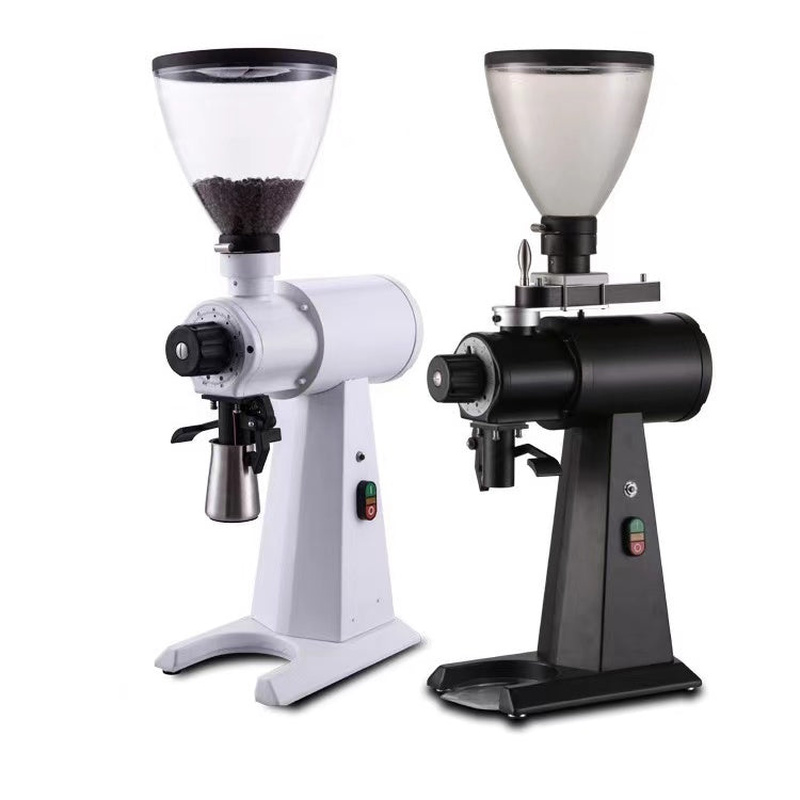
About one grinder enquiry in six leads with "110 V commercial electric coffee grinder" — buyers in the Philippines, Mexico, Colombia and Canada. A bulk grinder motor is not a field conversion.
| Supply | Where | Notes |
|---|---|---|
| 110–127 V / 60 Hz | Mexico, Colombia, Philippines, Canada, parts of Central America | Practical ceiling around 1.5–1.8 kW on a standard circuit |
| 220–240 V / 50 Hz | Europe, UK, Middle East, most of Asia, Australia | Covers the whole shop-grinder class |
| 220 V / 60 Hz | Philippines (commercial), Korea, parts of Latin America | State the frequency — it changes motor speed |
| 380–415 V three-phase | Industrial sites | Required above roughly 3 kW; check rotation at commissioning |
A 50 Hz motor on 60 Hz spins faster and changes throughput, consistency and bearing life; a reversed three-phase motor is the single most common commissioning fault we troubleshoot, on grinders and roasters alike.
6. Where It Sits in Your Line
Roaster → cooling → rest → grinder → filling and sealing. Buyers who order the grinder and packaging with the roaster consolidate one container instead of three, which is what a roastery in Oman did with a custom roaster line; the equipment list shows what belongs in a first container. The roasters are built in our own factory; the grinders and espresso machines we source and supply as a wholesaler alongside them.
What We Supply, and What It Costs
| Model | Class | Price, ex-works |
|---|---|---|
| YS-1100M | Industrial mill, 1.1 kW — bagging and catering volume | USD 608 |
| YS-2200M | Industrial mill, 2.2 kW, single or three-phase — the one that grinds Turkish-fine | USD 688 |
| Shop grinders, 64–98 mm | Counter and heavy shop class | On the grinder range page |
Ask for the motor rating (S1 or intermittent) and the throughput at your grind setting on the quote; we put both in writing.
Frequently Asked Questions
What size bulk grinder do I need for 200 kg a week?
Decide how many hours you can give it. Two hours a week means 100 kg/h and a heavy shop grinder with 90 mm or larger burrs on a continuous-duty motor; a full day means a 30–40 kg/h counter machine will cope, provided it is rated S1. Then discount the brochure figure by a third if any of it is espresso grind, and buy the class above if the number lands on a boundary.
Can a bulk grinder do espresso grind for bags?
Yes, at a cost in output and heat: at espresso fineness a shop grinder produces a third less per hour and runs warmer, so the chamber needs venting and the motor needs to be continuous-rated. What it cannot do is dose espresso on a bar — the burr geometry and the lack of a dosing mechanism make it the wrong tool there, whatever the fineness.
How long should I let coffee rest before grinding for retail?
Twelve to twenty-four hours minimum after roasting, at room temperature, and longer for dark roasts, which release gas faster. Then grind straight into a valve bag and seal; the valve lets the CO₂ that grinding released escape without letting oxygen in. Skip the rest and the bags pillow on the shelf; skip the valve and they split in the box.
Is 110 V enough for a shop grinder?
For the counter class, yes: a 1–1.5 kW motor on a 110–127 V circuit gives you 20–30 kg/h, which covers grind-at-till retail and small bagging. Above about 1.8 kW a 110 V circuit runs out, so the heavy shop class and anything industrial goes to 220 V or three-phase — which, in a 110 V country, means an electrician before the machine, not after.
Do you supply the grinder with the packaging machine?
Yes, and sizing them together is the point: the filler's bags per hour and the grinder's kilos per hour have to match, and the grind setting has to match the brew method printed on the bag. Tell us your weekly kilos, your bag sizes and how many hours you will give to packing, and we quote the pair, with the roaster if you need one, as a single shipment.
Final Thoughts
A bulk coffee grinder is chosen on three numbers — kilos per hour at your grind setting, a motor rated to run for as long as you will run it, and the rest time before you grind for bags — and built for your voltage. Send us your weekly kilos, your bag sizes and your supply, and we will quote the right class. Talk to us.
Get a Quote → WhatsApp +86 184 0771 4607Last updated: September 17, 2026
Pingback: Commercial Coffee Grinder Cleaning Schedule: Daily to Monthly
Pingback: How to Replace Grinder Burrs: When, the 45-Minute Job, Alignment
Pingback: Commercial Turkish Coffee Grinder: Fineness, Heat, Output
Pingback: Roasting Coffee for Cold Brew: Profile, Grind & Packaging