
If you are choosing a commercial coffee grinder, the specification that matters most is one most buyers skip: burr size against your drinks per day. Get that right and your grinder keeps up, runs cool and holds its grind through your rush. Get it wrong and every other feature is irrelevant. Here is how to size it, then the flat-versus-conical and single-dose questions, and what we supply for each job.
1. Your Drinks Per Day Decide the Burr Size
Burrs are the two cutting discs (or cones) that do the grinding. Bigger burrs grind faster, run cooler and hold their setting longer under load — which is why burr size, more than motor watts, is the number to match to your volume.
| Your espresso drinks per day | Burr size to look at | Why |
|---|---|---|
| Under 80 | 58–64 mm | Fast enough, cool enough; the 64 mm flat is the standard cafe grinder worldwide |
| 80–200 | 64–75 mm | 64 mm flat still covers this; 75 mm gives margin on hot afternoons |
| 200+ or two machines | 75–85 mm | Higher output and a wider sweet spot for the barista dialling in |
| Retail bags and roastery bulk | Dedicated bulk grinder | A different machine — see the bulk grinder guide |
If you are between two bands, size up. A grinder running at its limit heats the coffee and drifts the grind, and your barista spends the rush chasing it.
2. Flat or Conical: What the Burr Shape Does to the Cup
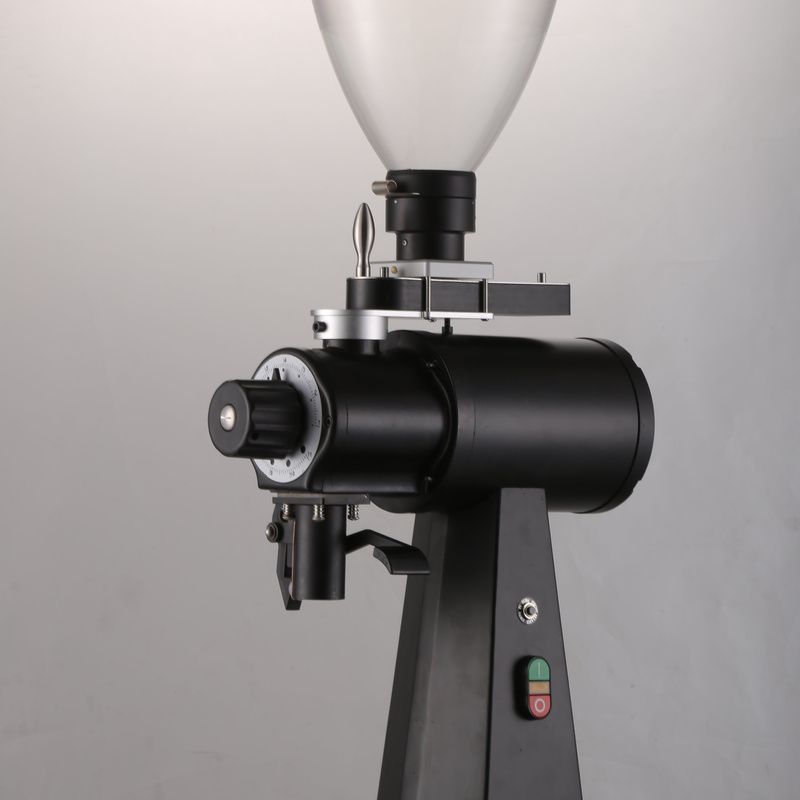
"Flat for clarity, conical for body" is the short version. Here is why, because it decides which one suits your menu.
A grinder never produces one particle size; it produces a spread. Flat burrs produce a tight, uniform spread — most particles close to the size you set, few fines — which extracts evenly and gives a clean, bright, clearly defined cup. That is why espresso bars chasing clarity in light roasts, and filter programmes, lean flat.
Conical burrs produce a two-peaked spread — a concentration of particles at the set size plus a population of fines. The fines extract fast and add body and sweetness; the larger particles keep the shot from over-extracting. That is the traditional espresso texture, and it is why a conical grinder forgives you a slightly wrong setting: the two populations average each other out. Conical burrs also turn at lower speed, so they run cooler and quieter on a busy bar.
For you, the decision is what the customer expects in the cup. If you run a specialty bar selling single-origin espresso and filter, you want the flat grinder's precision and you will dial in daily. If you run a neighbourhood cafe selling flat whites all day, you want the conical's body, forgiveness and quiet, and you would rather set it once. Both are right; they are answers to different menus. The espresso vs filter grinder guide goes deeper into burr geometry.
3. One Grinder Is Rarely Enough
A cafe pulling espresso and brewing filter needs two grinders, because the grind sizes are far apart and switching a single grinder back and forth wastes coffee and time — the grind size chart shows how far. A 2-group machine typically wants one espresso grinder; a 3-group, two. If you sell retail bags from a roastery you need a bulk grinder as well, ground to order.
Budget the grinders with the machine, not after. Our espresso machine package deals bundle the grinder for this reason.
4. Single-Dose or Hopper
Hopper grinders hold a kilo of beans and grind on demand — right for a busy bar on one coffee.
Single-dose grinders take a weighed dose per shot and are built for near-zero retention — right for a cafe rotating coffees, a roastery dialling in, or a training bar. The 64 mm flat single-dose class is the one most asked about; our 64 mm single-dose guide covers it.
Retention — the coffee left inside between doses — matters more than most buyers expect: stale grounds in the first shot of the morning, wasted coffee on every switch. The retention and static guide explains how to check it.
5. Voltage, Motor and Noise
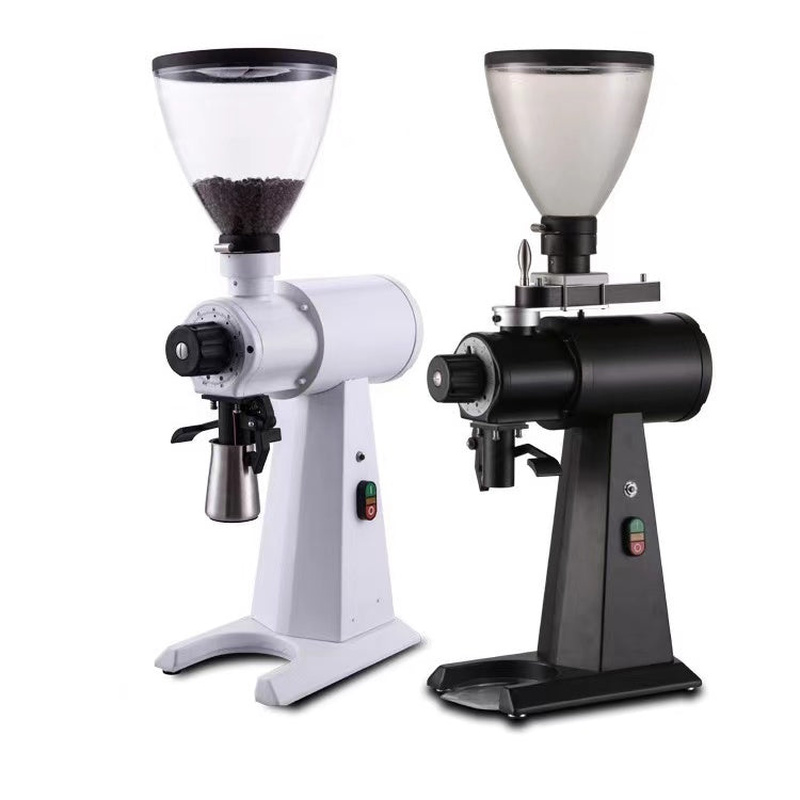
Commercial grinders come in 110–120V and 220–240V builds; the motor is sized to the burrs. Tell us your supply — a grinder is the one piece of equipment cafes most often buy in the wrong voltage because it looks small. Noise matters if your bar is open to the seating: conical and larger, slower-turning flat burrs are quieter.
For Turkish or Arabic coffee, the grind is finer than espresso and needs a purpose-built mill; among the machines we supply, the YS-2200M industrial mill (single or three-phase, 2.2 kW) is the one that grinds to that fineness.
6. Burr Life and Spares
Burrs wear on a kilo interval, not a calendar: roughly 500–1,000 kg for a 64 mm steel set on espresso, more for larger burrs and for titanium-coated sets. You will notice dull burrs as slower grinding, more heat, more fines and a flatter cup. Keep a spare set per grinder and change on the interval — the burr replacement guide shows how and when.
What We Supply
We are a wholesale supplier of commercial grinders, specified against the questions above:
| Grinder | Type | Fits |
|---|---|---|
| YS-C98pro | Electric burr grinder, cafe | Espresso bar under ~150 drinks a day — USD 1,099 |
| YS-020 | Electric flat-burr grinder | Espresso-focused cafe; pairs with our 2-group machines — USD 119 |
| YS-900N / YS-900A / YS-900E | 64 mm flat-burr cafe grinders, 1.5 L hopper, 350–360 W (900A/900E with dosing panel) | Cafe espresso bar; 64 mm single-dose bodies are covered in the 64 mm single-dose guide |
| YS-1100M / YS-2200M / YS-M18 | Industrial mills (1.1 kW single-phase / 2.2 kW / large) | Roastery retail, bulk, Turkish and Arabic coffee (2200M) — USD 608 / 688 / 5,700 |
Full range on the commercial coffee grinder and industrial grinder pages. Grinders ship in the same container as espresso machines and, if you roast, a roaster from our own factory.
Frequently Asked Questions
How do I know a grinder's motor will survive my rush?
Ask for the duty rating — continuous (S1) or intermittent — and the burr speed. A bar grinding an espresso dose every twenty seconds for two hours is closer to continuous duty than the brochure assumes, and an intermittent-rated motor in that role runs hot and dies early. The bulk grinder guide explains the ratings; the same question applies at the bar.
Should the grinder match the espresso machine's brand?
No — nothing in the espresso trade requires it, and the best bars mix freely. What has to match is capacity: a grinder that keeps pace with the machine's groups in the peak hour, and a portafilter fork that fits your baskets. Buy the grinder on its own merits and the machine on its own; the espresso buyer's guide sizes the machine side.
What should I do with the grinder at closing time?
Empty the hopper if you rotate coffees, brush the chute and the burr chamber, wipe the dosing area, and leave the hopper lid off overnight so no oil-laden air sits in the beans. Once a week, remove the top burr, brush the seat and check the alignment. Ten minutes a day is the difference between burrs that last their rated kilos and burrs that dull early.
Can I use one grinder for espresso and cold brew or batch brew?
Not well. Coarse cold-brew and batch-brew grinds are far from espresso fineness, the change purges coffee each way, and the espresso dial-in is lost by the time you return; a dedicated filter grinder pays for itself in wasted coffee alone. If volume is small, a bulk or shop grinder for the coarse work and the espresso grinder untouched is the workable pair.
How do I set up a grinder for a second location to match the first?
Same model, same burrs at a similar kilo count, same beans from the same roast date, and dial in by shot time and yield rather than by copying the dial number — the number is meaningless across machines. Record dose, yield and time per coffee on a shared sheet and check them across sites weekly; the grind size chart gives the target neighbourhoods.
Final Thoughts
Size a commercial coffee grinder from your drinks per day, choose flat or conical from your menu, and count on two grinders if you serve both espresso and filter. We supply cafe grinders, single-dose and industrial mills, and ship them with the espresso machine — or the roaster — in one container. Send us your daily drink count and voltage. Get a wholesale quote.
Get a Quote → WhatsApp +86 184 0771 4607Last updated: September 17, 2026
Pingback: Espresso Machine for a Busy Cafe: What Keeps the Line Moving | Yoshan
Pingback: Commercial Coffee Grinder Voltage: 110V, 220V and Dual-Voltage
Pingback: Commercial Espresso Machine Certification: CE and the Boiler | Yoshan
Pingback: Coffee Shop Equipment List: Three Set-Ups by Store Type | Yoshan
Pingback: Espresso Grinder vs Filter Grinder: Burr Types, Which to Buy | Yoshan
Pingback: Coffee Grind Size Chart: Microns by Method and Roast Level | Yoshan
Pingback: Coffee Grinder Retention & Static: The 20-Minute Sample Test | Yoshan
Pingback: Bulk Coffee Grinder: Throughput, Duty Cycle, Degassing | Yoshan
Pingback: 64 mm Flat Burr Single-Dose Grinder: Why It Won, How to Buy | Yoshan