
The stepped-versus-stepless debate is usually settled in a sentence: stepless for espresso precision, stepped for repeatability. That is true, and written for one person at one grinder. A café has three baristas, two shifts, a coffee that changes with the weather and burrs that wear, and under those conditions the question becomes which mechanism holds a setting. This guide explains the two mechanisms, what a step measures, and the habits that make either behave in a busy bar.
What the two mechanisms do
Grind size is set by the gap between the burrs, and the gap is changed by rotating the upper burr carrier on a thread.
Stepped carriers have detents — a spring-loaded ball or a toothed ring — that stop the rotation at fixed positions. Each click moves the burr a fixed distance. The number of clicks across the range decides how fine the control is: a grinder with ten coarse clicks behaves nothing like one with fifty fine ones.
Stepless carriers rotate freely on a fine thread, often called micrometric adjustment after the patent that made it standard on commercial grinders. Any position is available, and the setting is wherever the collar stopped. Some commercial designs are hybrids: fine steps that can be unlocked to stepless.
How far a step or a fraction of a turn moves the burrs is what matters. Espresso is sensitive to a few tens of microns — one thousandth of a millimetre each — of burr gap; a change of that size moves a shot by several seconds. A stepless collar can land anywhere in that range; a stepped one can only if its steps are that fine.
The debate, briefly
| Stepless | Stepped | |
|---|---|---|
| Precision | Any gap; the barista can land between what would be two clicks | Limited to the step size — fine on micro-step grinders, coarse on others |
| Repeatability | No inherent bookmark; returns to a setting by mark or memory | Snaps back to "click 8" |
| Switching brew methods | Awkward; re-dial each time | Easy |
| Learning curve | Steeper; no "correct click" to feel | Gentler |
| Wear and re-zeroing | Reference mark drifts as burrs wear | Click numbers drift as burrs wear — the same problem, less visible |
| Typical use | Dedicated espresso grinders in cafés | Retail and filter grinders; multi-method bars; some micro-step espresso grinders |
Two points the guides make that a buyer should hold on to. First, burr quality, alignment and retention affect the cup far more than the adjustment mechanism does — the mechanism is how you reach a setting, not what the setting tastes like; the burr questions are in espresso grinder burr size and coffee grinder retention and static. Second, a stepped grinder with fine enough steps is, for practical purposes, a stepless grinder with a bookmark.
The café conditions the guides skip
Several hands. On a stepless collar every barista's "a little finer" is a different amount. On a stepped collar it is one click. The remedy on a stepless grinder is a written scale: a reference mark on the body, a numbered ring or tape on the collar, and the current setting written on the batch card or the bar's whiteboard every time it changes — the routine in dialling in a grinder in a café. A stepless grinder without a written scale is re-dialled from memory by whoever opens.
Daily re-dialling. Coffee changes with age and humidity, so the setting moves through the week. Stepless handles the small daily moves best; stepped handles them if the steps are fine. Either way, the timed dose changes when the grind changes — the coupling explained in grind-by-weight vs grind-by-time — so a grind adjustment is always followed by a dose check.
Retail and filter on the same grinder. A bar that grinds bags for customers at filter or French-press settings and then returns to espresso needs to get back to the espresso setting exactly. Stepped wins outright here, or a second grinder does.
Worn burrs. As burr edges wear, the same gap grinds differently, and the reference — the click number or the collar mark — no longer means what it did. Both mechanisms drift; stepped hides it better because the number looks the same. After a burr change both need re-zeroing: find the point where the burrs just touch (the "chirp"), set the mark or the zero click there, and re-dial from that. The replacement intervals are in when to replace grinder burrs.
Adjusting a commercial grinder, either type
The procedure is the same and the mechanism only changes how the move is made.
- Establish the baseline: a dose and a shot time from the current setting.
- Move a small amount — one click, or a few millimetres of collar travel on a stepless grinder — with the motor running on grinders that specify it, so the burrs are not forced against packed grounds.
- Purge a dose to clear grounds from the old setting.
- Pull the shot; compare time and taste.
- Repeat in the same direction until the target is bracketed, then halve the move.
- Record the setting.
A stepless collar rewards larger first moves and smaller second ones; a stepped collar rewards counting clicks and writing the number down.
What we supply, and what to ask
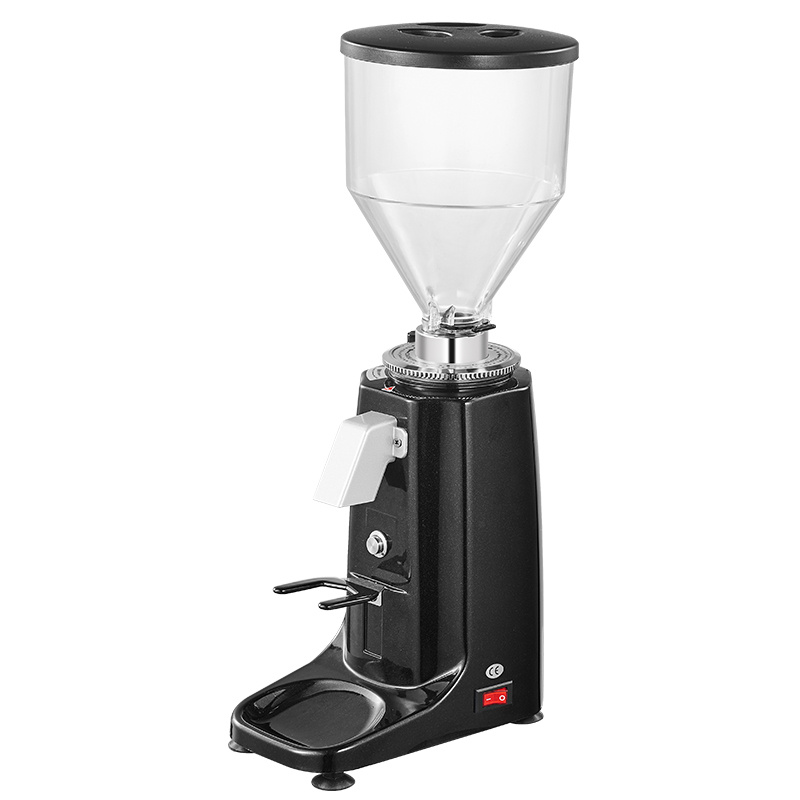
The commercial grinders we supply — the 60 mm YS-020/021 series, the 64 mm YS-900 series, a 74 mm model and the flat-burr YS-C98pro — are timed on-demand grinders; the adjustment mechanism varies by model, so ask us which system a given grinder uses before you decide on it for a multi-method bar. Whichever it is, it ships with the collar at a factory position and is re-zeroed at installation on your coffee, and a written scale from day one is the habit that makes it hold across a shift.
FAQ
What is the difference between stepped and stepless grinders?
A stepped grinder's adjustment collar clicks into fixed positions, each moving the burrs a set distance; a stepless collar turns freely on a fine thread so any burr gap is available. Stepless gives finer control for espresso; stepped gives a numbered setting you can return to.
Is stepless better for espresso?
For finding the exact setting, yes: espresso responds to a few tens of microns of burr gap and a stepless collar can land anywhere. A stepped grinder with fine micro-steps gets equally close and adds a bookmark. Burr quality and retention matter more to the cup than either.
How do you keep a stepless grinder setting consistent between baristas?
A written scale: a fixed reference mark on the body, a numbered ring or tape on the collar, and the current number recorded whenever it changes. Without it each barista re-dials from memory and the setting drifts through the week.
What is micrometric adjustment?
A fine-thread stepless mechanism that moves the burrs by very small amounts per degree of collar rotation; it became the standard on commercial espresso grinders after the original patent expired and is what most stepless collars are.
Do I need to re-zero a grinder after changing burrs?
Yes, for both types. New burrs sit at a different height, so the old click number or mark no longer corresponds to the same gap. Find the point where the burrs just touch with the motor running, set that as zero, and re-dial from there.
How do you adjust a commercial grinder?
Start from a known dose and shot time, move a small amount — one click or a few millimetres of collar — with the motor running where the maker specifies, purge a dose, pull a shot, and repeat in one direction until the target is bracketed, then halve the move. Record the setting every time.
Final Thoughts
Stepless finds the setting; stepped remembers it; a written scale and a re-zero after every burr change make either hold across a shift. As a wholesale supplier of commercial coffee grinders we will tell you which mechanism a model such as the YS-C98pro uses before you buy, and which suits a bar that grinds for more than espresso.
Get a quote or message Leon on WhatsApp at +86 184 0771 4607.
Get a Quote → WhatsApp +86 184 0771 4607Last updated: September 23, 2026
Pingback: How to Dial In an Espresso Grinder: Café Procedure