
Burr diameter is the first specification on every commercial grinder and the one most used as a proxy for everything else: bigger must be faster, cooler, better. Two of those are roughly true within a model family; none is a reason to buy on diameter alone. This guide explains what espresso grinder burr size changes, sizes a grinder from your café's own peak hour rather than a marketing tier, and says plainly where the 60–74 mm grinders we supply fit.
What burr diameter changes — and what it does not
A larger flat burr has more cutting edge per revolution, so at the same motor speed it grinds a dose faster and each bean spends less time in the chamber. That is the whole physical story; everything else follows from it or from the rest of the grinder.
| Property | Effect of a larger burr | Caveat |
|---|---|---|
| Speed per dose | Faster — a double that takes 8–12 s on a 64 mm grinder takes roughly 4–7 s on an 83 mm | Only within similar burr geometry and motor speed |
| Heat at the burrs | Lower peak temperature at volume, because grinding time per dose is shorter | Chamber design, motor and rpm matter as much |
| Motor | Needs more torque — larger burrs sit on 400–800 W motors where 64 mm units run 200–400 W | Watts are a consequence, not a quality |
| Particle distribution | Slightly tighter on well-made large burrs | The difference is small; geometry and alignment dominate |
| Retention | Often higher — more chamber volume | Depends entirely on the exit path design |
| Replacement burrs | More expensive and specific to the model | Diameter alone does not make burrs interchangeable |
| Price | Higher | — |
What diameter does not tell you: cups per hour. Two 64 mm grinders with different burr geometry, motor and feed can differ in throughput by more than a 64 versus a 75 mm from the same maker. Shortlist by the job, then confirm the model by testing it with your dose and your beans.
The tiers the trade uses
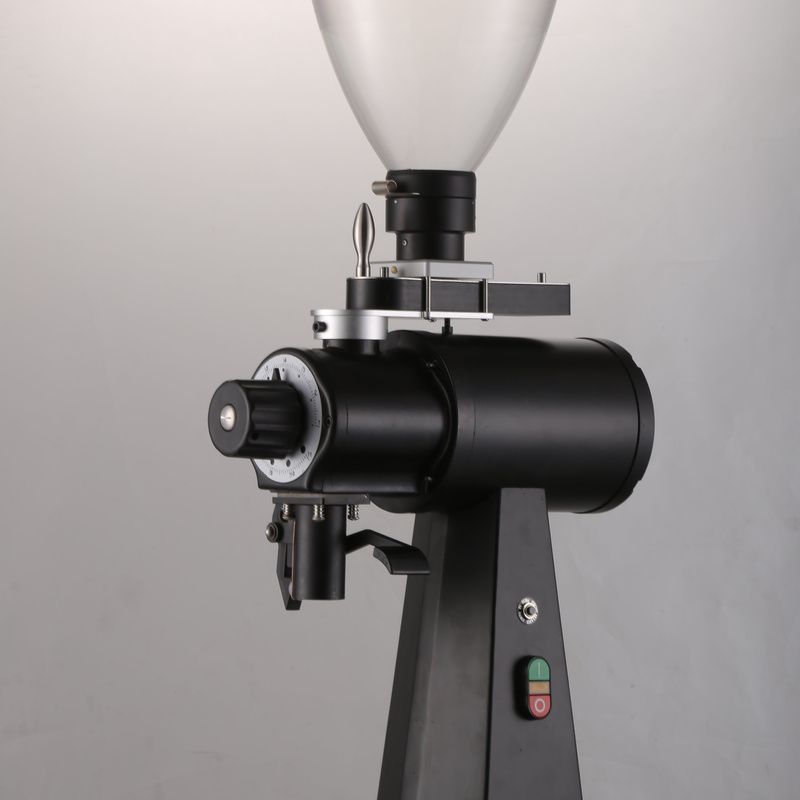
Dealers and manufacturers converge on three bands, and they are useful as a first sort:
| Burr class | Typical positioning | Daily shot volume commonly quoted |
|---|---|---|
| 60–64 mm | Entry and mid commercial: small cafés, restaurants, hotels, second grinders | Up to roughly 150 shots a day |
| 74–75 mm | Mainstream commercial: independent cafés, small chains | Roughly 150–500 shots a day |
| 83 mm and above | High-volume bars, training centres, flagship stores | 500 shots a day and up |
The bands overlap because they are describing whole grinders, not burrs. A well-engineered 64 mm grinder serves a café doing 100–150 shots without strain; an 83 mm grinder on a 40-shot day is heat and money spent on nothing.
Sizing from your own peak hour
Daily volume is the wrong unit — a café that sells 300 drinks a day may sell 80 of them between eight and nine. Work from the peak.
- Peak-hour espresso shots. Count doses, not drinks: a double basket is one dose. Suppose 70 in the peak hour.
- Seconds per dose to grind. From the tiers above: about 10 s on a 64 mm grinder, about 7 s on a 75, about 5 s on an 83.
- Grinding minutes in the peak hour = shots × seconds ÷ 60. At 70 shots: 11.7 min on 64 mm, 8.2 min on 75, 5.8 min on 83.
- Duty cycle = grinding minutes ÷ 60. That is 19%, 14% and 10%.
Interpret it with two rules. First, the grinder is a bottleneck only when its grinding time plus the barista's handling time per dose exceeds the drink interval — at 70 shots an hour the bar has about 50 seconds per dose, and even the 64 mm grinder uses a fifth of it. Second, heat follows duty cycle: a grinder that runs 10–15% of the hour cools between doses; one that runs 40% does not. Manufacturers state a continuous-run or duty-cycle limit for commercial grinders — respect it rather than the burr size.
By that method, a 64 mm grinder is comfortable to about 100–150 peak-hour-heavy days, a 74–75 mm grinder to a few hundred, and 83 mm earns its place when the peak hour itself passes roughly 100 doses or the bar grinds continuously.
The rest of the grinder
Three things change throughput and heat as much as diameter.
Motor speed. Lower-rpm grinders — our 64 mm YS-900 series and the 74 mm model run at 1450 rpm — grind a little slower per dose and cooler per revolution; higher-rpm grinders — the 60 mm YS-020 series at 2000 rpm and the flat-burr YS-C98pro at 2500 rpm — the reverse. The speed–heat relationship, and what happens when a grinder crosses from 50 Hz to 60 Hz mains, is in coffee grinder rpm and heat.
Burr geometry and material. Cutting-edge profile and coating decide particle distribution and burr life more than diameter does; replacement intervals and what wear looks like are in when to replace grinder burrs.
Dosing system. Timed or grind-by-weight, and how well the chute clears — the consistency question is in grind-by-weight vs grind-by-time.
Where our range fits, honestly
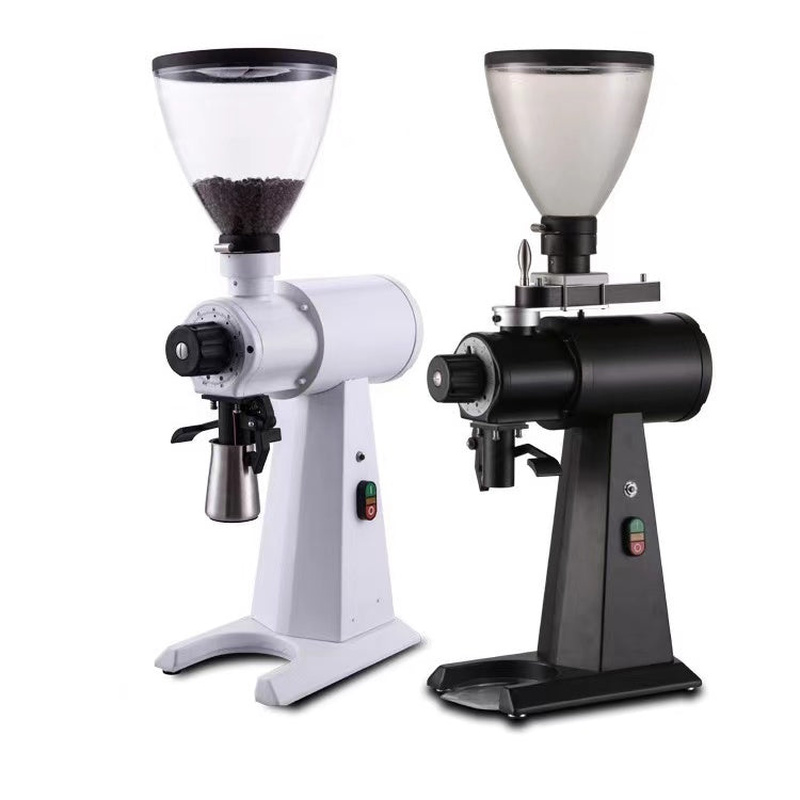
The commercial grinders we supply cover 60 mm flat burrs (YS-020/021, YS-018/019, YS-022), 64 mm flat burrs (YS-900N/A/E), a 74 mm flat-burr model with a 1.5 kg hopper, and the flat-burr YS-C98pro, with hopper capacities from about 1 to 1.5 L. That places them in the first two bands — cafés, restaurants and hotels up to a few hundred shots a day, and second grinders for decaf or a single origin on busier bars.
We do not supply an 83 mm grinder. A bar whose peak hour passes about 100 doses, or that grinds continuously through service, should buy in that class from a maker that builds it, and we will say so when asked. What we can size correctly is the majority of cafés below that line, and the second grinder every busy bar needs — the case for it is in how many grinders does a café need.
A short buying checklist
- Count peak-hour doses, not daily drinks.
- Run the seconds-per-dose calculation and check the duty cycle against the manufacturer's limit.
- Test the shortlisted model with your beans, your dose and your portafilter, and watch it for fifteen busy minutes.
- Ask for the burr replacement price and interval, and whether the burrs are model-specific.
- Buy the second grinder for decaf before buying a bigger first one.
FAQ
What burr size is best for an espresso grinder in a café?
For most independent cafés — up to a few hundred shots a day with a peak hour under about 100 doses — a 64 to 75 mm flat burr. Bars whose peak hour passes 100 doses or that grind continuously are 83 mm territory. Size from the peak hour, not from daily volume.
What is the difference between 64 mm and 83 mm burrs?
Cutting edge per revolution: an 83 mm set grinds a double in roughly 4–7 seconds where a 64 mm takes 8–12, runs cooler at volume because each dose is shorter, and needs a larger motor. In the cup the difference is small at low volume; at high volume the 83 mm holds consistency longer.
How many shots per day can a 64 mm grinder handle?
Trade guidance puts a well-built 64 mm grinder at up to roughly 150 shots a day comfortably, and the limit is really the peak hour: at 70 doses in an hour it runs about a fifth of the time and cools between doses. Check the manufacturer's duty-cycle limit rather than the diameter.
Is a 75 mm burr grinder a good middle ground?
Yes — it is the class most dealers describe as the mainstream commercial choice, covering roughly 150–500 shots a day: faster than 64 mm in the rush, without the motor, footprint and price of 83 mm. Our 74 mm model with a 1.5 kg hopper sits in this band.
Does a bigger grinder motor mean better coffee?
No. Motor wattage follows burr size — larger burrs need more torque — and says nothing about grind quality on its own. Burr geometry, alignment, speed and the chute decide the cup; the motor decides whether the grinder keeps up and stays cool in the rush.
Do you supply 83 mm grinders?
No. Our commercial range covers 60, 64 and 74 mm flat burrs for cafés up to a few hundred shots a day and for second grinders on busier bars. If your peak hour passes about 100 doses, we will say so and point you to the 83 mm class.
Final Thoughts
Size the grinder from the peak hour — doses, seconds per dose, duty cycle — and treat burr diameter as a category, not a verdict. As a wholesale supplier of commercial coffee grinders in the 60–74 mm classes, including the flat-burr YS-C98pro, we will tell you when your bar has outgrown them.
Get a quote or message Leon on WhatsApp at +86 184 0771 4607.
Get a Quote → WhatsApp +86 184 0771 4607Last updated: September 23, 2026
Pingback: 64 mm Flat Burr Single-Dose Grinder: Why It Won, How to Buy | Yoshan