
A mobile coffee bar runs on whatever electricity and water it brings with it, and that changes the machine question completely. In a café the supply is a given; on a cart the supply is the first decision and the machine the second. This guide covers power, water and drainage for a mobile set-up, then which espresso machine suits which mobile business — including where a full commercial machine is the wrong choice.
Start with power, because it decides the machine
An espresso machine is a heater, and heaters draw current. A two-group commercial machine such as the ones we supply runs at 3.6–4.2 kW; a commercial grinder adds up to 1.5 kW; a fridge, lights and a water pump add more. A mobile bar with a two-group machine and a grinder can peak at 6 kW or above.
That figure has to come from one of three places.
Shore power. A fixed pitch, market stall or event site with a mains hook-up. Check what the connection can supply — a 16 A outlet at 230 V delivers about 3.7 kW, which is not enough for a two-group machine and a grinder together; a 32 A supply is. Ask the site for the amperage before assuming.
A generator. Size it above the peak load with headroom: a 6 kW peak wants a generator of 7–8 kW continuous rating, and inverter generators handle heater loads better than cheap open-frame units. Weight, noise and fuel then become part of the cart. Generators also produce a less stable supply than mains; a machine with electronic controls benefits from a small voltage stabiliser between it and the generator.
Gas heating. Some mobile operators use LPG-heated espresso machines to avoid the power problem entirely. Our range is electric, so this route is not one we supply — if a site has no electricity at all and no room for a generator, that is the option to look at elsewhere.
The practical rule: add up every load, then choose the supply before the machine. A machine that draws more than the supply can deliver trips out in the middle of a queue, and it will do it at the busiest event of the year.
Water: feeding a commercial machine from a tank
Commercial machines with rotary pumps are built to draw from a pressurised mains supply, not to suck from a tank. That is not a problem on a cart; it means the water system has to do the mains' job.
A mobile water system for a rotary-pump machine is:
- A fresh-water tank sized for the day. A two-group machine and steam for milk drinks use roughly 20–30 litres for every 100 drinks; a full day at an event needs 60–100 litres, in a food-grade tank.
- A pressure pump between the tank and the machine — a small 12 V or 230 V diaphragm pump with an accumulator that delivers water at a steady 2–3 bar, which is what the machine's rotary pump expects at its inlet. Without it the rotary pump cavitates and the machine either starves or faults.
- Filtration on the line, sized for the water you fill with. Filling from unknown taps at different sites is the mobile bar's version of hard water, and scale kills machines on carts faster than in cafés. See espresso machine water treatment.
- A waste tank at least as large as the fresh tank, plumbed to the drip tray drain — and emptied somewhere legal.
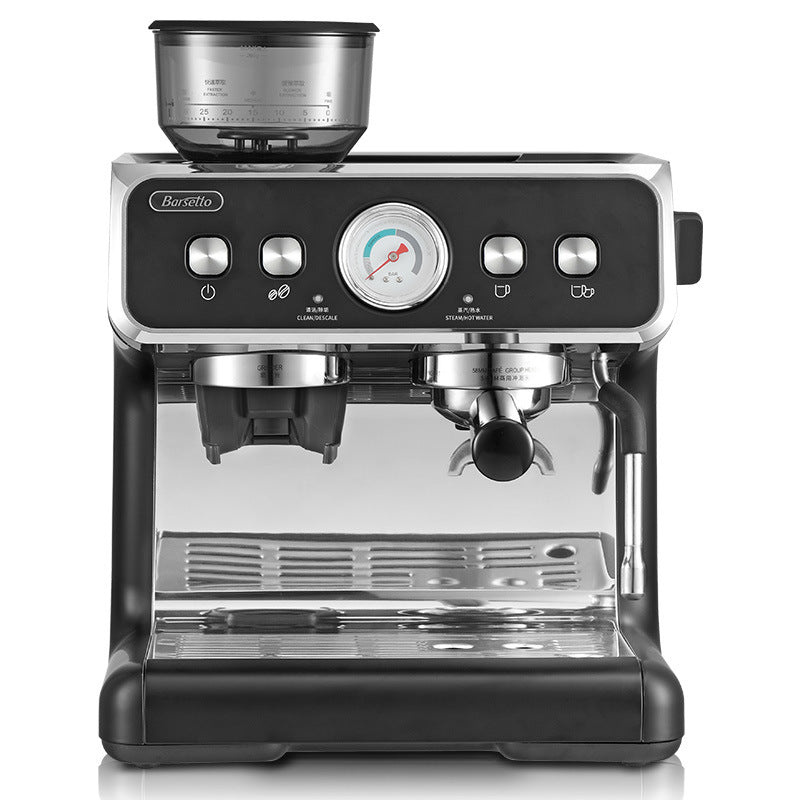
Some smaller commercial machines are built with an internal tank and a vibration pump for exactly this use. They avoid the pressure pump but trade away steam capacity, plumbing, and the smooth pressure of a rotary pump, as covered in rotary pump vs vibration pump espresso machines. Which trade is right depends on the volume, which is the next question.
Which machine for which mobile business
Mobile coffee is several different businesses, and they need different machines.
Occasional events and low volume — a few dozen drinks a day. A compact one-group or a small two-group with an internal tank and vibration pump, running from a modest generator or a single outlet. Light, simple, self-contained. It will not keep up with a queue and it is not meant to.
A regular pitch or market — 100 to 250 drinks a day, milk-heavy. This is where a full commercial two-group belongs. The volume justifies the power and water system, and the steam boiler is what keeps the queue moving: the machines we supply carry a 550 ml brew boiler and a 7 L steam boiler, which is café steam capacity, on a rotary pump fed by a pressure pump from the tank. This configuration needs shore power at 32 A or a generator of 7–8 kW. Our YS-3120 two-group, at 82 cm wide, 50 cm deep and 42 kg, is the size most trailer and truck counters are built around; see espresso machine steam boiler size for why the steam side decides.
A food truck with a fixed kitchen supply. Effectively a small café on wheels, with a permanent generator or a large shore connection and a plumbed water system with tanks. Treat it as a café installation — the installation requirements apply — and choose the machine by volume as a café would.
Where a full commercial machine is the wrong choice: a lightweight cart towed to weekend events with a small generator, a business doing forty drinks a day, or a site with a single 13–16 A outlet. Put a 4 kW machine on that supply and it will trip. In that situation a tank machine is right, and the volume does not need the steam capacity anyway.
Mounting, space and weight
A commercial two-group is around 40–55 kg empty and heavier full. On a trailer or truck it has to be secured against movement — bolted to the counter or strapped to fixed points — and the counter has to carry it while the vehicle moves. Leave working clearance as you would in a café: room behind for connections and heat, room at the side for the grinder, and a cut-out beneath for water, waste and power lines.
Height matters on a vehicle. A machine with cups on top may not clear the serving hatch; check the machine's height plus cups against the hatch opening before ordering.
Voltage and frequency on the road
Mobile operators sometimes trade across borders or buy a machine abroad. The machine's voltage and frequency are fixed at build — the machines we supply are 220–240 V 50 Hz — and a generator has to produce the same. Most mid-size generators are available in either, but not both. Confirm before buying either the machine or the generator; the country picture is in commercial espresso machine voltage and power requirements.
A mobile bar checklist
- Total peak load in kW: machine + grinder + pump + fridge + lights.
- Supply: shore amperage confirmed, or generator continuous rating with 20–30% headroom.
- Fresh tank litres for the day; pressure pump and accumulator; filtration; waste tank of equal size.
- Machine secured; counter rated for the weight; hatch clearance checked.
- Voltage and frequency of machine, generator and grinder all matching.
- A daily water-quality routine, since every site's tap is different.
FAQ
What size generator do I need for an espresso machine on a coffee cart?
Add up the peak load — a two-group commercial machine at 3.6–4.2 kW, a grinder at up to 1.5 kW, plus pump, fridge and lights — and choose a generator with 20–30% headroom above it: typically 7–8 kW continuous for a two-group set-up. Inverter generators handle heater loads better and give a cleaner supply for electronic controls.
Can I run a commercial espresso machine from a water tank?
Yes, with a pressure pump. Rotary-pump commercial machines expect water at around 2–3 bar at the inlet, which mains provides and a tank does not. A small diaphragm pump with an accumulator between the tank and the machine supplies that pressure. Add filtration, since fill water varies by site.
How much water does a mobile coffee bar use?
Roughly 20–30 litres per 100 drinks on a two-group machine making milk drinks, including steam and flushing. A full event day needs 60–100 litres of fresh water and a waste tank at least as large. Food-grade tanks, filled from a known source, with a filter on the line.
Is a two-group machine too much for a coffee cart?
For a low-volume or event cart on a small generator, yes — the power draw trips the supply and the steam capacity goes unused. For a regular pitch doing 100 to 250 milk drinks a day with 32 A shore power or a 7–8 kW generator, a two-group with a large steam boiler is what keeps the queue moving.
Do I need a special espresso machine for a food truck?
Not usually. A truck with a permanent generator or large shore connection and a tank-based plumbed water system is a small café; a standard commercial two-group with a rotary pump works, mounted securely and with the same installation requirements. The special cases are very small carts and sites with no power.
How do I secure an espresso machine in a vehicle?
Bolt it to the counter through its feet or strap it to fixed anchor points, with the counter built to carry 40–55 kg plus water while moving. Leave clearance for connections and heat, and check that the machine plus cups clears the serving hatch before choosing the model.
Which voltage should a coffee cart machine be?
The same as the supply it will run from. The machines we supply are 220–240 V 50 Hz; the generator or shore connection must match both voltage and frequency, since they are fixed at build. Confirm the country's standard and the generator's output before ordering either.
Final Thoughts
On a mobile bar, size the power first, build the water system to feed the pump, and then choose the machine for the volume you actually serve. As a wholesale supplier of commercial coffee machines, we supply the two-group YS-3120 and its siblings that regular pitches and trucks are built around, and we will tell you plainly when a smaller machine is the better fit.
Request a quote or message us on WhatsApp at +86 184 0771 4607.
Get a Quote → WhatsApp +86 184 0771 4607Last updated: September 17, 2026
Pingback: Tank vs Plumbed Espresso Machine: Choose by the Site, Not the Spec