
Most tank vs plumbed espresso machine articles are written for a kitchen counter: refill convenience against the cost of a plumber. For a business the decision runs the other way. The site — a fixed café, a cart, a market stall, a mall kiosk with no water point — decides which feed the machine can have; only then do pump and filtration matter. This guide takes the site first, then the installation each option needs, then whether a tank machine can be plumbed later.
What the two feeds actually are
Plumbed in. A braided line from a shut-off tap under the bench to the machine's inlet. The machine's pump draws from mains pressure; the boiler auto-fills; used water leaves through a drain hose to a waste point. Nobody touches water all day.
Tank-fed. A reservoir inside the machine, filled by hand. The pump draws from the tank; the drip tray is emptied by hand or piped to a drain. The machine can sit anywhere there is a power socket.
A commercial two-group draws water constantly — a busy bar can move tens of litres in a morning — which is why plumbed is the default for a fixed café. Tank machines exist for the sites where a line is impossible.
Choose by the site
| Site | Water point within reach? | Drain within reach? | Feed | Why |
|---|---|---|---|---|
| Fixed café, bar in place | Yes | Yes | Plumbed | Volume, no refilling, drain handles waste |
| Café in a rented unit, bar may move | Yes, with work | Yes | Plumbed, with a flexible line and a shut-off | Plumbing cost is small against the labour saved |
| Coffee cart, trailer, market stall | No | No | Tank | Portable; water carried in containers |
| Mall kiosk / island counter | Often no | Often no | Tank, or plumbed to a nearby service riser if the landlord allows | Depends on the fit-out |
| Event, pop-up, catering | No | No | Tank | Set-up and strike in an hour |
| Office, hotel breakout | Sometimes | Sometimes | Either; plumbed for 20+ people | Refilling is somebody's job |
The rule: if the machine will stand in one place for years and a water point can be reached, plumb it. If the machine moves, or the site has no water point, tank. Everything else — pump type, filtration, drain — follows from that.
What a plumbed installation needs
Four items, each a common source of trouble when skipped.
A pressure regulator. Mains pressure is often far above what the machine wants. Installers commonly work to an inlet of no more than about 40 psi (roughly 2.8 bar); higher pressure can push past internal valves and cause leaks or over-filling. A regulator on the inlet line is standard, with a gauge so the fitter can set it.
A filter or softener sized to the water. Scale is the main killer of commercial machines; the cartridge on a plumbed line removes hardness and chlorine and is replaced on a schedule — commonly every four to twelve months depending on water and volume. Choose the treatment by the site's water chemistry, not by habit; the options are in espresso machine water treatment.
A shut-off tap within reach, so the line can be closed for service or a leak.
A drain the hose can reach with a continuous fall — a common rule is about 25 mm of drop per 300 mm of horizontal run — so the tray does not back up.
The machines we supply for plumbed sites are rotary-pump: the two-group YS-3120 with an American Procon pump, the volumetric YS-3201, and the three-group SD-103, all rated 9 bar and all direct-connection. Rotary pumps are the type that works with a pressurised inlet; the difference from vibration pumps is in rotary vs vibration pump espresso machines. Bench cut-outs, circuit sizes and clearances are in commercial espresso machine installation requirements.
What a tank machine needs
Less, but not nothing.
Water that will not damage the machine. Never distilled, purified or reverse-osmosis water on its own: it is corrosive to boilers and fittings, and on machines with a level probe it can fail to register, so the boiler over-fills. Use filtered tap water of moderate hardness, or remineralised water, and an in-tank softener cartridge if the local water is hard — recharged and replaced on the supplier's schedule.
A refilling routine. On a busy cart the tank needs topping up every ten to fifteen drinks; assign it, or the low-water cut-out will stop the machine mid-queue.
Tank hygiene. Empty and rinse the tank at close, clean it fully every couple of weeks, and seat it correctly after every refill so the pump does not draw air.
A drip-tray plan. Emptied by hand, or piped to a container under the counter.
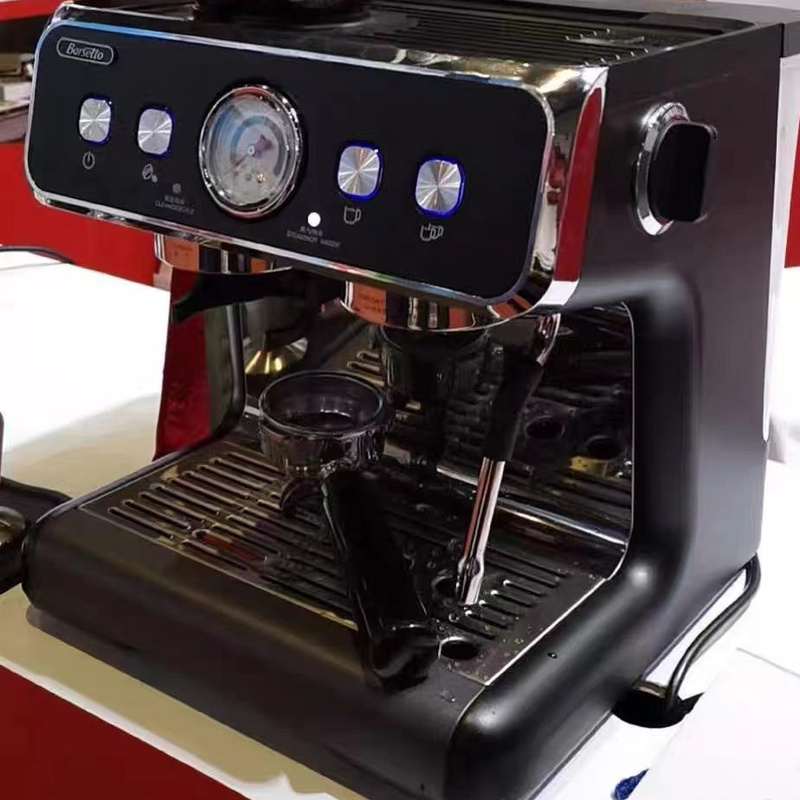
The tank machine we supply is the two-group YS-Tank: a stainless two-group with an Italian 9 bar rotary pump, two 500 ml brew boilers and a 9 L steam boiler, 4.2 kW, at USD 1,399 EXW Shenzhen, USD, 2026 for one unit, 1,359 for two or more and 1,299 for ten or more, shipped in stock within 7–15 working days. It is designed as a tank machine from the start — the reservoir, the pump inlet and the level control are built for it — which is what makes it suitable for a cart or a kiosk, and the reason for the next question.
Can a tank machine be plumbed in later?
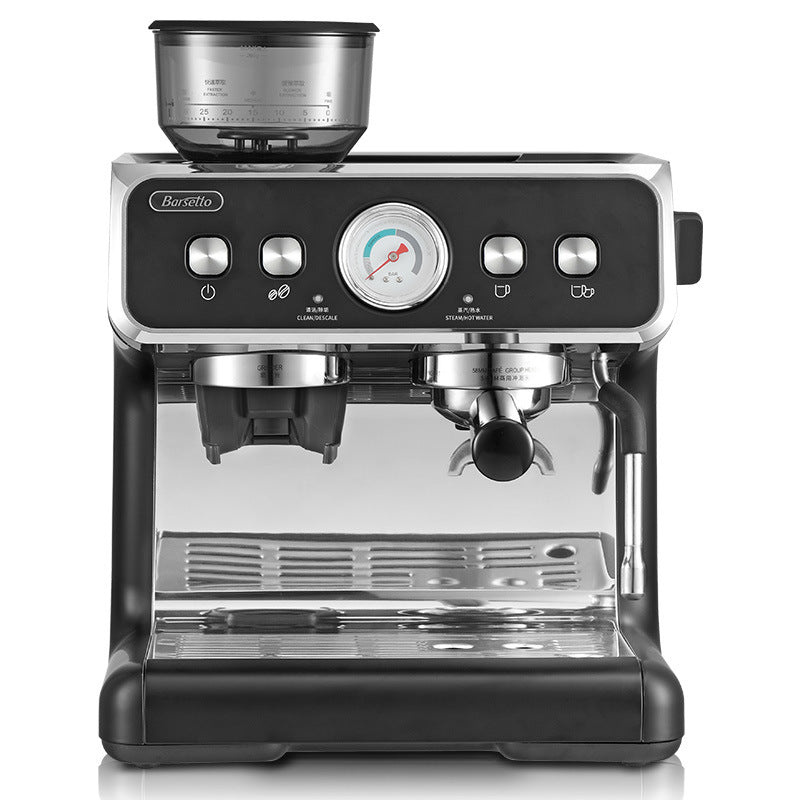
Ask the supplier of the specific machine, and do not assume. Some prosumer and commercial machines are built switchable, with an inlet fitting behind a panel and a valve to select tank or mains; others are tank-only by design. Plumbing a machine that was not built for a pressurised inlet risks flooding it. If a site might gain a water point later — a kiosk that will become a shop — the safer purchase is a switchable machine or a plumbed machine from the start; for the YS-Tank, contact us before ordering and we will confirm how it can be configured for your site.
The reverse is simpler: a plumbed rotary-pump machine cannot run without its line, so a café that plans to move the bar for events needs a second, tank-fed machine rather than a conversion. The full cart set-up — generator, water containers, tank machine — is in espresso machines for coffee carts and food trucks.
The electrical side is the same for both
Tank or plumbed, a two-group commercial machine is a 3–4.5 kW appliance — the YS-3120, YS-3201 and YS-Tank are all 4.2 kW at 220–240 V — and needs its own circuit. On a cart that circuit comes from a generator or shore power; in a café from the board. Tell us your country's voltage, frequency and plug before ordering, so the machine ships built for it.
FAQ
Should a café espresso machine be plumbed in or tank-fed?
A fixed café with a water point within reach should be plumbed: a two-group moves too much water for hand-filling, and the drain removes waste automatically. Tank machines are for carts, stalls, kiosks and events where there is no water point or the machine moves.
What water pressure does a plumbed espresso machine need?
Installers commonly set the inlet at no more than about 40 psi (2.8 bar) with a pressure regulator on the line; mains pressure is often much higher and can push past internal valves. The regulator, a shut-off tap and a filter cartridge are the standard trio on the inlet.
Do plumbed espresso machines need a water filter?
Yes. An inline filter or softener sized to the site's water chemistry removes the hardness that scales boilers, with the cartridge replaced roughly every four to twelve months depending on water and volume. Choose the treatment by the water, not by habit.
Can you use distilled water in a tank espresso machine?
No. Distilled, purified or reverse-osmosis water is corrosive to the boiler and fittings, and on machines with a level probe it may not register, so the boiler over-fills. Use filtered tap water of moderate hardness or remineralised water, with an in-tank softener where water is hard.
Which espresso machine works on a coffee cart?
A tank-fed machine with a rotary pump and enough boiler for the queue — the two-group YS-Tank we supply, for example, at 4.2 kW on a generator or shore power — with water carried in containers and the tray emptied by hand.
Can a tank espresso machine be plumbed in later?
Only if it was built switchable, with a mains inlet and a selector valve. Plumbing a tank-only machine risks flooding it. If a water point may arrive later, buy a switchable or plumbed machine now, or confirm the configuration with the supplier before ordering.
Final Thoughts
Let the site choose the feed: plumbed with a regulator, filter, tap and drain for a bar that stays put; tank-fed for anything that moves or has no water point. As a wholesale supplier of commercial coffee machines, we stock both — the plumbed YS-3120, YS-3201 and SD-103, and the tank-fed YS-Tank in package deals with grinder and tools — shipped within 7–15 working days.
Get a quote or message Leon on WhatsApp at +86 184 0771 4607.
Get a Quote → WhatsApp +86 184 0771 4607Last updated: September 23, 2026
Pingback: Pre-Infusion on Commercial Espresso Machines: Types & How to Test
Pingback: How to Move a Commercial Espresso Machine Safely
Pingback: Espresso Brew Pressure: What 9 Bar Means & How to Check It