
If you are weighing gas vs electric coffee roasters for a commercial operation, you are at one of the first forks — and the honest answer is that up to about 3 kg your building decides it, not your preference, and above that gas decides itself. Here is how each type heats the coffee, a side-by-side that reflects the machines we actually build, when electric is the right call, and what each costs to heat a kilo.
How Each Type Works
Gas coffee roasters use natural gas or LPG burners to generate heat. The drum rotates while hot air and direct or indirect flame roast the beans. This is the technology used by all major commercial brands — Probat, Giesen, Loring — and by Yoshan’s SD and YS series.
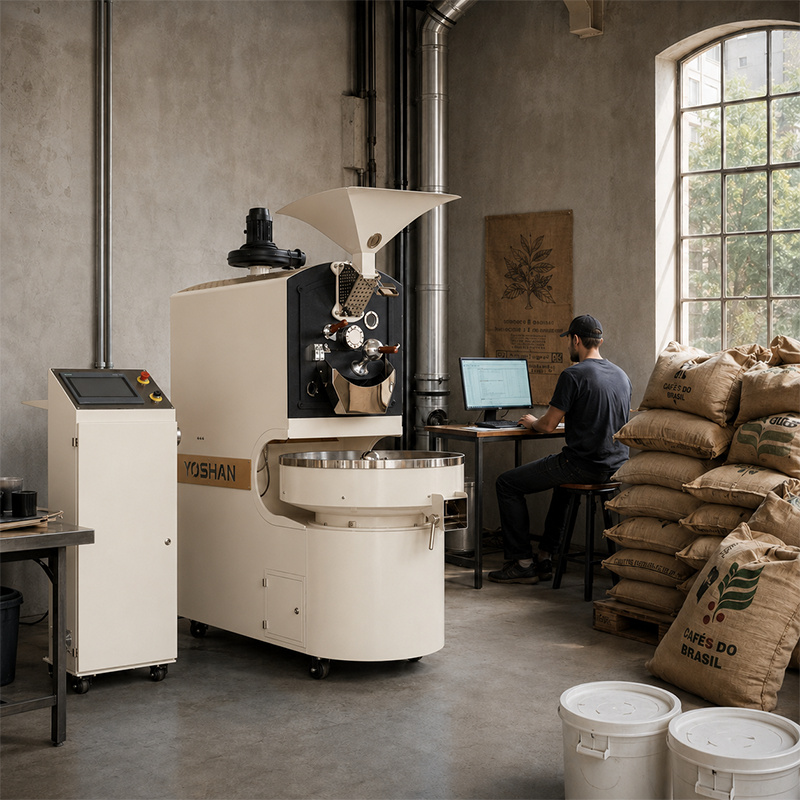
Electric coffee roasters use heating elements to generate heat. They are quieter, need no gas supply and no gas fitter, and are easier to install. In our range the electric build is the same machine as the gas one on the DY-1 and DY-2 (a 4.4 kW element) and available on the SD-1.5 and SD-3; the EC-500G is the electric sample roaster for lab and profile work.
Gas vs Electric: Side-by-Side Comparison
| Feature | Gas Roaster | Electric Roaster |
|---|---|---|
| Heat output | High — 1 kg to 300 kg batches | Competitive up to about 3 kg; above that the element load needs three-phase |
| Heat response | Immediate — the burner turns up and down in seconds | Slight lag; smoother, forgiving curves |
| Energy cost | A few cents per kilo of green | A few cents per kilo — slightly more where power is dear |
| Installation | Gas line or cylinder, licensed fitter, ventilation | Dedicated circuit from an electrician, ventilation; no gas fitter |
| Roast profile flexibility | High — fast heat adjustment | Moderate — slower thermal response |
| Commercial scale | Yes — up to 300 kg per batch | Yes, to about 3 kg — cafes, training rooms, malls |
| CE certification | Yes (Yoshan SD and YS series) | Yes (Yoshan EC-500G) |
When to Choose a Gas Roaster
- You are roasting more than about 3 kg per batch
- You want precise roast profile control for specialty coffee
- You need to scale production over time
- You are setting up a roastery, cafe supply operation, or industrial plant
- You want the lowest energy cost per kilogram roasted
Gas roasters dominate the professional market because they offer faster heat adjustment, higher capacity, and lower running costs at scale. Yoshan’s SD Series and YS Series both use precision gas burners with digital PLC control.
When to Choose an Electric Roaster
- You are roasting samples or doing quality control work
- You have no gas supply at your location
- You need portability — trade shows, pop-ups
- You run a cafe, training room or mall unit roasting up to 3 kg batches where gas is not allowed or not worth the fitter
The DY-2 electric build at USD 3,399 is the cafe machine for this case — 1.5–2 kg batches on a dedicated single-phase circuit — and the EC-500G at USD 1,699 is the electric sample roaster for green buyers and quality labs.
Running Costs: Gas Wins at Scale
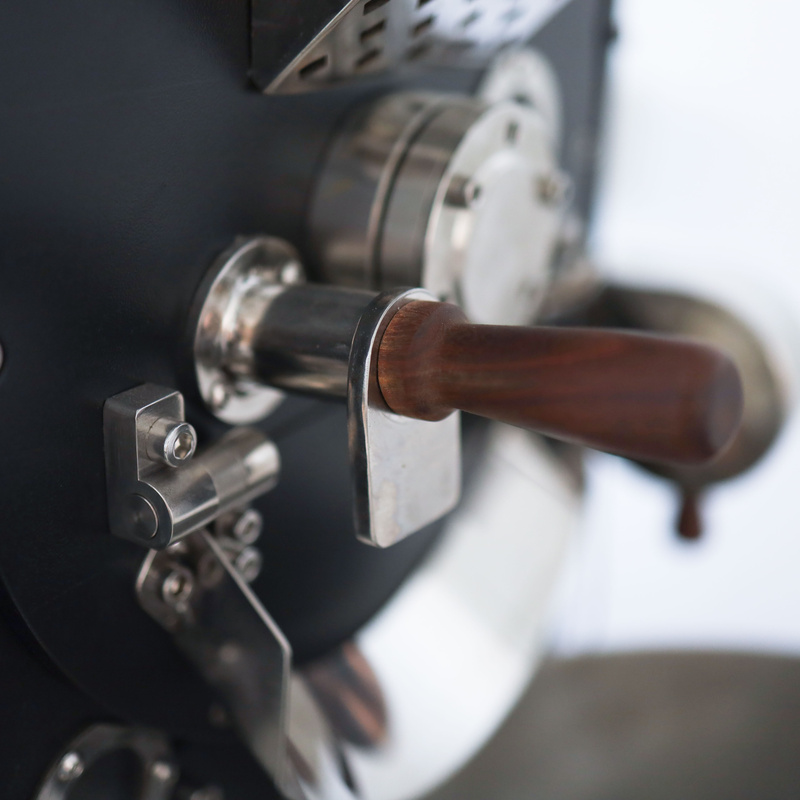
For commercial production gas wins on cost per kilo, and the gap widens with size, because a burner delivers heat more cheaply than an element in most markets. At 1–3 kg the gap is cents; at 12 kg and up it is a real line, which is one reason electric heating is not offered at that scale.
What About Installation?
Gas roasters need a gas line or cylinder connected by a licensed fitter, a flue — and an afterburner or filter where your rules require — and adequate ventilation. We provide installation drawings for every machine.
Electric roasters are simpler — a dedicated circuit from your electrician and a duct — but not "plug in": a 4.4 kW element is more than a wall socket delivers. The trade-off is the batch ceiling of about 3 kg.
Yoshan’s Recommendation
For anyone roasting above about 3 kg — roasteries, traders, industrial buyers — we recommend a gas drum roaster. The YS Series with Siemens PLC is our most popular choice for buyers who want modern automation. The SD Series suits buyers who prefer a Probat-style design with optional full automation.
For a cafe under 3 kg in a building without gas, the electric DY-2 or SD-3 build is the right tool; for sample testing and quality control, the EC-500G.
What Each Costs to Heat a Kilo
Because the DY-1 and DY-2 come in both builds at the same price — USD 2,599 and 3,399 — the fuel question is purely about your building, but buyers still ask what each costs to run. On a 1.9 kg batch in a DY-2:
| Per batch | Per kilo of green | At typical prices | |
|---|---|---|---|
| Electric (4.4 kW element cycling over 13 minutes) | ~0.6–0.7 kWh | ~0.35 kWh | USD 0.05–0.10 at 0.15–0.30 per kWh |
| Gas (about 0.2 kg LPG an hour) | ~45 g LPG | ~25 g | USD 0.04–0.08 at typical bottled-gas prices |
Heating a kilo of coffee costs less than the bag it goes into on either build; the difference over a year of two afternoons a week is well under a hundred dollars. The running costs guide has the full tables by machine size, and the 2 kg guide works the same sum for that class.
Frequently Asked Questions
Can I switch a machine from electric to gas later?
On the DY series the two builds share the body but not the heating assembly, so a change means fitting a burner, gas train and the associated controls — a factory job rather than a field conversion, and usually more than the price difference you saved. If gas may come to your building later, buy the gas build now and run it on cylinders; if it will not, buy electric and stop worrying about it.
Does electric heating change the cup?
A little, and not for the worse: an element delivers steady, gentle heat, so the drying phase runs slightly slower and the curves are smoother and more forgiving, which is why training rooms like it. What you give up is the burner's instant response for fast profile changes. Most drinkers cannot tell the two apart from the same drum; a roaster chasing very specific light profiles will notice the lag.
Which electric machine for a cafe in a shopping mall?
The DY-2 in its electric build, USD 3,399: 1.5–2 kg batches, a 4.4 kW element on a circuit your electrician installs, and the colour and logo that landlords tend to ask for. You still need a 150 mm duct to outside air and a ventilation plan for the landlord — the ventilation guide has the sizing.
Do I need three-phase for an electric roaster?
Not at 1–2 kg — the 4.4 kW element runs on a dedicated single-phase circuit. From about 3 kg the element load grows past what a single-phase circuit handles comfortably, and electric builds of the SD-3 and above are specified with three-phase where the building has it. Tell us what comes into the building and we build to it; the voltage guide lists what to send.
Is the electric roaster slower per batch?
Slightly, in warm-up more than in the roast: an element takes longer to bring the drum to charge temperature from cold, and recovers between batches a little slower than a burner. Once the machine is hot, the roast cycle is close to the gas build's 12–15 minutes. Plan for one long session rather than several short ones and the difference disappears.
Final Thoughts
Gas vs electric commercial coffee roasters is a question your building answers: with no gas supply and batches under about 3 kg, the electric build is a real machine at the same price; with gas available, or batches above that, the burner wins on response and on cost per kilo. Tell us what comes into your building and what you will roast, and we build the right one. Talk to our engineers.
Get a Quote → WhatsApp +86 184 0771 4607Last updated: September 17, 2026
Pingback: Best Coffee Roaster for Small Business: 2026 Sizing Guide | Yoshan
Pingback: Coffee Roaster for Colombia & Central America: Altitude and 60 Hz
Pingback: 1 kg Coffee Roaster: Three Machines, One Question | Yoshan
Pingback: LPG vs Natural Gas Coffee Roasters: Pressure and Consumption
Pingback: Roasting Coffee Inside a Café: Roaster on the Shop Floor
Pingback: Drum Roaster vs Fluid Bed: Which Fits a Growing Business | Yoshan
Pingback: 5 kg Coffee Roaster: Output, Specs, Price and What to Check | Yoshan
Pingback: Coffee Roaster for Australia & NZ: Circuit, Gasfitter, Border | Yoshan
Pingback: Coffee Roaster for India & South Asia: Power, LPG, Paperwork | Yoshan
Pingback: Types of Commercial Coffee Roasters: Heat Transfer, Source & Scale
Pingback: Coffee Roaster for Ethiopia & East Africa: Voltage, Gas, Ports