
A coffee brand can exist without a roaster. Plenty do, paying a contract roaster per kilogram and spending their own effort on the brand, the customers and the bag. At some volume that stops being the cheaper option — and at some point before that, control over the product starts to matter more than the cost. This guide sets out both sides without pretending the answer is the same for everyone, and gives the arithmetic for finding your own crossover.
What you are really buying from a contract roaster
A contract roaster's price per kilogram bundles several things: the roasting itself, the labour, the use of their machine and premises, their quality control, often their green sourcing, and their packaging line. You pay for all of it on every kilogram, whether you sell fifty a month or five hundred.
That is the structure to understand. Contract roasting is a variable cost with no fixed cost — no machine, no lease, no staff — which is exactly what a new brand wants and exactly what a growing brand eventually resents. The per-kilogram premium over the raw green and roasting cost is the roaster's margin plus their overhead spread across their clients. It does not fall as your volume rises, or not by much.
What you get for it is real: no capital, no permits, no operator to train, a lead time of a few weeks from order to delivery, and someone else's problem when the machine breaks. For a brand that does not yet know its monthly volume, that flexibility is worth the premium.
What owning a roaster really costs
The machine is the number everyone starts with and it is the smallest part of the picture. Owning means:
- The roaster, plus freight, installation and commissioning.
- The site: a space with a flue, gas or three-phase power, and the approvals to roast in it — the full list is in coffee roastery startup costs.
- Ancillary equipment as volume grows: destoner, loader, packaging.
- Labour: someone roasting, someone packing. Even at small volume, roasting is hours a week that were previously spent elsewhere.
- Green coffee bought in bags rather than roasted coffee bought as needed, which means cash tied up in stock.
- Fuel, maintenance, spares and the occasional lost batch.
Almost all of that is fixed: it costs the same whether the machine runs one day a week or five. So owning is the mirror image of contract roasting — high fixed cost, low variable cost — and the two cross at some volume.
Finding the crossover
Put the two structures side by side and the arithmetic is simple.
Contract cost per year = roasted kilograms per year × the premium you pay per kilogram above the cost of the green and the direct roasting inputs. (Use the difference between what the contract roaster charges and what green plus fuel plus packaging would cost you — that difference is what you are paying for their service.)
Ownership cost per year = the annual fixed cost of running your own roastery: the roaster and installation spread over its working life, plus site cost attributable to roasting, plus labour, plus maintenance and spares — minus nothing, because these are incurred regardless of volume.
The crossover is the volume at which the contract premium equals the ownership fixed cost. Below it, contract roasting is cheaper. Above it, owning is.
Where that volume lands depends entirely on the local premium and the local site cost, so no article can give you a number that is yours. But the shape is consistent across the brands we work with:
| Weekly roasted volume | Usual answer |
|---|---|
| Under about 50 kg | Contract roasting, almost always. The fixed cost of a site is not recovered. |
| 50–200 kg | Depends on the premium, the site, and — more often — the non-financial reasons below. |
| Over about 200 kg | Owning, almost always. The contract premium on that volume funds a roastery. |
Run the arithmetic with your own figures before trusting the table. The running cost and payback guides give the ownership side in more detail.
The reasons that override the arithmetic
For many brands the decision is made in the middle band by things that do not appear on the spreadsheet. Three push toward owning; two push the other way.
Control of the profile. A contract roaster roasts your coffee the way you approved — within their tolerance, on their machine, by whoever is on shift. If the brand is built on a particular roast style, or on freshness the customer can taste, the tolerance becomes the product. Owning puts the profile in your hands.
Speed and freshness. Contract lead times of two to six weeks mean roasting to forecast. Owning means roasting to order, which for a subscription or wholesale brand is a competitive difference as well as a stock-holding one.
The story. "Roasted by us" is a claim; "roasted for us" is a footnote. For some brands the roastery is part of what they sell — a reason a roaster on the café floor is worth more than its capacity.
Against those:
Capability. Roasting is a skill and running a roastery is a second business. A brand without someone who wants to learn it should not buy a machine on arithmetic alone.
Uncertainty. A brand whose volume could halve or triple next year is better served by a variable cost until it stabilises.
A middle path that is often the right one
The decision is not always binary. Two hybrid routes come up often:
Start on contract, buy at the crossover. Use the contract roaster to prove the volume, then bring roasting in-house when the arithmetic and the capability are both there. Keep the contract roaster as overflow capacity afterwards — many brands do.
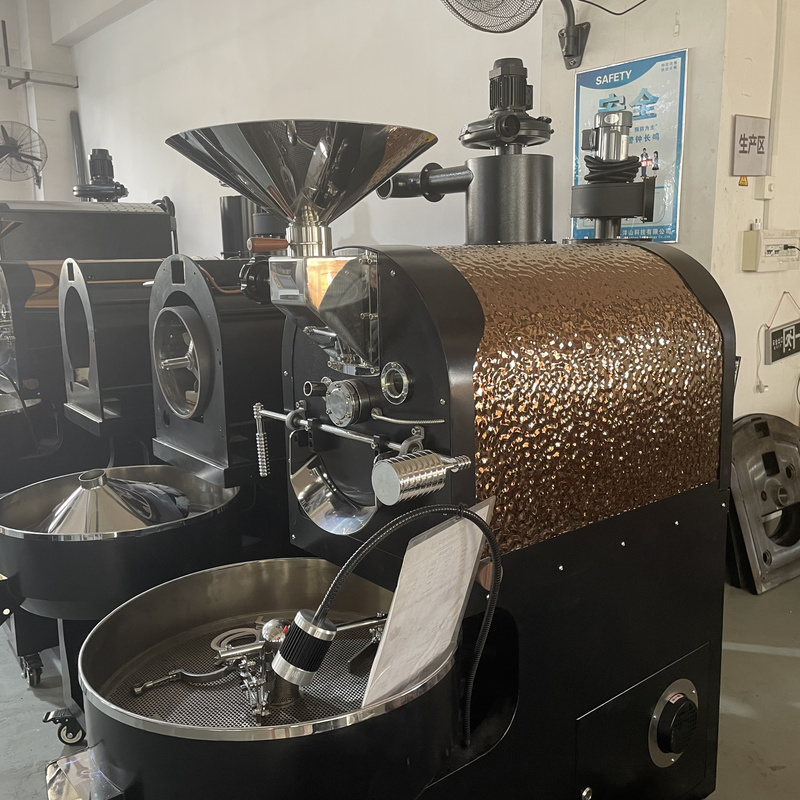
Own a small machine for development and signature coffees; contract the volume line. A 1–3 kg roaster in-house lets a brand develop profiles, roast limited releases and roast the coffee that defines it, while a contract partner produces the volume blend to that profile. It is also the cheapest way to build the capability before the big machine arrives. Our DY series and 3 kg machines are the usual starting point.
If you decide to buy
Size the machine from roasted demand converted to green — see coffee roasting weight loss — and from the twelve-month forecast rather than today's volume. Choose the control level by who will operate it. And budget the site, not just the machine. A brand crossing from contract to owning usually lands on a 6–15 kg machine; our commercial coffee roaster range covers that band with manual, semi-automatic and fully automatic control.
FAQ
Is it cheaper to roast my own coffee or use a contract roaster?
It depends on volume. Contract roasting is a variable cost with no fixed cost; owning is mostly fixed cost. Below roughly 50 kg a week, contract is almost always cheaper; above roughly 200 kg, owning almost always is. In between, run the arithmetic with your local premium and site cost.
What does a contract roaster's price include?
Roasting labour, use of their machine and premises, quality control, often green sourcing and packaging, plus their margin, all spread across every kilogram. The premium above your own green and direct roasting cost is what you pay for the service, and it does not fall much as your volume grows.
At what volume should a coffee brand buy a roaster?
When the annual contract premium on your volume exceeds the annual fixed cost of a roastery — machine, site, labour, maintenance — and when someone in the business is ready to run it. For most brands that is somewhere between 50 and 200 kg of roasted coffee a week.
Can I keep a contract roaster after buying my own machine?
Yes, and many brands do, using the contract partner for overflow, for a volume blend, or for a second location. It removes the risk of buying a machine sized for a peak and keeps the relationship for when volume grows again.
Should a brand buy a small roaster first?
Often. A 1–3 kg machine lets you develop profiles, roast signature and limited coffees, and build the skill, while a contract roaster produces the volume line to your profile. It is the lowest-risk way to move from contract to owning.
What are the non-financial reasons to own a roaster?
Control of the roast profile, roasting to order rather than to forecast, and the ability to say the coffee is roasted by you. Against that, roasting is a skill and a second business, and a brand with volatile volume is better served by a variable cost.
How long does it take to move from contract to in-house?
Plan two to five months from order to first roast for a production machine — build time, sea freight, installation and commissioning — plus whatever site approvals take, which can be longer. Order the machine while the contract roaster is still supplying and overlap the two.
Final Thoughts
Contract roasting is a variable cost; owning is a fixed one. Find the volume where they cross, then let control, freshness and capability decide the middle band. If the answer is to buy, we size the machine from your roasted demand and build it to your site — from a 3 kg development roaster to a full production line in our commercial coffee roaster range.
Request a factory-direct quote or message us on WhatsApp at +86 184 0771 4607.
Get a Quote → WhatsApp +86 184 0771 4607Last updated: September 17, 2026
Pingback: Coffee Roaster ROI and Payback: Fill In Your Own Four Numbers | Yoshan