
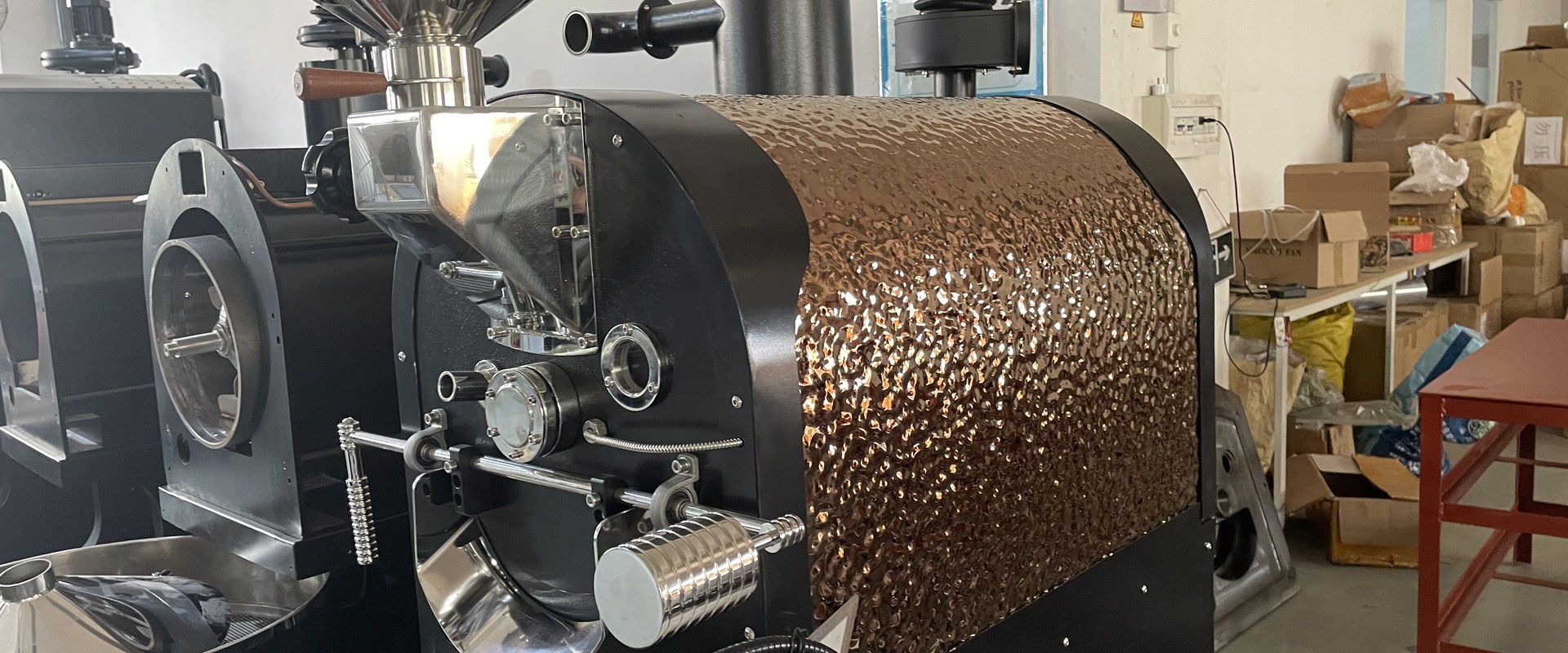
If you have ever heard a stone go round a drum, you already know why a coffee destoner earns its place: green coffee arrives with stones, nails, glass and metal in it, and one of them will chip a drum flight or shatter a set of grinder burrs. Here is how a destoner works, when your roastery genuinely needs one, how to size it to your roaster, and where it sits in the line — with what ours cost.
What a Coffee Destoner Actually Does
A coffee destoner is a densimetric (gravity) separator. Green beans and foreign objects are pulled through the machine on a stream of controlled airflow. Because a stone, a bolt, or a clod of baked clay is far denser than a coffee bean of the same size, the two separate cleanly: the lighter beans are carried up and forward to the outlet, while the heavier debris drops down and out through a reject gate. There is no screen sizing here — a pebble the exact diameter of a bean still gets rejected, because the machine sorts by density and terminal velocity, not by size.
This matters because a screen or sieve alone cannot catch a same-size stone, and a magnet only catches ferrous metal. A gravity destoner catches stones, glass, ceramic, dense mud balls, wood, and both ferrous and non-ferrous metal in one pass. Most roastery lines pair a destoner with a magnet and a screen so each contaminant type has something that removes it.
Where the destoner sits
In a typical line the destoner is installed upstream of the roaster — after the storage silo or bag hopper, feeding a green-bean loader that lifts cleaned beans to the roaster charge door. This protects the roaster from day one. Some cupping labs also run a small destoner on roasted beans before packaging to catch anything introduced during roasting.
What it protects
Every stone you remove is a stone that does not chip a drum flight, wear the bearing seals, dent the cooling tray, or — worst of all — travel downstream and destroy a set of commercial grinder burrs at the café. Burr replacement is one of the most common after-sales questions we get; a destoner prevents most of it.
Does Your Roastery Actually Need One?
Not every roaster needs a standalone destoner, but the threshold is lower than most first-time buyers expect. Use this as a quick decision guide:
-
You roast unwashed or natural-process green from smallholder origins (much of Ethiopia, Yemen, parts of Brazil and Indonesia): high stone and debris risk — a destoner is strongly recommended.
-
You run 12 kg batches or larger, or roast daily as a business: the cost of one drum repair or one bearing failure exceeds the destoner. It pays for itself on prevented downtime alone.
-
You supply a café or wholesale grind: protecting downstream grinder burrs is reason enough. A single stone through a 64 mm flat burr set is an expensive lesson.
-
You are building a full line (silo → loader → roaster → cooling → grinder → packaging): a destoner belongs in that flow. See our complete roastery equipment guide for how the pieces connect.
-
You are a home or 1 kg sample roaster hand-picking every batch: you can often skip it and inspect manually — though a benchtop destoner still saves time.
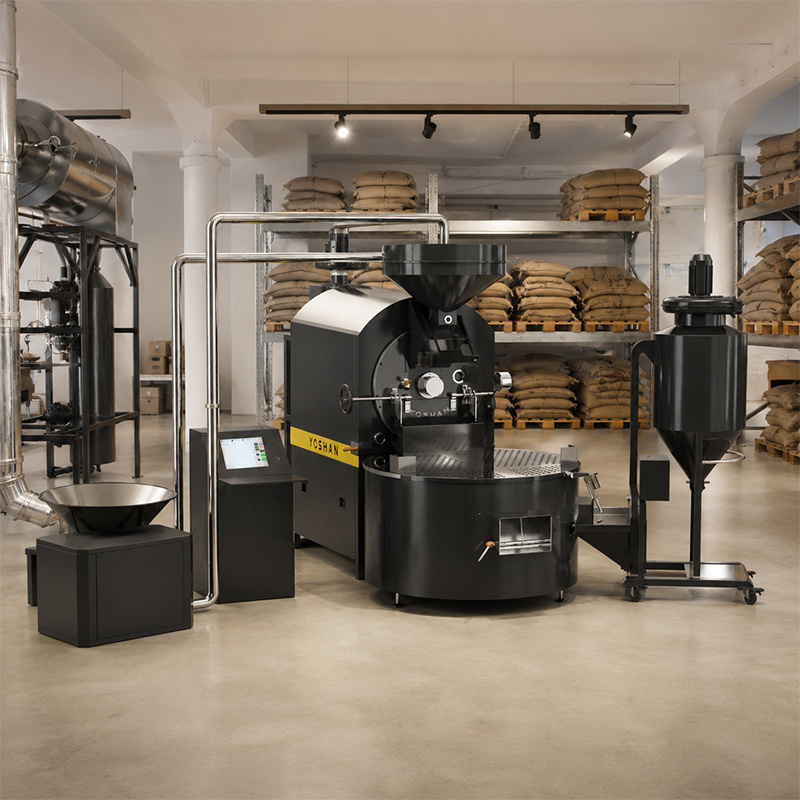
One of our customers, a roastery in Oman, ordered a custom white LPG roaster together with a green-bean loader and destoner as a single line. Their reasoning was simple: they were sourcing naturals directly from farms, and they did not want a $12,000 roaster taken offline by a $2 stone. That is the whole business case in one sentence.
Destoner Types & Configurations
Standalone gravity destoner
A dedicated cabinet with its own blower and reject chute. Highest capacity and cleanest separation. Best for roasteries at 12 kg batches and up, and for anyone processing high-debris naturals.
Inline / loader-integrated
The destoning stage is built into the green-bean loader or the pneumatic conveying line, so cleaning happens as beans are lifted to the roaster. Saves floor space; ideal for compact roasteries.
Aspiration + destoning combo
Adds a chaff/dust aspiration stage before density separation, so light husk and dust are removed along with heavy stones. Useful where green is dusty or poorly hulled.
Post-roast destoner
A smaller unit placed after cooling, before packaging. Cupping labs and specialty roasters use it as a final safety check on the roasted product.
Sizing a Destoner to Your Roaster
A destoner must comfortably out-run your roaster’s charge rate so it is never the bottleneck. The rule we give buyers: pick a destoner whose hourly throughput is at least 1.5× your roaster’s hourly green consumption. Here is how our common configurations line up with roaster batch sizes. Prices are quoted per line; contact us for factory-direct figures.
| Matched roaster batch | Destoner throughput | Typical airflow | Power | Best for |
|---|---|---|---|---|
| 1–3 kg | 150–300 kg/h | ~1,000 m³/h | 0.75–1.1 kW | Micro-roastery, sample lab |
| 6–15 kg | 300–600 kg/h | ~2,000 m³/h | 1.5–2.2 kW | Growing café-roasters |
| 20–30 kg | 800–1,500 kg/h | ~4,000 m³/h | 2.2–4 kW | Regional wholesale |
| 60 kg+ | 2,000–5,000+ kg/h | 6,000+ m³/h | 4–7.5 kW | Industrial lines |
Figures are representative of our standard densimetric destoner range and depend on green density and moisture. We build to order — voltage (220V single, 380V three-phase, or your local spec), airflow, and reject-gate settings are all configurable at the factory.
Integrating the Destoner Into a Roastery Line
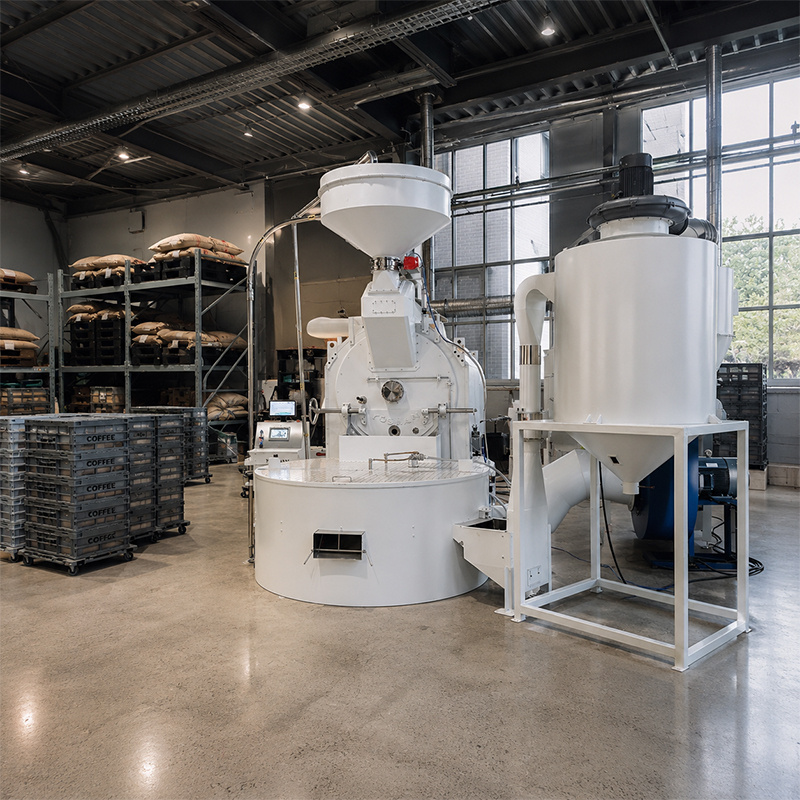
The destoner is one link in the handling chain — loader, destoner, silo, roaster. For the upstream half (vacuum vs auger vs bucket elevator, hopper sizing, air and power) see our green bean loader and silo guide.
A destoner rarely works alone. In a well-designed line it sits between green storage and the roaster, and it shares dust and airflow handling with the rest of the equipment. The usual flow we deliver is:
Green silo / bag hopper → Destoner → Green-bean loader → Roaster charge hopper → Roaster → Cooling tray → Destoner (optional post-roast) → Grinder / Packaging
If you are also planning smoke and emissions control, the destoner’s dust aspiration can often tie into the same extraction plan as your afterburner and smoke suppression system. And if you are still deciding on your core machine, start with our roasting plant setup guide and browse the full Yoshan roastery equipment lineup. Buying the roaster and its support equipment from one factory means matched voltages, matched airflow, and one point of contact for spare parts.
Maintenance & Operating Notes
-
Empty the reject chamber daily. A full reject bin lets stones back-feed into the clean stream — this is the number one operator error.
-
Tune the airflow to your green. Dense, low-moisture beans need more air; soft, high-moisture naturals need less. A destoner set too aggressively will reject good beans; set too gently it lets stones through. We supply a starting curve and you fine-tune on the deck screw.
-
Check the deck screen and seals monthly. Worn gaskets leak air and degrade separation.
-
Keep the blower filter clean so airflow stays constant batch to batch.
Frequently Asked Questions
What do your destoners cost, and which fits which roaster?
Two models cover most roasteries, ex-works: the YS-Q3 at USD 1,299, sized for 1–6 kg drums, and the YS-Q12 at USD 2,109 for 12–30 kg lines; larger inline units are quoted with the industrial roasters they feed. Both run on single-phase 220 V and ship in the same crate as the roaster, with the discharge matched to your hopper height. The equipment page lists them.
Can a destoner damage the beans?
A correctly set gravity destoner does not — the beans are lifted on air and never struck. What damages coffee is a unit set too aggressively, which carries good beans into the reject jar, or one running with a blocked screen, which lets stones through. Check the reject jar for the first few lots of a new origin and you will see whether the airflow needs a click either way.
Does a destoner replace hand sorting for quakers and defects?
No. It separates by density, so it removes stones, metal and glass and some dense foreign matter; it does not see colour or shape. Quakers, broken beans and insect damage are sorting-tray or colour-sorter problems, and the cupping lab guide covers the intake check that catches them. Think of the destoner as machine protection first and cup quality second.
Where should the reject jar go, and how often do I empty it?
Somewhere you will look at it: a clear jar at eye height on the front of the unit, emptied every session and logged when it holds anything unusual. What you find in it tells you about your supplier — a lot that arrives with nails and mud is a lot to discuss with them — and a jar that has been full for a week means the next stone goes into the drum.
Can I add a destoner to a roaster I bought elsewhere?
Yes, in either position: standalone at the intake bench, discharging into your own sacks or loader, or inline ahead of an existing hopper if the height allows. Send us the roaster model, the hopper height and a photo of the intake and we quote a unit with the right discharge; the loader and destoner together, matched to the roaster, is the cheapest way when you buy the line at once.
Final Thoughts
A coffee destoner is the least glamorous machine in the roastery and the fastest to pay for itself the first time it catches a rock. Fit one before you buy naturals or lower grades, before your first wholesale account, and certainly before a 12 kg drum; size it at 1.5× your hourly green use and put it ahead of the silo. Send us your roaster and your origins and we size it. Talk to our engineers.
Get a Quote → WhatsApp +86 184 0771 4607Last updated: September 17, 2026
Pingback: Coffee Roastery Equipment: Buy Now, in Six Months, in a Year | Yoshan
Pingback: Sizing an Industrial Coffee Roasting Line: 30–300 kg | Yoshan
Pingback: Green Bean Loader & Silo: When to Buy, How to Size the Chain | Yoshan
Pingback: 2 kg Coffee Roaster: No Gas Fitter, No Three-Phase — Even Electric