
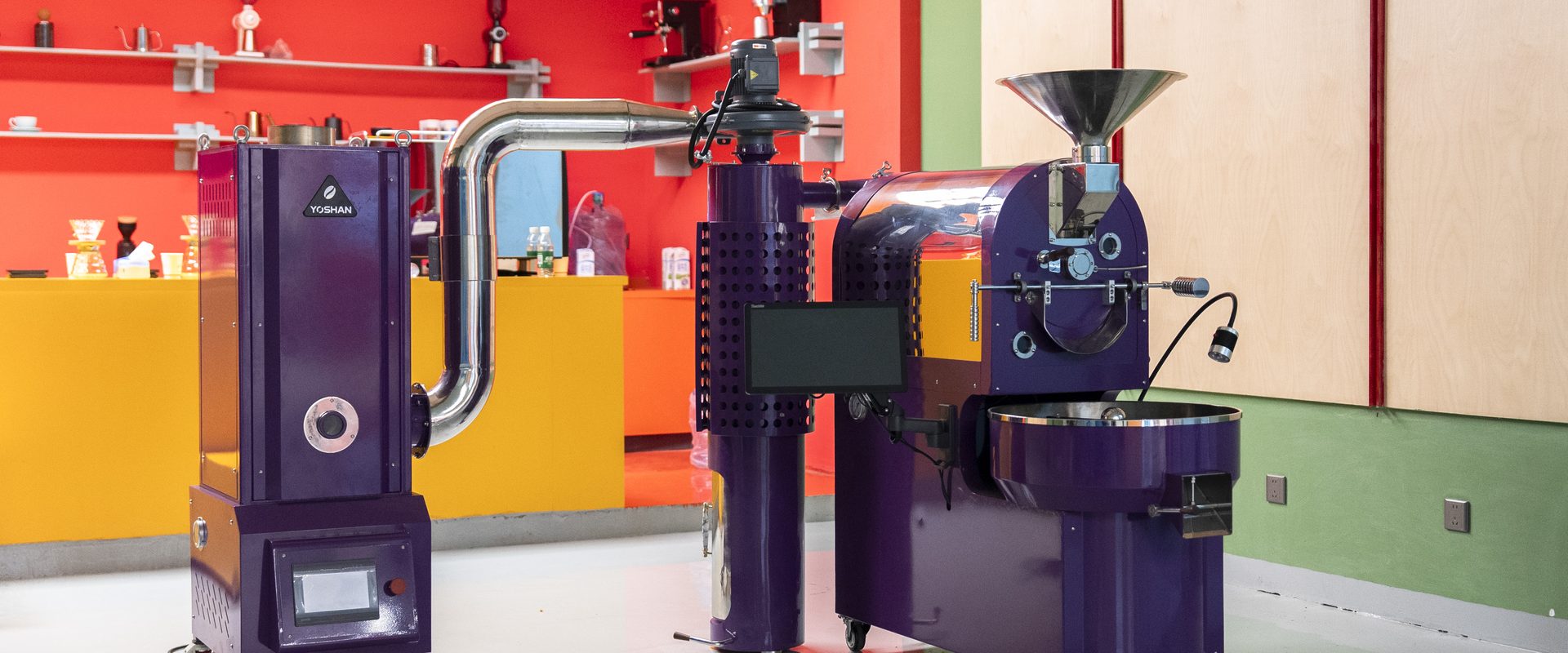
If you are shopping for a coffee roaster for a small business, you have probably already hit the wall: buy too small and you are roasting at midnight within a year; buy too big and you have tied up money in a drum that runs half empty. This guide gives you the maths to size it against your own weekly volume, the five things about your building that decide the answer, and where each size lands.
What "Small Business" Means When You Are Sizing a Roaster
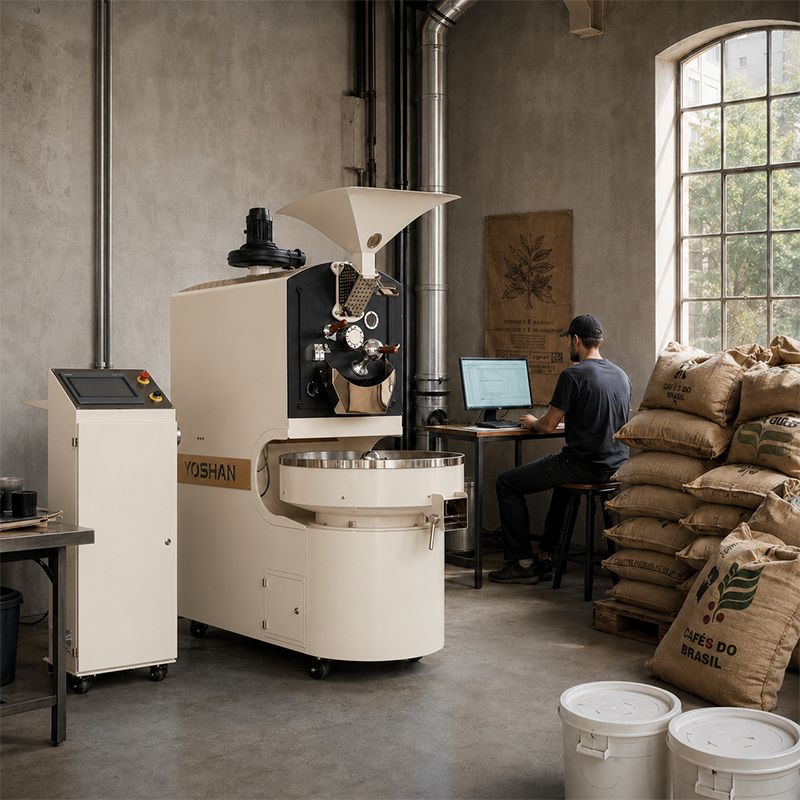
Forget how many staff you have. For a roaster, the only number that matters is how much roasted coffee you sell in a week. Find your band first — every decision below hangs off it.
- Under 40 kg a week. You are a cafe roasting what you pour, or you are just starting to sign wholesale customers.
- 40 to 150 kg a week. Your cafe supplies its own shelves plus a few wholesale accounts, or you run a micro-roastery selling retail bags. This is the band most of our first-time buyers are in.
- 150 to 350 kg a week. Roasting is the business. You have a dedicated room and somebody whose job is the machine.
If you are not sure, count last month's bags and divide by four. That is your number.
Turn Your Weekly Volume Into a Batch Size
Four numbers take you from "kilos sold" to "drum size". Each one changes what you should buy.
1. Start from roasted weight, then convert to green. Coffee loses 14–20% of its weight in the drum — a safe working figure is 18%. So divide your roasted target by 0.82. If you sell 100 kg of roasted coffee a week, you are buying and loading about 122 kg of green. What this means for you: order green coffee against the bigger number, not the one on your sales sheet.
2. Load the drum at 60–80% of its rating, not 100%. A drum sold as 6 kg is built to roast well at 4–5 kg. Light roasts sit near the bottom of that range, dark roasts near the top. Run it flat out every batch and the drum cannot get back up to temperature between roasts, so your third batch tastes different from your first. What this means for you: when you compare machines, compare the working batch, not the headline number.
3. Count three batches an hour. Load, roast, drop, cool, sweep out the chaff (the papery skin that comes off the beans). Eight to fifteen minutes of roasting plus handling puts most shop-size drums at three cycles an hour. Bigger production machines with a separate cooling fan manage four.
4. Multiply. Working batch × 3 batches × the hours you will actually spend roasting = your weekly green capacity. Compare that to the number from step 1.
The Mistake That Makes People Buy the Wrong Size
The maths above is standard. Where most guides go wrong is the last number — the hours.
They assume a 40-hour roasting week. That is right for a wholesale roaster with someone on the payroll to run the machine. It is wrong for you if you are also opening the shop, pulling shots, ordering milk and doing the books, and roasting in whatever hours are left.
Size the machine against the roasting sessions you can genuinely protect, not the hours the drum could theoretically run. If two afternoons a week is realistic — call it eight hours — then eight goes into the multiplication. Not forty.
That one substitution is usually the whole difference between a 3 kg machine and a 6 kg one. Get it right and you buy once.
Here is what that looks like on our own drums, at 75% loading and three batches an hour:
| Model | Rated batch | Your working batch | Roasted output, 8-hour week | Roasted output, 20-hour week |
|---|---|---|---|---|
| DY-2 | 0.3–2.5 kg | ~1.9 kg | ~37 kg | ~93 kg |
| SD-3 | 2–3 kg | ~2.3 kg | ~45 kg | ~113 kg |
| SD-6 Pro / YS-6 | 3.5–7 kg | ~5.3 kg | ~104 kg | ~260 kg |
| SD-12 Pro | 3.5–13 kg | ~9.8 kg | ~193 kg | ~482 kg |
These are estimates, not rated specifications — 75% loading, three batches an hour, 18% roasting loss. Your profile and your workflow will move them.
Read the table against your band. Selling 60 kg a week with one free afternoon? An SD-3 is already tight; a 6 kg drum gives you room. Selling 60 kg with two full days? The SD-3 covers it comfortably.
Five Things About Your Building That Pick the Machine
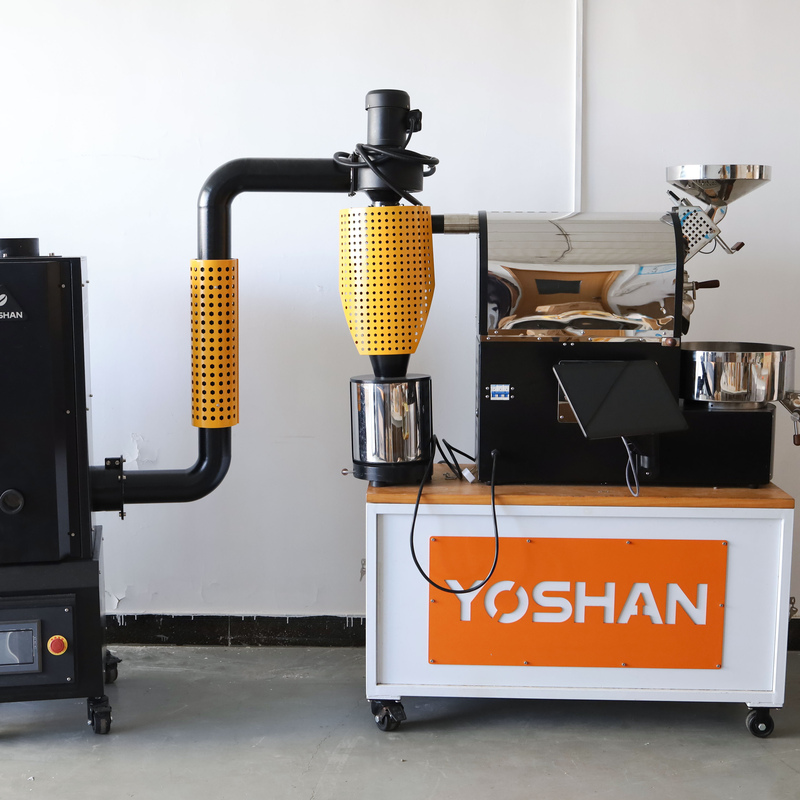
Volume tells you the batch size. These five tell you whether that machine can actually run where you are. Check them before you ask anyone for a quote — they cost nothing now and a great deal later.
| Check | What you need to find out | Why it decides |
|---|---|---|
| Your electricity | What comes out of your wall: 110V, 220–240V single phase, or 380V three phase (the three-wire supply factories use); 50 Hz or 60 Hz | Motors, fans and controls are built to one supply. Our gas-heated drums up to 15 kg run on ordinary 220V/50Hz single phase; electric-heated builds above that need three phase. Getting this wrong is the single most common reason a machine arrives and will not switch on |
| Your fuel | Bottled LPG, piped natural gas, or electric only | The burner is fitted with different jets for LPG and natural gas. Tell us which you have and it ships correct. Change your mind after delivery and you are buying new jets and re-tuning |
| Your exhaust route | Where the smoke and chaff will leave the building, and what your local authority requires | In many markets a short duct to an outside wall is all you need. In a dense urban site, or under strict air rules, you may need an afterburner or smoke filter |
| Your floor | Footprint of the machine plus about a metre of working space around it, plus somewhere to keep green coffee | An SD-6 Pro takes about 2.2 × 1.3 m and weighs around 280 kg before you add beans; a YS-12 weighs 758 kg. Measure the doorway and check the floor can take the weight, not just the room |
| Your time | Who runs it, and how many hours a week they really have | This feeds straight back into the sizing maths above. It also tells you how much automation is worth paying for |
Settle the first two — electricity and fuel — before anything else. Everything downstream depends on them.
Match Your Week to a Machine
| Your weekly roasted volume | Batch size to look at | Where it lands in our range |
|---|---|---|
| Under 25 kg, plus trying out new coffees | 1–2 kg | DY series — DY-1 or DY-2, classic drums, LPG or natural gas |
| 25–60 kg | 3 kg | SD-3, or DY-2 if you can roast more sessions |
| 60–150 kg | 6 kg | SD-6 Pro or YS-6 — the size most first-time commercial buyers end up with |
| 150–350 kg | 12–15 kg | SD-12 Pro or YS-12, usually with a loader so nobody is lifting sacks |
| 350 kg and up | 20 kg and above | You are into production and industrial equipment |
Factory prices, ex-works, so you can put a number against each row: DY-1 USD 2,599, DY-2 USD 3,399, SD-3 USD 4,599, YS-6 USD 7,499, SD-6 Pro USD 12,999 with loader, YS-12 USD 9,980, SD-12 Pro USD 15,999 with loader. Freight, duty and installation are your own lines — the price guide lists every model.
Between two bands? Take the larger one, as long as it passes the five checks above. Outgrowing a drum in eighteen months costs you far more than running a slightly bigger one at 60% for a while.
Gas or Electric: Your Building Decides, Not Your Preference
Gas — LPG or natural — gives you fast, responsive heat and the direct burner control most roasters learn on. It is the standard build across our SD and DY drums. You need a fuel supply and an exhaust path.
Electric takes the gas supply out of the picture entirely. That matters if you are in a leased unit, a shared building, or somewhere a gas connection is slow or simply not allowed. The trade-off is slower heat response and, on bigger machines, a three-phase supply.
One thing to be aware of if you read US-focused guides: they push hard toward ventless electric machines, because in many American cities the permits and ductwork really do dominate the project cost. That logic does not carry everywhere. If you are somewhere bottled LPG is cheap and a small roastery faces no emissions permitting, paying a premium to avoid a duct is paying to solve a problem you do not have. Check your own local rules first — the full comparison is in our gas vs electric guide.
What the "Best Roaster" Lists Will Not Tell You
When you search this topic you get ranked lists. Read a few and you will notice something: the drum maker's comparison concludes you should buy their drum, the ventless-machine company's "honest comparison" concludes you should buy their ventless machine, and the equipment retailers rank whatever they have in stock.
That does not make the lists useless — the criteria they use are worth stealing. But the rankings are not for you. We are a factory, so a ranked list from us would be no more independent. What we can give you instead is the set of questions that separates any two suppliers, ours included. Ask all seven in writing:
- What is the rated batch range, and what batch size do you actually recommend for daily production?
- Which voltage, phase and frequency will my machine be built to?
- LPG or natural gas — and what changes if I switch later?
- Does it log to Artisan, and can I export the curves?
- What is in the crate, and what do I still have to buy?
- Where do spare parts come from, and how long does a burner or a bearing take to reach me?
- What is the warranty, and who supports me in my country?
A supplier who answers all seven in writing is telling you more than any ranking will.
Budget for the Machine — and for Everything Around It
The quote for the drum is the start of your number, not the end. Line these up before you decide:
- Freight and duty. Sea freight, port charges, customs duty and inland delivery to your door. On a small machine going to a distant port this is a real share of what you pay, and it depends on your country far more than on the machine.
- Exhaust. Ducting, a chaff cyclone, and — where your rules require it — an afterburner or electrostatic smoke filter.
- Electrical and gas connection. Usually modest for a single-phase shop drum; more for three-phase electric builds.
- Green storage. Somewhere cool, dry and off the floor. Cheap to do properly, expensive to fix after a wet season.
- Spares. Bearings, seals, thermocouples, a spare burner nozzle. Order them with the machine, not after a breakdown on a Saturday.
Your real number depends on your voltage, your fuel, your port and your accessories, so ask us for a quote built to those. The commercial coffee roaster price guide breaks the structure down.
Frequently Asked Questions
Can I run a small commercial roaster off a generator?
Yes, if the generator carries the exhaust fan and the drum motor together — on a gas-heated 3–6 kg drum that is under 1.5 kW, so a modest unit does it; an electric build needs the element's 4.4 kW on top. What matters is that a power cut never leaves a hot drum without airflow, so size the generator to the machine's connected load, not to the lights, and fit a stabiliser for the control board.
I only sell at weekend markets — is a commercial roaster still the right buy?
If you sell 15–25 kg a week from a stall, a DY-2 roasted on one weekday afternoon covers it, and the machine's cost per kilo is a few cents whether you roast once or five times a week. What a market business needs more than capacity is a saved profile that repeats, because your customers buy the same bag back — which is the argument for logging every batch from day one.
How do I size if my summer and winter volumes are very different?
Size to the low season loaded at 60–80% of rating, and let the high season run more sessions rather than a bigger drum: a 6 kg drum roasting two afternoons in winter and five in summer costs the same to buy and heats the same iron per batch. A drum sized to the peak spends eight months underloaded, which is where inconsistency and wasted gas come from.
Does the drum size change what green coffee I can buy?
Practically, yes. A 3 kg drum eats a 60 kg sack in a fortnight and lets you rotate single origins from an importer by the bag; a 12 kg drum wants pallets, a conditioned store and a buying cycle. If you plan to build a range of rotating coffees rather than one house blend, that is an argument for the smaller drum and more sessions — the green storage guide explains the buying units.
What should the first month on the new machine look like?
Twenty to thirty batches of cheap green before you sell anything: three to five seasoning batches thrown away, then a fixed batch size and one coffee until the curve repeats, then your other coffees one at a time. Budget a sack of practice green into the purchase and push your first real week out by a month; the commissioning guide sets out the sequence.
Final Thoughts
Get your weekly volume and the five building checks right, and the machine almost picks itself. We build drums from 1 kg to 300 kg at our own factory, and we would rather tell you a smaller one is enough than sell you a bigger one. Send us your weekly volume, your voltage and your fuel type — that is all we need to tell you which size fits. Talk to our engineers.
Get a Quote → WhatsApp +86 184 0771 4607Last updated: September 22, 2026
Pingback: Yoshan Coffee Roaster Factory Tour: Built Since 1990
Pingback: 5 kg Coffee Roaster: Output, Specs and What to Check Before Ordering | Yoshan
Pingback: Coffee Roaster Batch Size Guide: Usable Window, What Breaks | Yoshan
Pingback: Espresso Grinder vs Filter Grinder: Burr Types, Which to Buy | Yoshan
Pingback: Entry-Level Commercial Coffee Roaster: 1–3 kg Machines Compared
Pingback: How to Buy a Coffee Roaster from China: Fix These Four First | Yoshan
Pingback: Drum Roaster vs Fluid Bed: Which Fits a Growing Business | Yoshan
Pingback: Coffee Roaster OEM vs ODM: Which One Your Brand Needs | Yoshan
Pingback: How to Start a Coffee Roasting Business: Volume, Machine, First Roast
Pingback: Connect Your Coffee Roaster to Artisan: USB, Bluetooth, Fixes | Yoshan
Pingback: Coffee Roaster for the Philippines: 60 Hz, Resellers, Barako | Yoshan
Pingback: Coffee Roaster for Southeast Asia: MY, ID and TH Bean by Bean | Yoshan
Pingback: Coffee Packaging Equipment: Hand-Bagging Ceiling to Valves | Yoshan
Pingback: Coffee Roastery Equipment: Buy Now, in Six Months, in a Year | Yoshan