
A spec sheet can say “12 kg per batch” and “0–400 °C” and be printed by anyone. The only way to know a roaster does what its sheet says is to put green coffee in it and roast. So we do, on every machine, before it is packed — on the gas and the voltage you will use, with the curve recorded.
Where this step sits
The test roast is the last of the functional tests, after the gas leak test, the electrical test and the heat-up dry run. It is part of the third of the three inspections every machine receives, and it is what you see in the video inspection.
What the test roast is for
A dry run proves the machine heats and turns. A roast proves the machine roasts. Specifically, it shows:
- That the burner delivers enough heat at your gas setting to bring a full batch through first crack in a normal time.
- That the probes read correctly — the bean temperature drops on charge, turns, and climbs at a rate that makes sense for the batch size.
- That airflow and drum speed are right — no scorching on the drum face, no tipping, chaff pulled cleanly into the cyclone.
- That the cooling tray does its job — beans down to hand temperature in the time the sheet states (1–2 minutes on YS and DY, about 2 minutes on SD Pro).
- That the drum is seasoned. A new cast iron drum should not meet its first coffee in your building. The factory batches put the first layer of oils on the metal so your first roast is not a throwaway.
How it is done in our plant
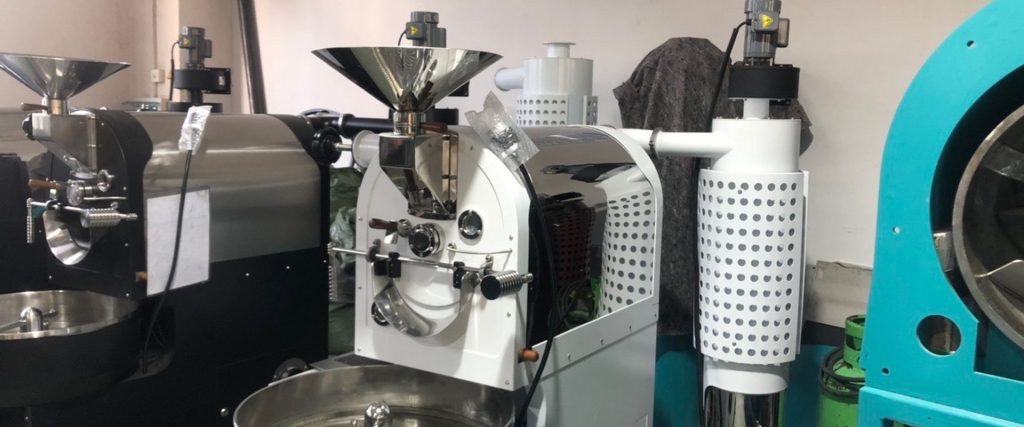
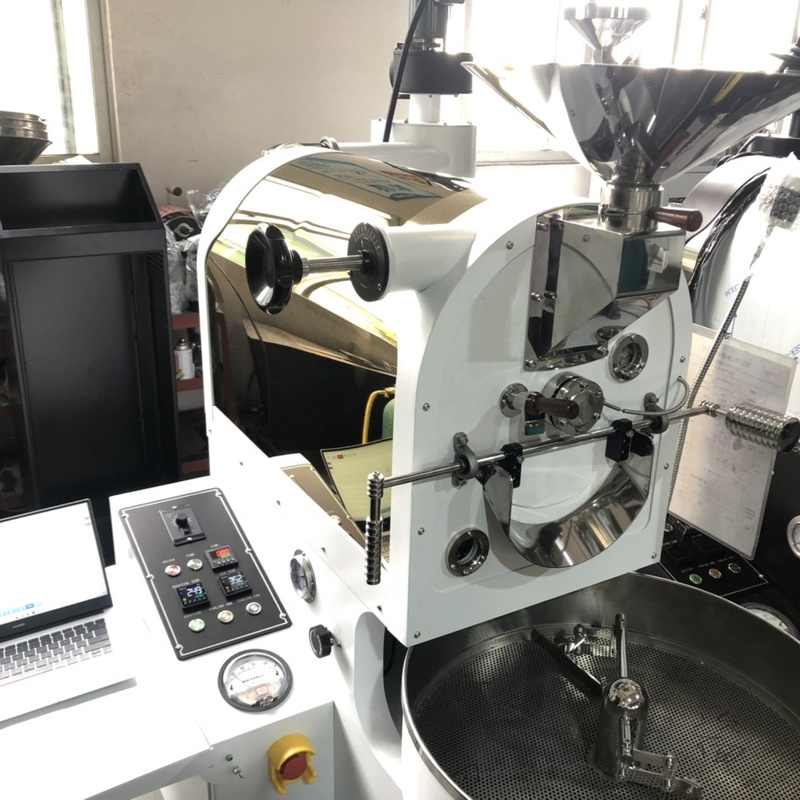
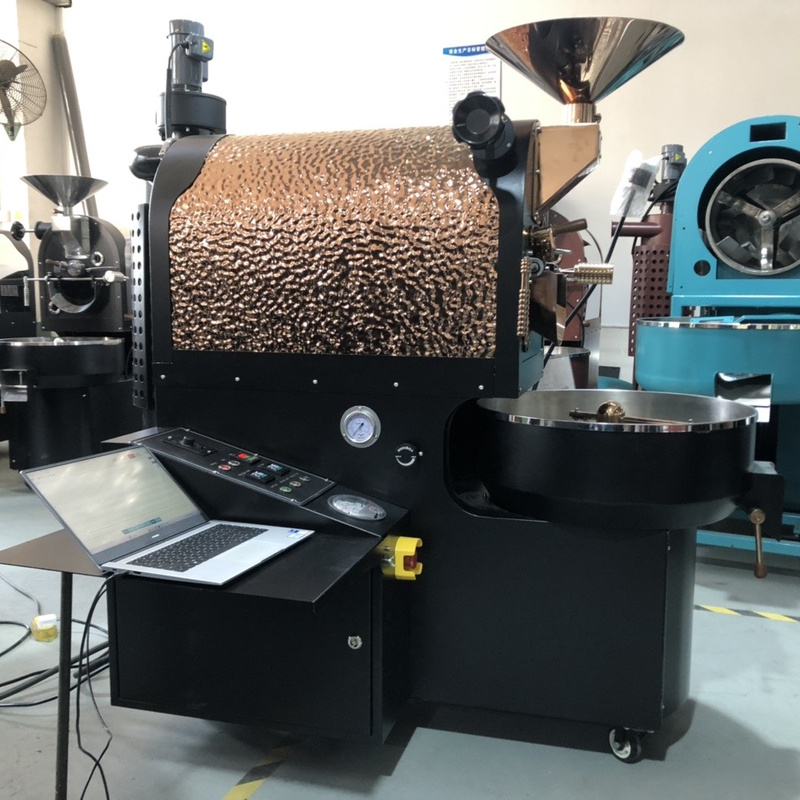
The machine is set up as it will be installed: connected to LPG or natural gas as ordered, on the voltage it was wired for, with the exhaust connected. A technician runs the machine through preheat, charges green coffee, follows a standard profile for that model size, drops the batch and cools it. The curve — bean and air temperature against time — is recorded on the machine’s own system (YS and SD Pro) or on a laptop running Artisan connected to the data port (DY and manual SD). The photographs on this page are from that process: a row of machines under test, an SD-3 running with a laptop logging, a technician at a YS control screen, an LPG cylinder feeding a machine on the test floor.
The batch is then inspected in the cooling tray and, on larger machines, a sample is pulled through the trier during the roast. Anything that is not right — a probe reading late, a slow cooling fan, a flame that will not hold at low setting — is fixed and the machine is re-tested before it goes to packing.
What this means for you
- The machine you receive has already roasted coffee. Nothing about its first day in your building is an experiment.
- You have a reference curve for the machine, on your gas, before you develop your own profiles. Our profile development article explains how to build from it.
- The drum is seasoned. You still run a few commissioning batches on site, but you are not starting from bare iron.
How to verify this on any roaster
Ask for three things before you pay the balance on any machine, from any factory:
- The test roast curve for your machine — a screenshot or an exported file, with the serial number.
- A short video of the roast, showing the charge and the drop.
- The gas type and voltage the test was run on, in writing.
A factory that test-roasts every machine has these on file for every serial number. A factory that does not will send you a video of a different machine, or a curve with no serial number, or an explanation.
Frequently asked questions
Which coffee do you use for the test?
We use green coffee stocked at the plant for testing. If you would like the test run with a coffee you supply, or with a specific origin, tell us at order and we will confirm whether it can be arranged for your machine.
Will I receive the curve file?
Yes — ask for it when your machine is scheduled for testing. For YS and SD Pro machines it is exported from the Siemens system; for DY and manual SD machines it is the Artisan log. Curves are kept against the serial number.
Does a test roast make the machine "used"?
No. A test-roasted machine is a finished, inspected machine. The alternative — a machine that has never roasted — is one whose faults you would discover yourself. The few batches of factory coffee it has run are the same batches you would otherwise have to run to season the drum.
Can I watch the test roast live?
Yes. Tell us your time zone and we schedule the roast for a live video call. See final QC and video inspection.
Will the profile from the test work as my production profile?
Treat it as a starting point, not a recipe. Your green coffee, altitude, ambient temperature and gas supply differ from ours. Our profile scaling guide explains what transfers between machines and what does not.
Final thoughts
We test-roast every machine because it is the only test that answers the question you are actually asking: does this roaster roast? The video inspection page shows how you watch it happen, and the three-stage inspection page shows where the test roast sits in the full check. Or return to the full build sequence.
Tell us your country, voltage, gas type and kilograms per week — we will send the matching spec sheet, and schedule your machine’s test roast for a live call when it is built. Request the spec sheet · WhatsApp: +86 184 0771 4607
Last updated: September 15, 2026