
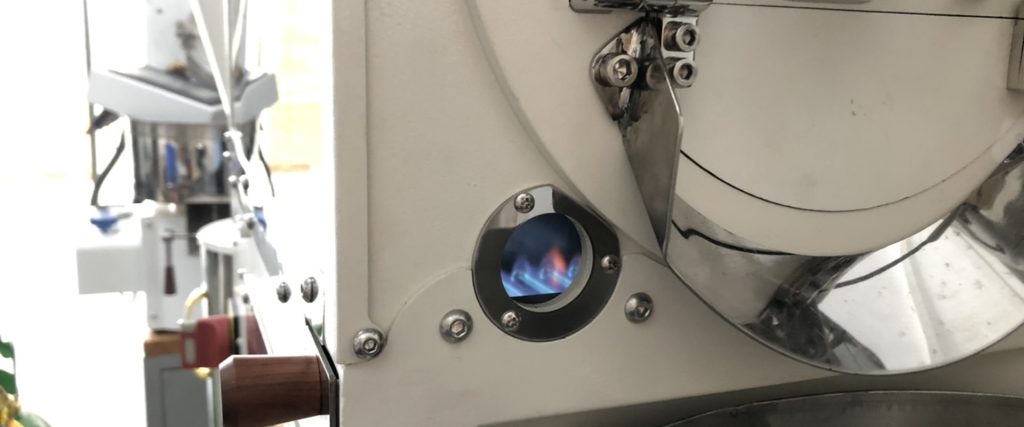
Most of what we test on a roaster is about performance: does it heat, does it hold a curve, does it cool fast. This test is about something simpler. A gas roaster must not leak — not at the factory, not after six weeks at sea, not after five years of heat cycling. Every gas-fired machine is pressure-tested and leak-checked on its gas train before it is allowed to roast, and the result is written against its serial number.
Where this step sits
The gas leak test is the first of the assembled-machine tests, after final assembly and before the electrical safety test, the heat-up run and the test roast. It is part of the second of the three inspections.
What is tested
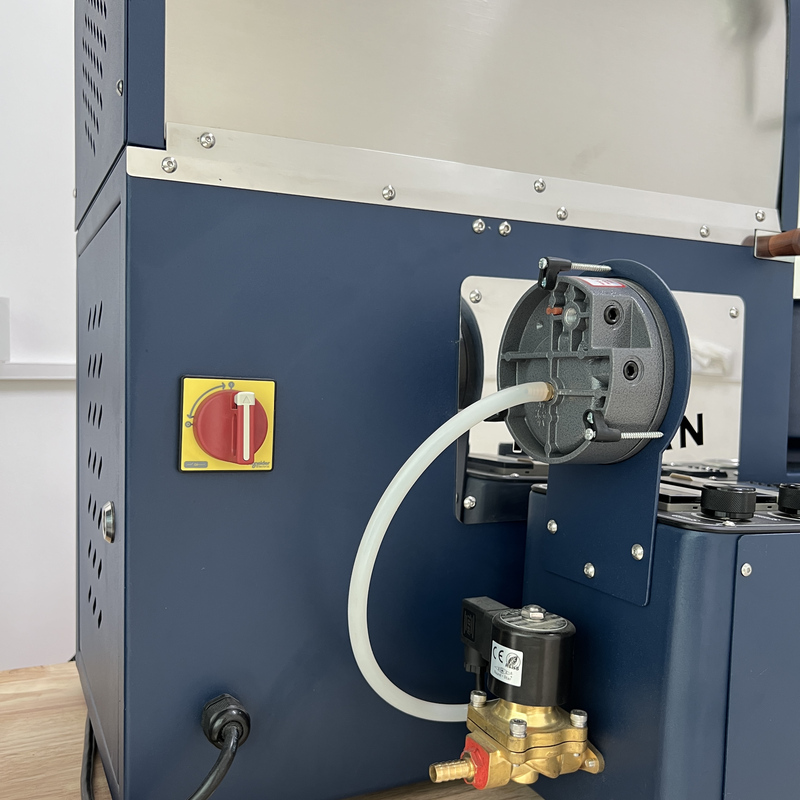
The complete gas train as fitted to the machine — inlet connection, regulator, pressure gauge, solenoid valve, pipework, burner connection — as described on the burner assembly page.
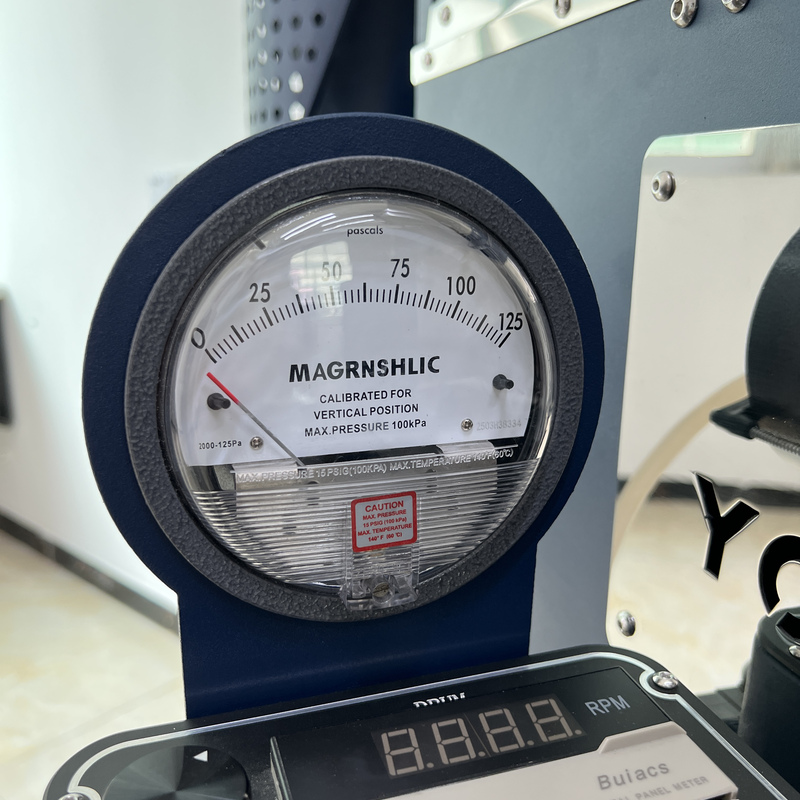
Pressure test. The train is pressurised and held, and the pressure is watched for decay. A drop means a leak somewhere in the train, even one too small to smell.
Joint-by-joint leak check. Each threaded joint, the regulator, the valve body and the burner connection are checked individually with leak-detection solution so that any leak is found and located, not just detected.
Solenoid and shut-off. The solenoid valve is checked to close fully on power-off and on loss of flame signal, and to open cleanly on ignition. A valve that weeps when closed is a failure.
Regulator and gauge. The regulator is confirmed to hold the set outlet pressure for the ordered gas type, and the gauge is confirmed to read correctly against it.
Ignition and flame supervision. Ignition is tested; flame supervision is tested by interrupting the flame and confirming shut-off.
Any leak, however small, is repaired and the full test is repeated from the start. Values are recorded on the machine’s inspection sheet.
Why this is never a sample test
Some tests can reasonably be done on a sample of machines from a batch. This is not one of them, for two reasons. First, the gas train is assembled from threaded joints, and every joint on every machine is made by hand; there is no batch. Second, the consequence of a missed leak is not a poor roast but a fire. So the test is run on every machine, without exception, and the inspection sheet for a gas machine is not signed until it has passed.
What this means for you
- Your gas fitter connects a train that has already been proven tight, and does a final check on the site connection only.
- Your insurer and fire authority can be shown a test record for the specific machine, with its serial number, if they ask.
- The machine’s own safety devices — solenoid, flame supervision — have been shown to work before the machine reaches you. Our fire safety guide covers what to do on your side.
How to verify this on any roaster
Ask for the gas leak test record for your serial number — the test pressure, the hold result and the date. Ask whether the solenoid and flame supervision were function-tested. A factory that tests every machine has this on a sheet for every machine. One that does not will describe its “strict QC” and change the subject.
Frequently asked questions
Do I still need a leak test on site?
Yes — on the connection between your supply and the machine’s inlet, which is made on site by your gas fitter, and as required by your local regulations. The factory test covers the machine’s own train; the site test covers the joint to your supply.
Does transport affect the gas train?
Threaded joints properly made and tested do not loosen in transport, and the train is inside the machine body. We still recommend the site leak check above as normal practice.
What if I change gas type later?
After a nozzle and regulator change, the train should be leak-tested again by the technician who does the changeover. We provide the procedure.
Is the test different for LPG and natural gas machines?
The procedure is the same; the regulator setting and test parameters are for the gas the machine is configured for.
Final thoughts
A gas roaster is judged on flavour every day and on safety only once — the day something goes wrong. We test so that day does not come. Next in the sequence is the electrical safety test; the documentation behind it is on the certifications page. Or return to the full build sequence.
Tell us your country, voltage, gas type and kilograms per week — we will send the matching spec sheet for that model. Request the spec sheet · WhatsApp: +86 184 0771 4607
Last updated: September 15, 2026