
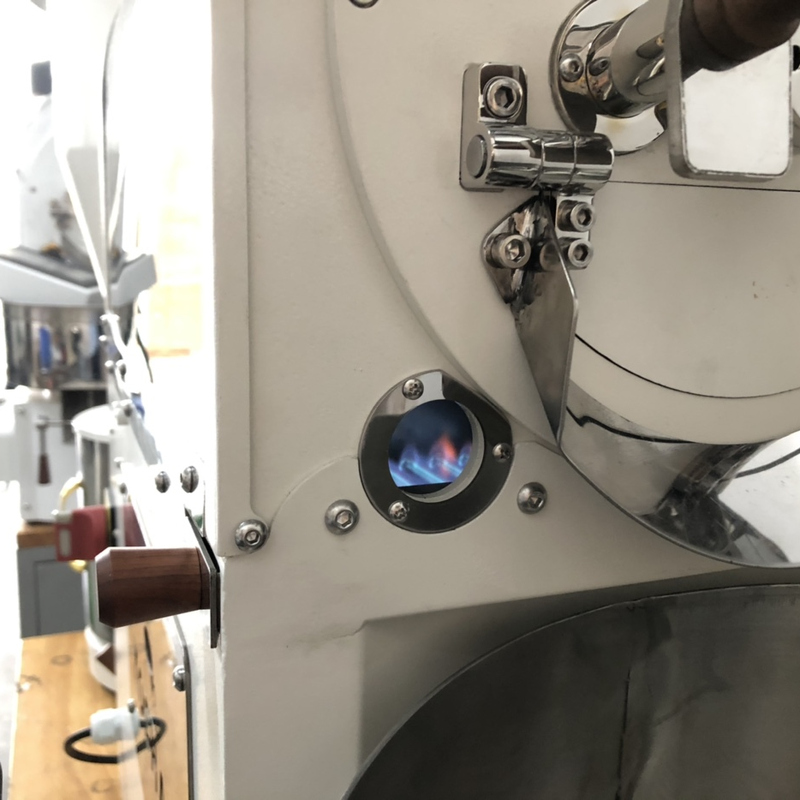
Every spec sheet in the industry says something like “temperature range 0–400 °C”. Ours does too. The difference between a number on a sheet and a number you can rely on is whether the machine was actually taken there, empty, on the gas and voltage you will use, with someone watching what happened on the way up. That is the heat-up test.
Where this step sits
The heat-up run follows the electrical safety test and comes immediately before the test roast with green coffee. It closes the second of the three inspections.
Why a dry run before a roast
A roast is a poor test of a machine, because the coffee hides things. A slow burner, a probe that lags, a fan pulling less than it should — with beans in the drum, all of these just look like a slightly different roast. Empty, they are obvious. So the machine is run empty first, through its whole range, and only a machine that behaves correctly empty goes on to roast.
What is checked as the machine heats
Ignition and low fire. The burner lights cleanly and holds a stable low flame without lifting or going out — the setting a roaster uses at the end of a batch.
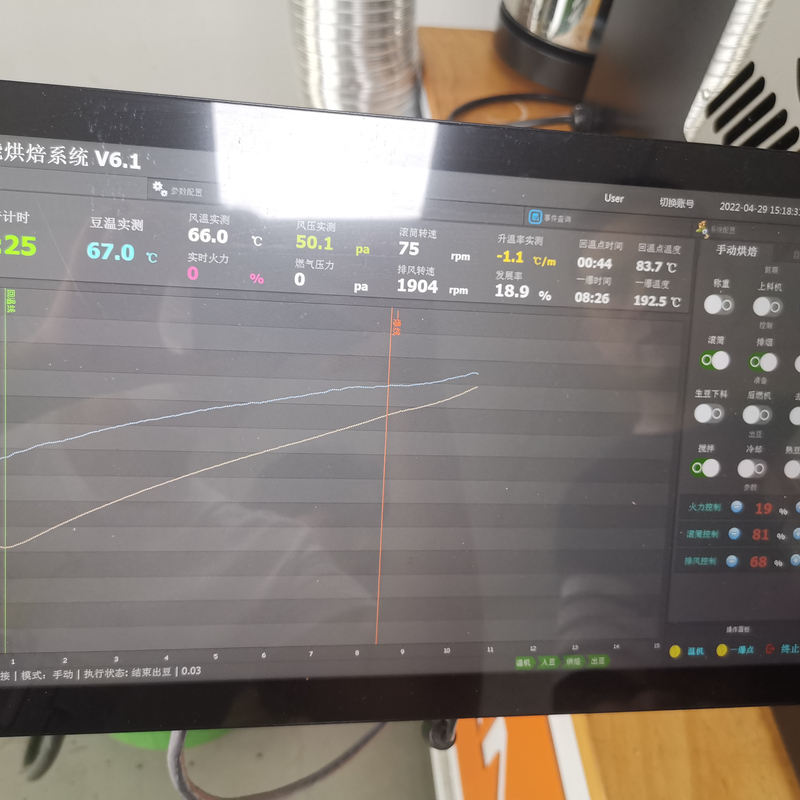
Modulation. Heat is stepped up through the burner’s range. Each step should produce a visible change in flame and a corresponding change in the rate of temperature rise. A burner that does nothing between 30 % and 60 % is a burner with a gas-supply or nozzle problem.
Probe tracking. Bean and air probes are watched against each other and against the rate of rise. Empty, the air probe should lead and the bean probe should follow smoothly; a bean probe that lags badly or jumps is replaced.
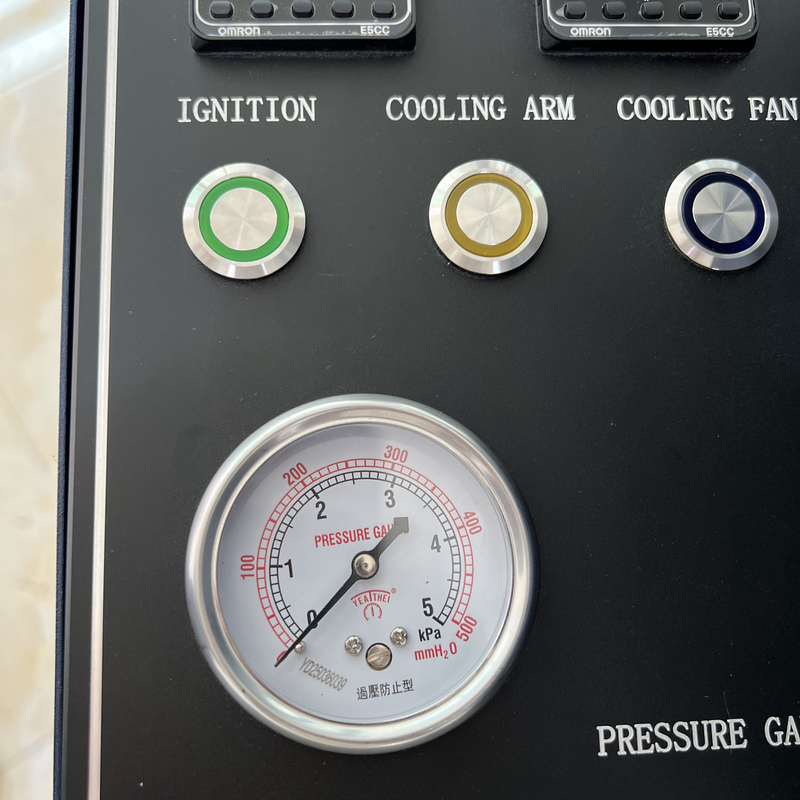
Airflow. The exhaust fan is run through its range at temperature; draught is confirmed at the cyclone and chaff path.
Thermal expansion. As the cast body and drum heat, the drum is watched for any change in its running clearance and for any noise. This is where a drum that was not stress-relieved would begin to scrape; ours does not, and the test confirms it.
Full range and hold. The machine is taken to the top of its working range and held so that every heat-path part reaches temperature. Safety cut-outs are confirmed to operate. The machine is then brought down and cooled.
Temperatures, times and observations are recorded on the inspection sheet.
What this means for you
- The “0–400 °C” on your spec sheet has been reached by your machine, on your gas, and the curve of how it got there is on file.
- Burner modulation, probes and airflow — the three things you will actually use to shape a profile — are known to work across their range, not just at one setting.
- Nothing about the first heat-up in your building is new to the machine. It has done it before, with an engineer watching.
How to verify this on any roaster
Ask for the heat-up record — the time from ignition to the top of the range and any notes. Then, on the inspection video, ask to see the flame at low fire and at high fire through the sight port. Two settings, one minute, and you know whether the burner modulates.
Frequently asked questions
Why does an empty drum matter if I will never run it empty?
Because faults are visible empty and hidden by coffee. Every roaster preheats empty at the start of a day; the test is that preheat, done under observation, through the full range.
Does the heat-up test season the drum?
Not by itself — seasoning needs coffee oils, which come from the test roast batches that follow and from your own first batches. The heat-up does bake off any residue from manufacture so the first coffee meets a clean drum.
Is the test the same for electric-heated models?
The same principle — heat through the full range empty, watch elements, probes and airflow — with the heating elements’ current draw checked as they run.
What happens if the machine does not reach range?
It is investigated — nozzle, supply pressure, regulator, burner — corrected, and the test is repeated. It does not go to the test roast, and it does not ship, until the range is confirmed.
Final thoughts
The dry run is how a figure on a spec sheet becomes a fact about your machine. The step after it is the one that matters most to a roaster: the test roast with real green coffee. Or return to the full build sequence.
Tell us your country, voltage, gas type and kilograms per week — we will send the matching spec sheet for that model. Request the spec sheet · WhatsApp: +86 184 0771 4607
Last updated: September 15, 2026