
Most cafés choose an espresso machine by the number of groups, then find the queue is decided by something else: how fast the wand textures milk, and whether it still does at the tenth latte in a row. That is the steam boiler's job, sized in litres and kilowatts on the spec sheet. This guide explains how to read the two numbers together, how to turn drinks per hour into steam demand, and what the common sizes handle.
Why steam decides the queue on a milk bar
An espresso shot takes about half a minute and the machine makes one per group at a time. Texturing milk for a flat white takes a comparable time, and a barista does it while the shot runs. So far the two jobs are balanced.
The imbalance comes from recovery. A shot uses a small amount of brew water at brew temperature, which the brew boiler replaces easily. Texturing milk pulls a large volume of steam out of the steam boiler, dropping its pressure; the element then has to boil more water to bring the pressure back. If the next drink arrives before it has, the wand delivers weaker, wetter steam, texturing takes longer, and the barista waits. Multiply by a queue and the bar is steam-limited, not group-limited.
On a café where most drinks are milk-based — which is most cafés — this makes the steam boiler the specification that matters most after the number of groups. On a bar that sells mostly espresso and filter, it matters much less.
Litres and kilowatts: read them together
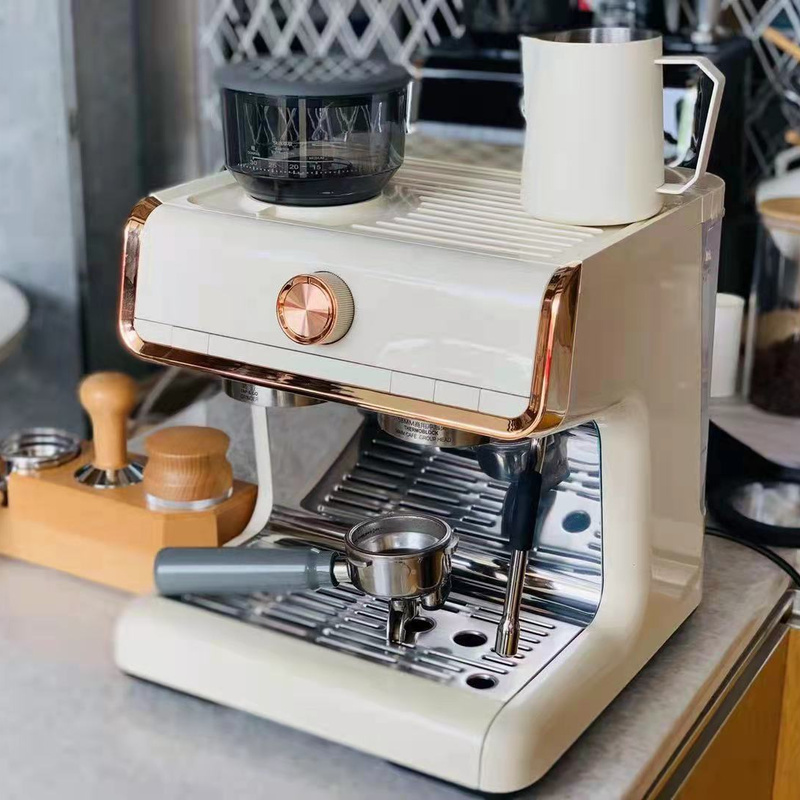
A steam boiler is specified by two numbers, and a spec sheet that gives only one is hiding half the picture.
Capacity, in litres, is the reserve. A large boiler holds more steam at pressure, so it can supply several drinks in quick succession before pressure falls noticeably. It is the buffer for a burst of orders.
Heating power, in kilowatts, is the recovery. It sets how fast the element boils water to restore pressure after steam has been drawn. It is what sustains a long rush once the buffer has been used.
A 7 L boiler with a strong element handles both a burst and a sustained rush. A 7 L boiler with a small element handles the burst and then falls behind. A small boiler with a strong element recovers quickly but has no buffer, so pressure dips on every drink. Two machines with "7 L steam boiler" on the sheet can behave very differently on the bar depending on the element behind it — so ask for both figures.
On the machines we supply the two are stated together: the YS-3120 and YS-3201 two-groups carry a 7 L steam boiler alongside a separate 550 ml brew boiler, with total machine power of 4.2 kW and 3.8 kW respectively. The three-group SD-103 carries a 14 L boiler at 3.6 kW. Those numbers, and what they mean for volume, are the next section.
From drinks per hour to boiler size
A working method, using round figures.
- Estimate peak drinks per hour, not daily average. A café doing 300 drinks a day may do 80 in its busiest hour.
- Estimate the milk share. For most cafés 70–85% of drinks are milk-based.
- Milk drinks per hour = step 1 × step 2. At 80 drinks and 75% milk, that is 60 milk drinks in the peak hour — one a minute.
- Match to boiler class.
| Peak milk drinks per hour | Boiler class that keeps up | Typical configuration |
|---|---|---|
| Up to 20 | Small — around 2–3 L | One-group or compact machines |
| 20–50 | Medium — around 5–7 L with a strong element | Two-group commercial |
| 50–80 | Large — 7–10 L with high power, or two groups with dedicated steam boilers | Two-group at the top of its range; three-group |
| Over 80 | 10–15 L, or two machines | Three-group or a second machine |
The two-group machines we supply, at 7 L, sit comfortably in the middle band and reach into the third; the 14 L three-group covers the top. If your peak milk demand is at the top of a band, choose the class above — steam is the one specification where margin is cheap and shortfall is visible to every customer in the queue.
Boiler layout changes what the numbers mean
The same litres behave differently depending on how the machine is built.
Dual boiler — separate brew and steam boilers, each with its own element and control — is the layout on all three machines we supply. The steam boiler's size and power apply fully to steaming, and drawing steam does not disturb brew temperature. This is the layout for milk-heavy volume.
Heat exchanger — one large boiler making steam, with brew water heated by passing through it — uses its full volume for steam, so a heat-exchanger machine with a 10 L boiler has plenty of steam reserve. The cost is that heavy steaming can nudge brew temperature, and the machine is harder to hold at a precise brew set-point. The comparison is in heat exchanger vs dual boiler.
Single boiler — one boiler doing both jobs by switching temperature — cannot steam and brew at once and is not a café configuration at any boiler size.
A PID controller on a dual-boiler machine holds the brew boiler stable while the steam boiler works hard, which is why PID and dual boiler are usually listed together; what PID does is in PID temperature control on commercial espresso machines.
Wand design matters as much as the boiler
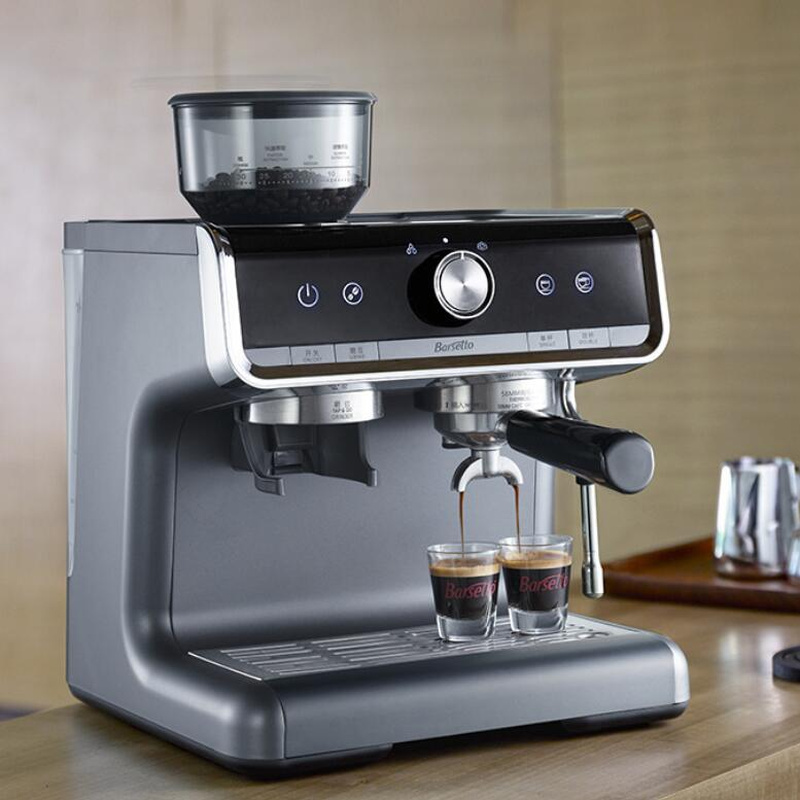
A large boiler through a poor wand still textures slowly. Two things to check on the machine itself.
Steam tip. A four-hole tip delivers more steam faster than a two-hole; the machines we supply use four-hole tips. Larger holes texture faster but demand more skill; smaller holes are gentler.
Two wands. A two-group machine with a wand at each end lets two baristas steam at once — which halves the queue on a rush — but doubles the instantaneous steam draw, which is when boiler litres and kilowatts both get tested. A two-group with two wands needs the larger boiler class more than one with a single wand.
Also check the wand's reach and articulation over a full jug: a wand that will not reach a 600 ml pitcher at the right angle slows every drink regardless of the boiler behind it.
The power supply is part of the answer
A large steam boiler with a strong element needs the electrical supply to feed it. A 4.2 kW two-group draws close to 19 A at 230 V and needs its own circuit; larger three-group machines move toward 30 A or three-phase. A machine on a supply that cannot deliver its rated power recovers slower than its spec sheet says — sometimes the "weak steam" complaint is an undersized circuit, not a small boiler. The installation requirements guide covers sizing the circuit.
FAQ
What size steam boiler does a café espresso machine need?
Size it to peak milk drinks per hour, not daily totals. Up to 20 an hour, a small 2–3 L boiler; 20–50, a 5–7 L boiler with a strong element; 50–80, 7–10 L at high power; above 80, 10–15 L or a second machine. Choose the class above if you sit at the top of a band.
Is a bigger steam boiler always better?
Bigger gives more reserve for a burst of orders, but recovery depends on heating power, not litres. A large boiler with a weak element still falls behind in a sustained rush. Read litres and kilowatts together, and check that the supply circuit can actually deliver the rated power.
What does a 7 litre steam boiler handle?
Paired with a strong element, roughly 20–50 milk drinks in a peak hour comfortably and up to around 80 with good technique — the range of a busy two-group café bar. The two-group machines we supply carry a 7 L steam boiler alongside a separate 550 ml brew boiler.
Does a dual boiler machine steam better than a heat exchanger?
It steams more consistently while brewing, because steam draw does not disturb the separate brew boiler, and it holds brew temperature more precisely. A heat exchanger uses one large boiler for steam and can have more raw reserve, at the cost of brew stability under heavy steaming.
Why is my steam weak during a rush?
Usually the boiler's element cannot recover fast enough for the rate of milk drinks — either the boiler class is too small for peak demand, or the supply circuit is not delivering the machine's rated power. Check the circuit before replacing the machine; an undersized supply mimics a small boiler.
Do two steam wands need a bigger boiler?
Yes. Two baristas steaming at once double the instantaneous draw, which tests both reserve and recovery. A two-group with two wands should be in the larger boiler class than the same drinks volume served through one wand. Two wands are what make a two-group bar fast on a rush.
How much power does a large steam boiler need?
A two-group machine at around 4 kW draws close to 19 A at 230 V and needs a dedicated circuit; three-group machines with 10–15 L boilers move toward 30 A or three-phase supply. Confirm the circuit before ordering, since the machine cannot recover faster than the supply feeds it.
Final Thoughts
On a milk-drink bar, size the steam boiler to your peak hour and read litres and kilowatts together. As a wholesale supplier of commercial coffee machines, we supply dual-boiler two-groups with 7 L steam boilers — the YS-3120 and YS-3201 — and the 14 L three-group SD-103 for the top band. Tell us your peak hour and we will match the class.
Request a quote or message us on WhatsApp at +86 184 0771 4607.
Get a Quote → WhatsApp +86 184 0771 4607Last updated: September 17, 2026
Pingback: Pre-Infusion on Commercial Espresso Machines: Types & How to Test
Pingback: Espresso Machine Steam Boiler Pressure: Gauge & Faults