
A commercial grinder is a motor, and a motor cares about two things in its supply: the voltage, which everyone checks, and the frequency, which almost nobody does. Get the voltage wrong and the grinder will not run or burns out. Get the frequency wrong and it runs — at the wrong speed, hotter, with a different grind. This guide covers the world's supplies, what each does to a grinder, what dual-voltage solves, and what a transformer cannot.
The two numbers on the supply
Voltage is the pressure of the supply. Most of the world runs household and light-commercial power at 220–240 V; North America, Japan and parts of Latin America run at 100–127 V. A motor wound for one does not run properly on the other: a 220 V grinder on 110 V struggles to start and overheats under load; a 110 V grinder on 220 V is destroyed.
Frequency is how many times a second the alternating current cycles: 50 Hz in most of the world, 60 Hz in the Americas, Japan's east, the Philippines, Saudi Arabia and a few others. Most commercial grinders use induction motors, and an induction motor's speed is set by the frequency, not the voltage. A motor rated 1,420 rpm at 50 Hz runs at about 1,700 rpm on 60 Hz — 20% faster — and one rated 2,500 rpm at 50 Hz runs near 3,000 on 60 Hz.
That speed change matters. Faster burrs grind faster but run hotter, and heat in the grounds affects flavour and static; the particle distribution also shifts slightly. A grinder specified at one frequency and run at the other still works, but it is not the same grinder, and the settings the manufacturer quotes will not match. A transformer changes voltage; nothing simple changes frequency.
Supply standards by region
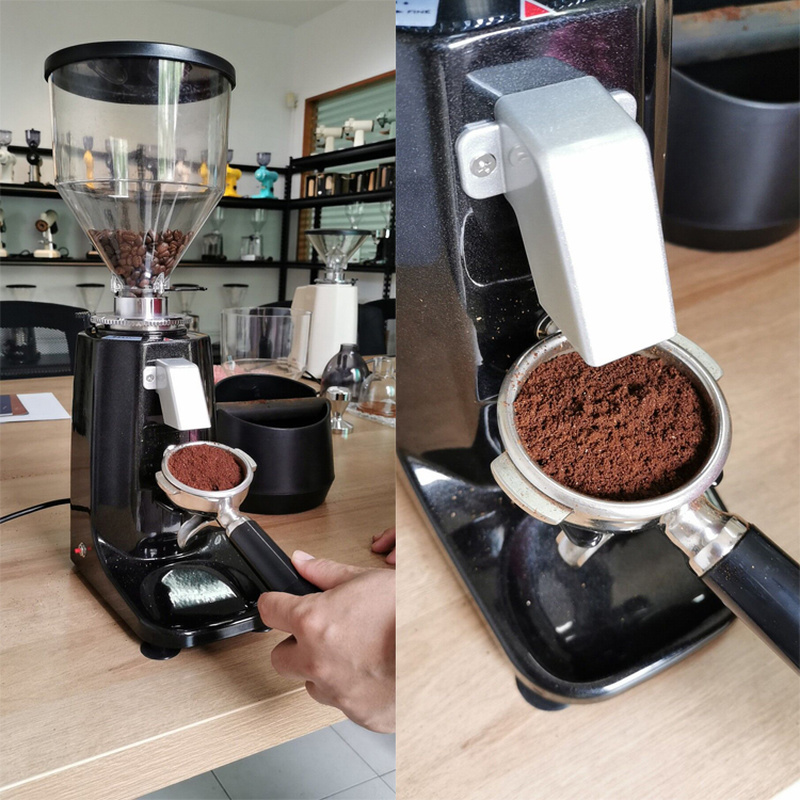
A working table for the markets we ship to most. Confirm locally before ordering — some countries have more than one standard, and commercial premises sometimes differ from domestic.
| Region | Typical single-phase supply | Frequency |
|---|---|---|
| Europe, UK, Turkey, most of Africa | 220–240 V | 50 Hz |
| Middle East — UAE, Qatar, Kuwait, Oman | 220–240 V | 50 Hz |
| Saudi Arabia | 220–230 V (110 V also found in older buildings) | 60 Hz |
| Southeast Asia — Malaysia, Indonesia, Thailand, Vietnam, Singapore | 220–240 V | 50 Hz |
| Philippines | 220–230 V | 60 Hz |
| India, Pakistan, Bangladesh | 220–240 V | 50 Hz |
| Australia, New Zealand | 230–240 V | 50 Hz |
| USA, Canada | 110–120 V single phase; 208–240 V available in commercial premises | 60 Hz |
| Mexico, Colombia, Ecuador, Central America, Caribbean (most) | 110–127 V | 60 Hz |
| Brazil | 127 V or 220 V depending on state | 60 Hz |
| Argentina, Chile, Uruguay, Paraguay, Bolivia | 220 V | 50 Hz |
| Peru | 220 V | 60 Hz |
| Japan | 100 V | 50 Hz east / 60 Hz west |
| South Korea | 220 V | 60 Hz |
Three things stand out. The Philippines and Saudi Arabia are 220 V but 60 Hz — the combination that catches importers of European-spec grinders, because the voltage is right and the motor still runs fast. Latin America splits three ways. And North American commercial premises usually have 220–240 V available even though the domestic standard is 110–120 V, which changes what a café there can order.
What a dual-voltage grinder solves
Several commercial grinders — including the café and industrial models we supply, the YS-C98 Pro and the YS-1100M and YS-2200M disc grinders — are built for 110/220 V, 50–60 Hz. That specification means the motor and controls are designed to accept either voltage range and either frequency, so one model can ship to Manila, Riyadh, Bogotá or Berlin without a different build.
What it does: it removes the voltage question. The grinder runs correctly on the local supply, and the importer or distributor does not need separate stock for 110 V and 220 V markets.
What it does not do: it does not make the grinder frequency-blind. On a dual-voltage induction-motor grinder the burr speed still follows the local frequency, so the machine's grind and thermal behaviour at 60 Hz differ a little from 50 Hz. Rated outputs — the YS-2200M's 20–50 kg/h, for example — are quoted for a stated frequency, and a 60 Hz site will see the higher end. For most bars and retail grinding this is absorbed in dialling in and never noticed. For a roastery grinding by throughput, it is worth knowing which frequency the rated figure assumes.
Grinders with universal or brushless DC motors and electronic speed control are genuinely frequency-independent, because the electronics set the speed. They are a different class, and the spec sheet will say so.
What a transformer can and cannot do
A step-up or step-down transformer converts voltage. A 110 V site can run a 220 V grinder through a step-up transformer sized above the grinder's power rating — the 1.5 kW café grinder we supply would want a transformer rated at 2 kW or more to handle the motor's start-up surge.
A transformer does not change frequency. A 220 V 50 Hz grinder in the Philippines through a transformer is still running at 60 Hz, at higher speed. If the grinder is a single-frequency model, that is the compromise you accept; if it is a dual-frequency model, the transformer is not needed at all. Either way, buying a dual-voltage grinder is simpler, cheaper and safer than pairing a single-voltage grinder with a transformer in a wet, busy environment.
Plugs, circuits and phase
Voltage and frequency are the motor's concern. Three more things are the electrician's.
The plug. Grinders ship with a plug for the factory's standard or with no plug, and the site's outlet type varies by country even at the same voltage. Plan on the electrician fitting the correct plug, or hard-wiring.
The circuit. A commercial grinder is a motor with a start-up surge. Put it on its own circuit, separate from the espresso machine, so the surge does not trip the machine's breaker mid-shot — a point our installation requirements guide makes for the whole bar. A 1.5 kW grinder at 230 V draws around 7 A running and more on start-up; a 10 A circuit is a minimum.
Phase. Bar grinders are single-phase. Larger industrial grinders — our YS-M18 at 2.2 kW is offered in 220 V single-phase or 380 V three-phase — may need three-phase supply, which is a separate question for the site. The voltage picture for roasters is similar and covered in the coffee roaster voltage guide.
Ordering the right grinder for your country
- Confirm the site's voltage and frequency, from the utility or the electrician, not from memory.
- Prefer a dual-voltage, dual-frequency model where one exists for the class of grinder you need; it removes the voltage risk entirely.
- If the grinder is single-frequency, know which frequency it is rated for and expect burr speed to differ by about 20% if your site is the other one.
- Specify the plug or hard-wire, and give the grinder its own circuit.
- For industrial grinders, confirm single- or three-phase.
Tell the supplier the country, and the city if the country has more than one standard. On our side that is enough to ship the right build; for the wider choice of grinder the commercial coffee grinder buyer's guide covers the rest.
FAQ
Can I use a 220 V coffee grinder in a 110 V country?
Only through a step-up transformer rated above the grinder's power, or by choosing a dual-voltage model that accepts both. A 220 V motor on 110 V struggles to start and overheats. The transformer also does not change frequency, so a 50 Hz grinder in a 60 Hz country still runs faster than rated.
Does 50 Hz vs 60 Hz matter for a coffee grinder?
Yes, for induction-motor grinders, which are most commercial models. Motor speed follows frequency, so a grinder rated at 50 Hz runs about 20% faster on 60 Hz — hotter burrs, slightly different grind, higher throughput. It works, but rated figures and settings shift. Electronically controlled motors are unaffected.
What is a dual-voltage coffee grinder?
One built to run on either 110–120 V or 220–240 V, usually at 50 or 60 Hz, so the same model ships to any market. It removes the voltage risk and the need for a transformer. Burr speed on an induction-motor model still follows the local frequency; the electronics are voltage-flexible, not frequency-flexible.
Which voltage is the Philippines for a coffee grinder?
220–230 V at 60 Hz — the same voltage as Europe but the American frequency. A European 50 Hz grinder runs there at higher speed; a dual-voltage 50–60 Hz model runs as designed. Saudi Arabia is the same combination. Confirm both numbers, not just the voltage.
Do I need a separate circuit for a commercial grinder?
Yes. A grinder is a motor with a start-up surge, and sharing a circuit with the espresso machine trips breakers mid-shot. A 1.5 kW café grinder wants its own circuit of at least 10 A at 230 V; larger industrial grinders may need three-phase supply.
Will the grinder come with the right plug?
Not always — plug types vary by country even at the same voltage, and commercial grinders often ship with the factory's plug or none. Plan on the electrician fitting the local plug or hard-wiring the grinder to an isolator. State the destination country when ordering so the supplier can advise.
Which of your grinders are dual voltage?
The YS-C98 Pro café grinder and the YS-1100M and YS-2200M industrial disc grinders are built for 110/220 V at 50–60 Hz. The YS-M18 industrial mill is offered in 220 V single-phase or 380 V three-phase. Tell us the country and we will confirm the build.
Final Thoughts
Check voltage and frequency, choose a dual-voltage model where one exists, give the grinder its own circuit, and let the electrician fit the plug. As a wholesale supplier of commercial coffee grinders, we ship the dual-voltage YS-C98 Pro and the 110/220 V industrial disc grinders to every region in the table above — tell us the city and we will confirm the build before it leaves.
Request a quote or message us on WhatsApp at +86 184 0771 4607.
Get a Quote → WhatsApp +86 184 0771 4607Last updated: September 17, 2026