
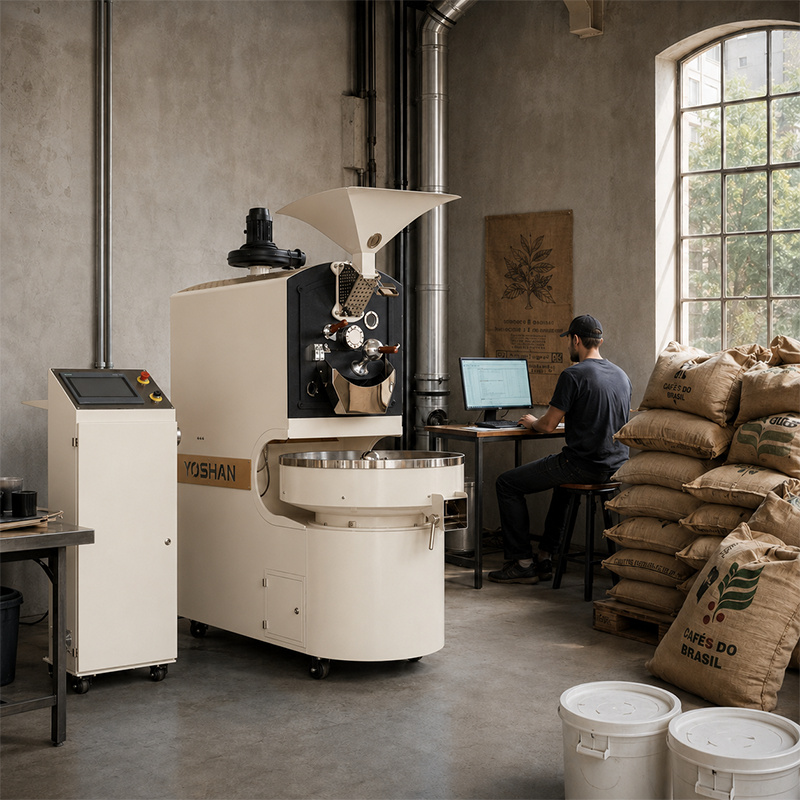
"Does this work with 110 volts?" is, after price and shipping, the question we hear most — and a roaster built for the wrong supply means an expensive retrofit or a machine that will not start. This coffee roaster voltage guide explains what to tell us by country and by machine size, why it matters even on a gas machine, where single-phase ends and three-phase begins, and what to send before we build.
Why Voltage Matters Even on a Gas Roaster
A common misconception: “My roaster is gas, so power does not matter.” Every drum roaster you might buy — gas or electric — uses electric motors for the drum, cooling fan and exhaust fan, plus a control panel. A gas roaster typically draws only 0.5–2 kW, but that power must still match your wall socket in voltage, frequency and phase. Fully electric roasters draw far more (3–20+ kW), which is why electric heating is mainly offered up to the 3 kg class for single-phase buyers.
The Three Numbers You Must Tell Your Supplier
-
Voltage — 110–120V, 220–240V, or 380–415V
-
Frequency — 50 Hz or 60 Hz (affects motor speed; a 50 Hz motor on a 60 Hz grid runs ~20% fast)
-
Phase — single-phase or three-phase
All three are factory configurations for your machine. Changing them before production costs nothing; changing them after delivery means replacing motors and control components.
Voltage by Region: Quick Reference
| Region | Typical supply | Notes for roaster buyers |
|---|---|---|
| Canada | 120V / 60 Hz | 1–2 kg electric models available in 110–120V; larger machines use 220V (dryer-style) circuits — guide en français pour le Québec : torréfacteur de café |
| Mexico, Central & South America | 110–127V or 220V, 50/60 Hz mixed | Varies by country — confirm both voltage and frequency; Argentina/Chile are 220V 50 Hz, Colombia/Ecuador 110–120V 60 Hz |
| Europe & UK | 230V / 50 Hz | Standard configuration; CE documentation available on export models |
| Middle East & GCC | 220–240V / 50 Hz (KSA partly 60 Hz) | Saudi Arabia uses 230V/60 Hz in most areas — state your city; full details in the Saudi & Gulf buyer guide |
| Southeast Asia | 220–230V / 50 Hz (Philippines 60 Hz) | The Philippines is 220V but 60 Hz — a detail often missed; Malaysia/Indonesia/Thailand are 50 Hz (see the Southeast Asia guide); see our Philippines buyer guide |
| Africa | 220–240V / 50 Hz | If grid power is unstable, choose gas heating with low electric load; a small stabilizer protects your control board — more in our Ethiopia & East Africa guide |
| Australia & NZ | 230V / 50 Hz | Standard configuration |
Single-Phase vs Three-Phase: Where Is the Line?
-
Up to 12 kg (gas heating): single-phase 220–240V is normally enough, because gas provides the heat and electricity only runs motors and controls.
-
Electric heating above ~3 kg: heating elements push the load beyond what a single-phase circuit handles comfortably — three-phase becomes necessary.
-
20 kg and above: plan for 380–415V three-phase regardless of heat source. Larger motors and your optional afterburner need it.
If your building has no three-phase supply, tell us early — on many mid-size machines we can configure the motor package for single-phase operation.
Circuit rating matters as much as voltage in some markets: in Australia and New Zealand a standard 10 A outlet supplies only about 2.3 kW, so most electric roasters need a dedicated higher-amperage circuit — see the Australia & New Zealand buyer guide.
Plugs, Breakers and Installation Details
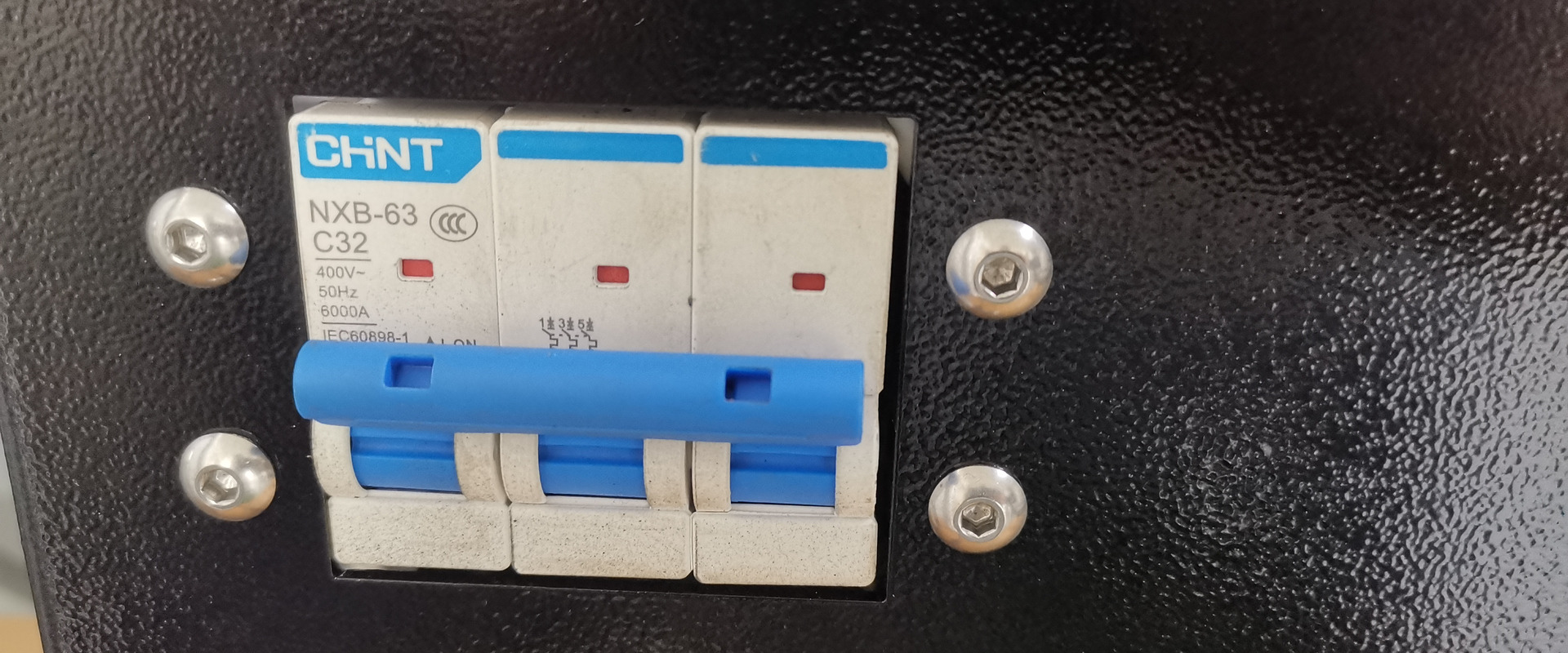
“Where are the plugs for your machines?” is a real question from a recent buyer — and a fair one. The machine you order, if it is above 2 kW, is normally shipped without a molded plug, because plug standards differ by country. Your electrician hard-wires your machine or fits a local plug to your supplied cable. Prepare:
-
A dedicated circuit with the breaker size stated on your quotation (typically 10–16A for gas models)
-
Grounding — mandatory on your machine if it has a PLC or digital controls
-
For an unstable grid: a voltage stabilizer sized to your control load
What to Send Us Before the Build
Three things settle the electrical build in one message, and they take your electrician ten minutes:
- A photo of the distribution board with the main breaker and the circuit you intend for your roaster visible — it shows phase count and breaker rating better than any description.
- The reading, not the nominal figure. "230 V" on paper is often 215 or 245 at the wall; a stabiliser decision depends on the real number and how much it moves during the day.
- The frequency and the plug standard, and whether three-phase exists anywhere in the building even if not at your machine position — on a 20 kg machine that decides whether the fan motors go single or three-phase.
With those, your machine is wired, the nameplate stamped and the wiring diagram sent ahead, so the circuit is in before the crate lands; the commissioning guide covers the electrician's checks on the day. Every model from the DY-1 at USD 2,599 to the SD-60 Pro full set at USD 61,999 is built to the supply you send, at no extra charge.
Frequently Asked Questions
What draws the power on a gas roaster?
The drum motor, the exhaust and cooling fans, the burner ignition and the controls — typically 220 W on a DY-2 and under 2 kW on drums up to 15 kg. That is why gas machines run on an ordinary single-phase circuit in every market, and why the frequency matters more than the voltage: the motors are what a wrong frequency affects. Electric heating is a different question, because the element adds 4 kW and up.
Can one machine be built to run in two countries?
Not economically. Motors and controls are specified for one voltage and frequency, and a dealer moving a showroom machine from a 220 V/50 Hz market to a 110 V/60 Hz one is buying new motors. If you serve two markets, order machines for each; if a machine must travel — a trade-show unit, say — tell us both destinations and we specify for the one it will roast in and a transformer for the other.
Do PLC machines need anything extra?
A clean earth and, on an unstable grid, a stabiliser sized to the control load — a few hundred watts — because the PLC and touch screen are the parts a spike takes out. On three-phase machines the electrician must also confirm phase rotation at commissioning, or the drum and fan run backwards. Nothing else: the YS series Siemens controller runs on the same supply as the motors.
What breaker size should my electrician plan for?
The figure on your quotation, which is set by the machine's connected load: typically 10–16 A for gas-heated drums up to 15 kg, a dedicated 20–32 A single-phase circuit for the 4.4 kW electric DY builds, and a three-phase feed sized to the nameplate from 20 kg up. Give the electrician the nameplate rating and the wiring diagram we send ahead of delivery and the circuit is right first time.
Which countries most often get this wrong?
The mixed ones: Brazil, Mexico and Colombia, where 127 V and 220 V coexist in the same building; the Philippines and Saudi Arabia, where 220 V comes with 60 Hz; and any site where "we have three-phase" turns out to mean "somewhere in the building". The fix in every case is the same — send the board photo and the reading — and the regional guides for Latin America, the Philippines and the Gulf cover the local detail.
Final Thoughts
Coffee roaster voltage is three numbers — voltage, frequency, phase — read at your board rather than assumed from your country, and sent to us before the build. Get them right and the machine arrives wired, stamped and ready for the circuit your electrician has already installed; get them wrong and you are replacing motors. Send us the board photo and the reading. Talk to our engineers.
Get a Quote → WhatsApp +86 184 0771 4607Last updated: September 17, 2026
Pingback: Coffee Roasters for Colombia & Central America Guide
Pingback: Coffee Roastery Startup Costs: The Budget Lines That Sit Outside the Roaster Quote – Yoshan Coffee Roaster
Pingback: Commercial Espresso Machine Voltage & Power: 3 Numbers by Country
Pingback: Coffee Roasting Plant Setup: Six Things to Settle in Order | Yoshan
Pingback: 20 kg Coffee Roaster: What Changes Stepping Up From 12 kg | Yoshan
Pingback: PLC Coffee Roaster Automation: What It Does and Cannot Do | Yoshan
Pingback: How to Buy a Coffee Roaster from China: Fix These Four First | Yoshan
Pingback: How to Start a Coffee Roasting Business: Volume, Machine, First Roast
Pingback: How to Read a Coffee Roaster Spec Sheet: Four Lines to Get in Writing
Pingback: Coffee Roaster for the Philippines: 60 Hz, Resellers, Barako | Yoshan
Pingback: Coffee Roaster for India & South Asia: Power, LPG, Paperwork | Yoshan
Pingback: Used Coffee Roaster vs New: The Three-Column Comparison | Yoshan
Pingback: Coffee Roaster for Southeast Asia: MY, ID and TH Bean by Bean | Yoshan
Pingback: Coffee Roaster for Canada: Voltage, CSA and Field Evaluation | Yoshan
Pingback: Receiving a Coffee Roaster: Unloading, Moving and Positioning
Pingback: Torrefador de Café: Tensão, Gás, Capacidade, Importação | Yoshan
Pingback: Molino de Café Comercial: Fresas, Hora Pico, Voltaje, Precios | Yoshan
Pingback: Coffee Roastery Equipment: Buy Now, in Six Months, in a Year | Yoshan
Pingback: Entry-Level Commercial Coffee Roaster: 1–3 kg Machines Compared
Pingback: Gas vs Electric Coffee Roasters: Your Building Decides | Yoshan
Pingback: Coffee Roaster Installation Checklist: 5 Deadlines to First Roast