
Seventy-nine of our recorded buyer questions are about installation — mostly about the exhaust. This page does not repeat our ventilation requirements guide, which covers duct design, airflow and chimney height. It covers the other half of the question: what the machine gives you to connect to, what ships in the crate for it, and what to have ready before the crate arrives.
Where this step sits
Installation follows unboxing and precedes commissioning and drum seasoning and operator training.
What the machine gives you to connect to
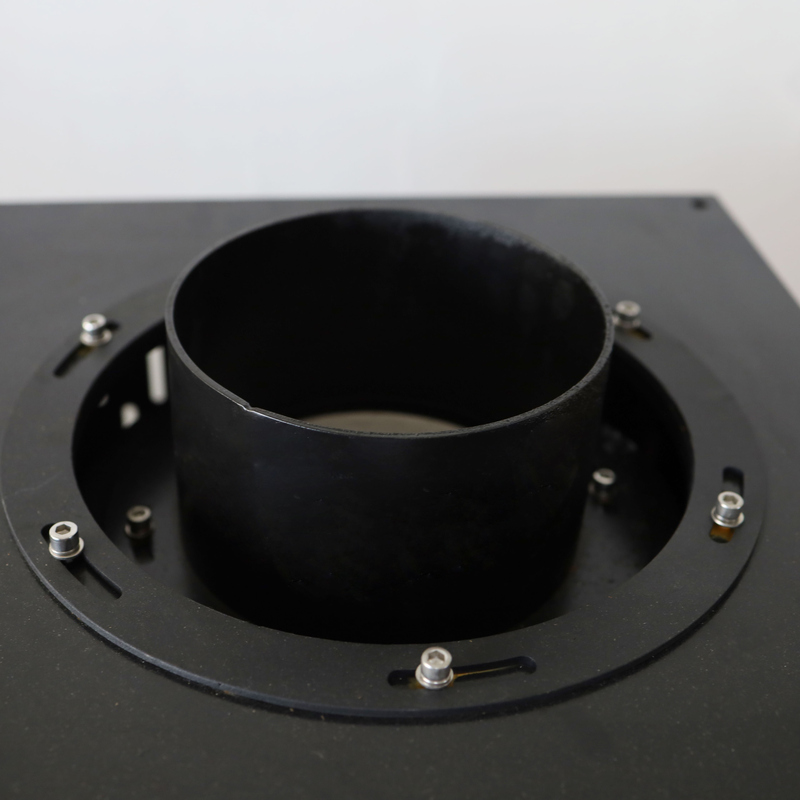
Exhaust outlet. The roaster’s exhaust leaves through a round outlet on the cyclone or the top of the machine, with a flange or spigot sized for the model. The outlet diameter is on your spec sheet so your duct can be ordered before the machine arrives. The first section from the outlet is made with the flexible aluminium foil pipe and two clamps that ship in the accessory kit; from there, rigid duct to outside.
Cooling exhaust. On most models the cooling fan’s discharge is separate from the roast exhaust; it carries chaff dust and warm air and should also be ducted outside or filtered. Its outlet position and size are on the spec sheet.
Gas inlet. A threaded connection — 3/8″ on the smallest gas models, larger on larger machines — at the rear or side of the gas train, with a pressure gauge you can read. Grommets and a copper pipe sleeve set are in the kit. Connection is by a licensed gas fitter.
Electrical inlet. A labelled supply terminal in the control cabinet, for the voltage and phase the machine was wired for; connection by an electrician through a local isolator.
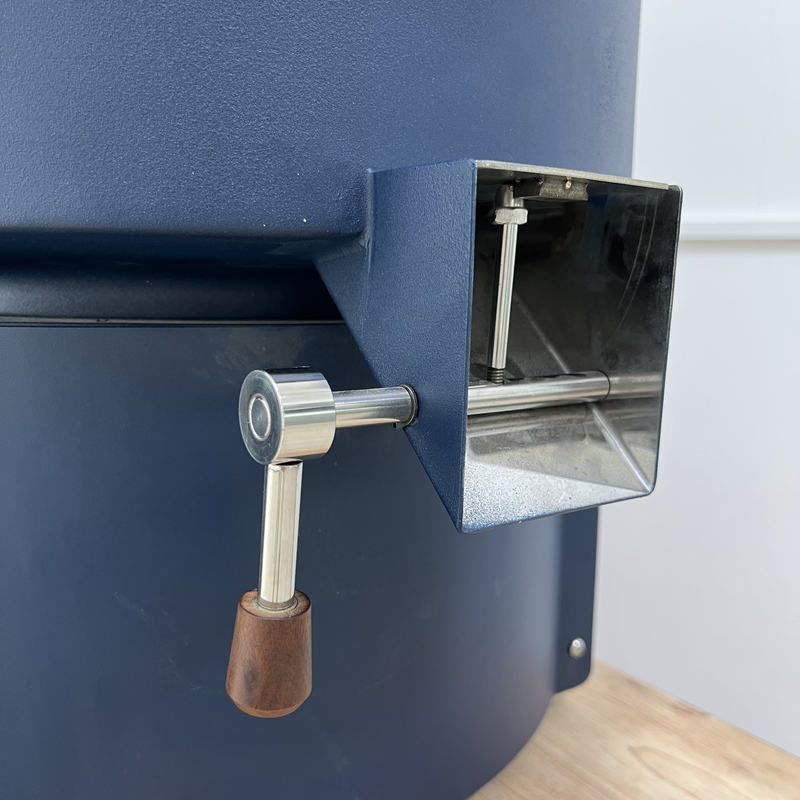
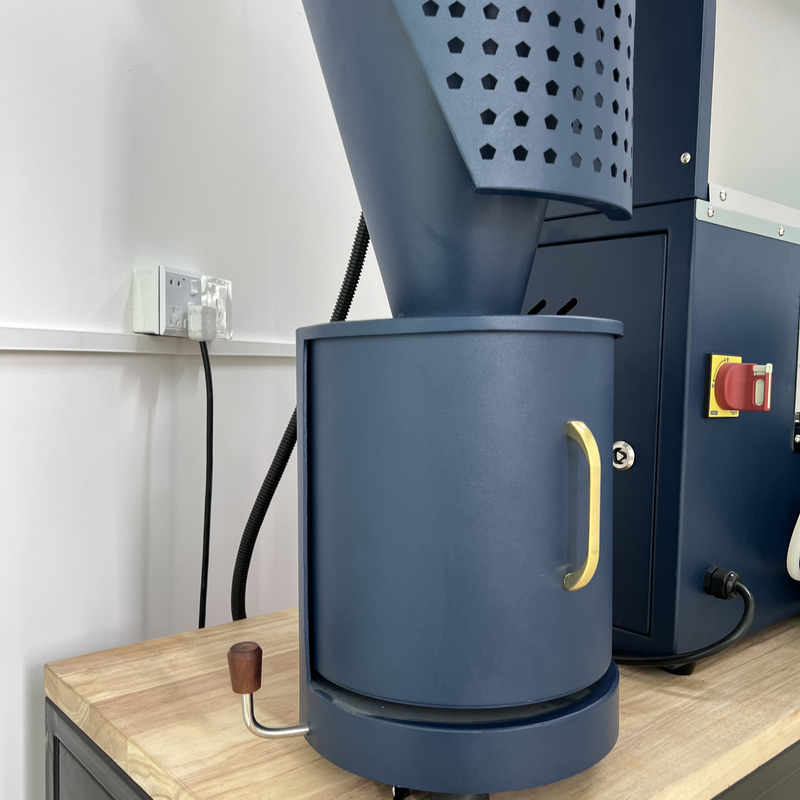
Chaff collector. The cyclone’s collector bin is separate from the body and needs clear floor access for emptying.
What to prepare before the crate arrives
- The exhaust route. Where the duct will run from the outlet to outside, its diameter and its length, with as few bends as possible. Read the ventilation guide for sizing; ask us with your layout if in doubt.
- Make-up air. A roaster pushes air out of the room; the same volume has to come in. A closed room with a roaster exhausting to outside starves the burner and the cooling fan. Plan an inlet.
- Gas supply of the ordered type at the machine’s position, with an isolation valve.
- Electrical supply of the ordered voltage and phase, with an isolator.
- Floor and access. A level floor that carries the machine’s weight; a route from the delivery point to the position that the crate or the machine on its base fits through.
- Clearances around the machine for operation, cleaning and service, as given in the manual.
- Smoke and smell control, if your location needs it — an ESP smoke filter or an afterburner is best planned into the exhaust route now, not retrofitted.
What we do to help
Send us a sketch of the room with the machine position, the proposed exhaust route, the gas and electrical points and the door widths, and we will mark up what to change before you spend money on ducting. Our installation team has been fitting roasters and exhaust systems for three decades, and for industrial lines we design the dust and exhaust system for your building. For single machines, remote guidance during installation is included; operator training follows.
What this means for you
- Your fitters have the outlet size, connection sizes and drawings before the machine arrives, so the installation is a day’s work, not a week’s.
- The first section of exhaust is in the crate; the rest was ordered in advance.
- Smoke control was planned with the exhaust, not bolted on after the neighbours complained.
How to verify this on any roaster
Ask for the exhaust outlet diameter, the gas connection size and the electrical requirement for the exact model, in writing, before you order. If the supplier cannot give all three from a spec sheet, they have not documented the machine well enough for a fitter to prepare for it.
Frequently asked questions
How far can the exhaust run?
It depends on diameter, bends and fan capacity; the ventilation guide gives the method. Long runs and many bends need larger duct or an in-line fan. Ask us with your layout.
Can the roast exhaust and cooling exhaust share one duct?
Generally they are kept separate to the outside, or joined only after any smoke treatment, because the cooling air is high in volume and low in temperature and can cool the roast exhaust to the point where oils condense in the duct.
Do I need an afterburner?
It depends on batch size, roast level, location and local rules. Small machines in industrial areas often need only good exhaust; residential locations and larger machines usually need an ESP filter or an afterburner. The guides linked above set out the decision.
Will you install the machine for me?
For industrial lines, on-site installation and commissioning by our team is available and quoted per project. For single machines we provide drawings, remote guidance and training; local licensed gas and electrical connection is required in almost every country.
Final thoughts
A roaster is installed once and used for years; the hours spent preparing the exhaust route and utilities before delivery are the best-spent hours of the whole project. Once connected, follow the commissioning and seasoning guide for the first batches, and book operator training. Or return to the full build sequence.
Tell us your country, voltage, gas type and kilograms per week — and send a sketch of your room — and we will send the matching spec sheet with connection sizes and a marked-up layout. Request the spec sheet · WhatsApp: +86 184 0771 4607
Last updated: September 15, 2026