
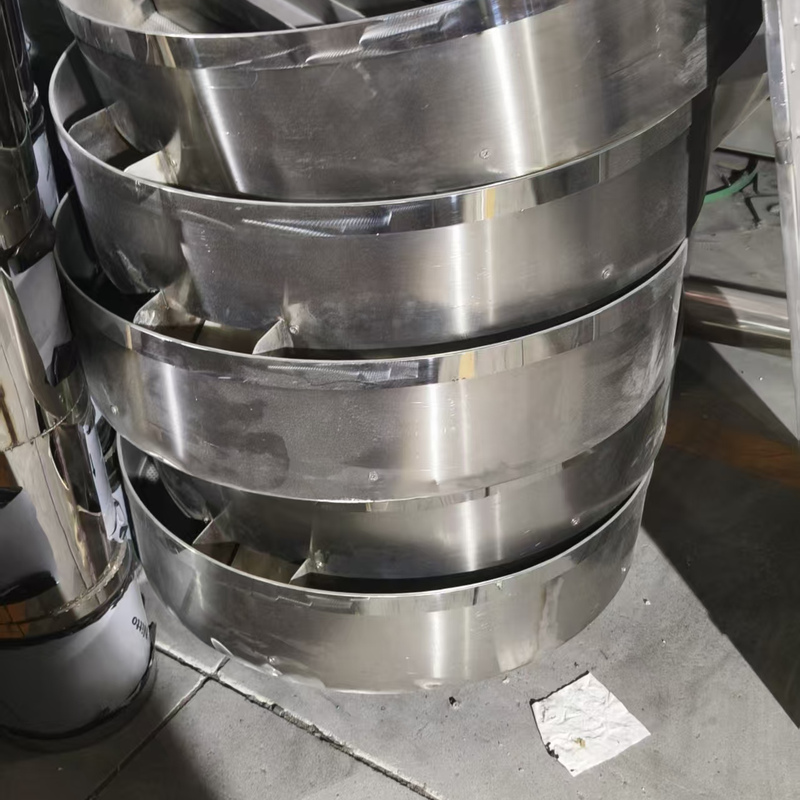
A casting is not finished when it comes out of the mould. As molten iron cools, the outside solidifies before the inside, and the thick and thin sections of the drum shrink at different rates. The result is a drum that looks perfect and is, internally, pulling against itself. Machine it straight away and it will be round on the lathe and slightly oval six months later, in your roastery, at 200 °C.
Where this step sits
Stress relief is the step between casting the drum and machining it. It adds time to the build. It is also the reason a cast drum stays round.
What internal stress does to a drum
Locked-in stress from casting does not stay locked in. Every time the drum is heated to roasting temperature and cooled again, some of that stress is released, and the metal moves a little. On a drum that was machined round while still stressed, the movement shows up as:
- Ovality. The drum runs slightly eccentric. The gap to the front plate closes on one side and opens on the other.
- Scraping. At the tight side, the drum rubs the front plate or the chute — a sound every roaster knows and dreads.
- Bearing load. An eccentric drum loads its bearings unevenly on every rotation, and they fail early.
- Cracked attachments. Where vanes, end plates or shaft bosses are attached, movement in the drum wall concentrates stress at the joint.
None of this appears on the factory test roast. It appears after a few hundred heat cycles — which is to say, in your first year.
How we relieve it
Before machining, drums cast in our plant are rested to let the internal stress equalise, so that the metal has already done its moving before the lathe and boring mill define its final shape. Only after this step is the drum turned, bored and fitted with its shaft. We do not publish the process parameters on this page; if you are specifying a machine for an engineering review, ask and we provide them for your model.
The photograph of drum shells on this page shows castings staged before machining.
What this means for you
- The clearance between drum and front plate that was set in the factory is the clearance you have in year three.
- No scraping, no eccentric bearing wear, no vanes coming loose.
- A machine that can be run for a full shift, day after day, without the drum “settling”.
How to verify this on any roaster
Ask the manufacturer whether their cast drums are stress-relieved before machining, and how. The answer you want is a description of a step between casting and machining. If the answer is “the casting is machined directly”, you now know why some machines start scraping after the first winter.
Frequently asked questions
Does stress relief apply to stainless drums too?
Rolled and welded stainless drums carry stress from forming and welding rather than from casting. On DY and EC models the drum is stress-relieved after welding, before final finishing, for the same reason.
Can a drum that has distorted be fixed?
Sometimes, by re-machining, if there is enough wall thickness. Often the practical repair is a new drum. It is far cheaper to prevent than to fix, which is why this step exists.
How long does the step add to production?
It is built into the standard production time on your quotation. You do not wait extra for it; it is simply part of how long a machine takes to build.
Is this why cast iron machines take longer to build than sheet-metal ones?
It is one of the reasons. Casting, resting, machining and balancing a drum is more work than rolling a sheet. The result is a drum that behaves the same in year five as on day one, which is what a production roastery is paying for.
Final thoughts
Stress relief is a step you never see and would never know was skipped until the drum starts to scrape. We do it because the alternative is a warranty claim in your second winter. The drum then goes to machining and balancing; the machines that carry these drums are the SD series. Or return to the full build sequence.
Tell us your country, voltage, gas type and kilograms per week — we will send the matching spec sheet for that model. Request the spec sheet · WhatsApp: +86 184 0771 4607
Last updated: September 15, 2026