
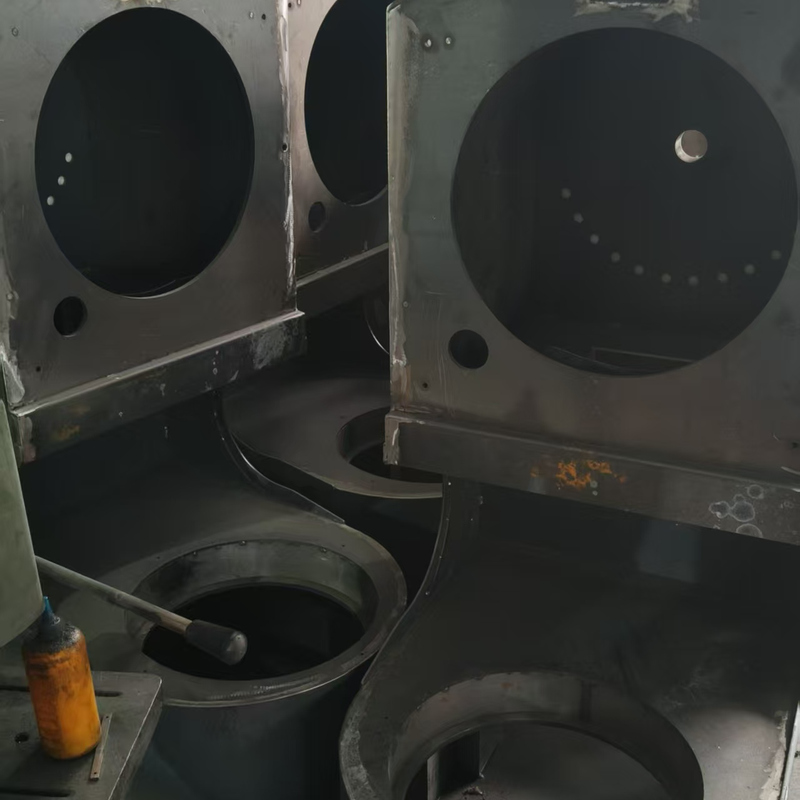
Run your hand along the inside edge of a cheap roaster’s cooling tray and you will find out why this page exists. A laser-cut edge is sharp. A weld bead is rough. Neither is dangerous on a drawing, and both are dangerous on a machine that an operator cleans by hand every day. Grinding and deburring cost time and add nothing you can photograph for a catalogue, which is precisely why they are the first thing a cost-cutting factory drops.
Where this step sits
Grinding and deburring follow welding and precede brushing and polishing and powder coating. The first of the three inspections is carried out on the ground, deburred body before any finish goes on.
Two different jobs
Grinding deals with welds. A weld bead stands proud of the surface. On a structural joint that is fine and the bead stays. On a visible seam it is ground flush so that after brushing the seam disappears; on a seam that will be powder-coated it is ground smooth so the coating lies flat. Grinding is also where welds are inspected: a bead ground back reveals porosity or lack of fusion that a bead left alone would hide.
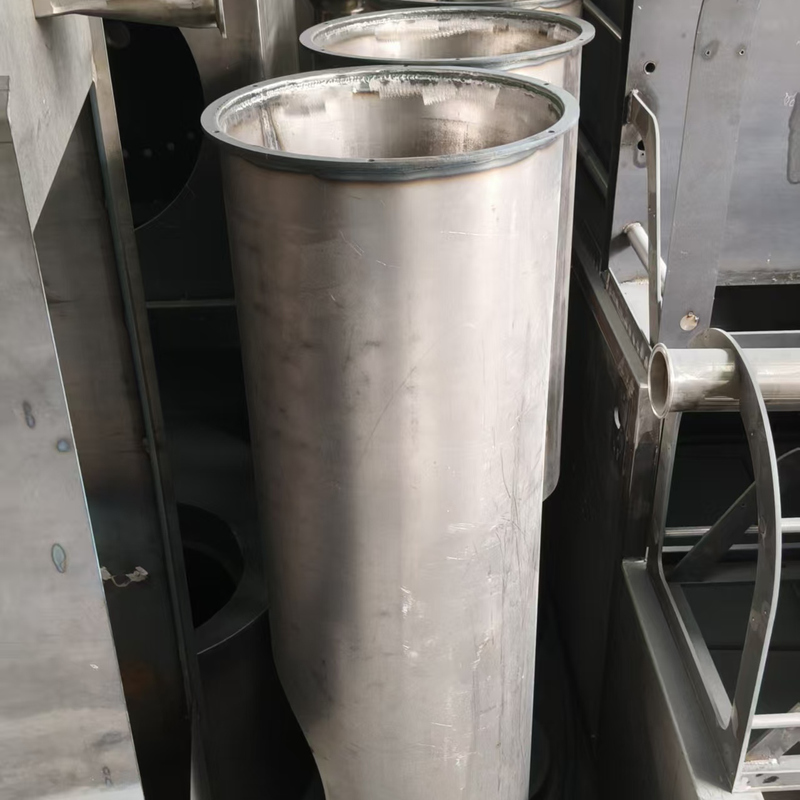
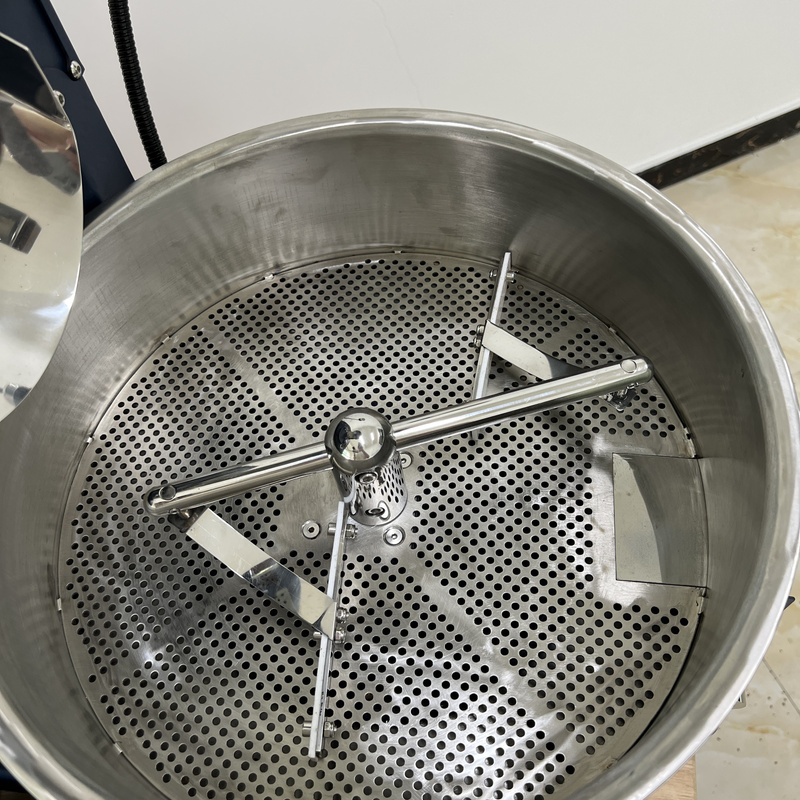
Deburring deals with edges. Every cut and every drilled or punched hole leaves a burr — a thin, sharp lip of metal. Every edge on the machine that a hand, a cloth or a bean can reach is deburred: the cooling tray and its perforations, the chute, the hopper, the drum door, panel returns, the openings around switches and gauges, the inside of the cyclone.
How we do it
Bodies, cyclones, trays and panels are ground and deburred in our plant after welding, before finishing. Visible seams are ground flush and blended; structural welds are cleaned of spatter and dressed. Edges are deburred by hand and machine according to where they are. The photographs on this page show bodies and cyclones at the stage between welding and finishing, which is when this work is done.
What this means for you
- Safety. No edge on the machine cuts a hand. That is a legal requirement in many markets and a decency everywhere.
- Cleaning. A cooling tray with deburred perforations can be wiped and brushed without catching a cloth; chaff and oils do not lodge on rough edges.
- Finish. Brushed stainless only looks right on a surface that was flat and clean underneath. Powder coat only lies smooth on a ground seam.
- Weld quality. Because grinding exposes weld defects, the step is also an inspection. Defects found here are repaired before paint.
How to verify this on any roaster
Use your hand. Run a finger — carefully — along the rim of the cooling tray, around the inside of the drum door opening, along the edge of the chute and across a few perforations. Then look at a visible seam under the finish. If you feel a burr or see a seam, the step was skipped or rushed. Most buyers never check; it is the fastest way to tell a well-built machine from a quickly-built one.
Frequently asked questions
Does grinding weaken a weld?
Grinding a bead flush on a sheet-metal seam does not weaken a sound weld; the joint’s strength is in the fused metal, not the bead standing above it. Structural welds that carry load are dressed, not ground flush, and their bead stays.
Why is deburring done partly by hand?
Because the edges are in different places and orientations — inside a cyclone, around a perforation, along a return. Machine deburring handles flat edges; the rest needs a person with a tool and time.
Is the drum deburred?
The cast drum is machined, which leaves clean edges; the vanes and the door opening are dressed where they could catch beans or hands. Stainless drums on DY and EC models are deburred after forming.
Is the inside of the machine deburred, or only what is visible?
Anything a hand reaches during cleaning or maintenance, and anything a bean touches, is deburred — inside the cyclone, the chute, the tray, the hopper. Purely internal structural edges are not.
Final thoughts
The best evidence of care in a machine is often in the places no one photographs. From here, visible stainless goes to brushing and polishing and painted parts go to powder coating. Or return to the full build sequence.
Tell us your country, voltage, gas type and kilograms per week — we will send the matching spec sheet for that model. Request the spec sheet · WhatsApp: +86 184 0771 4607
Last updated: September 15, 2026