
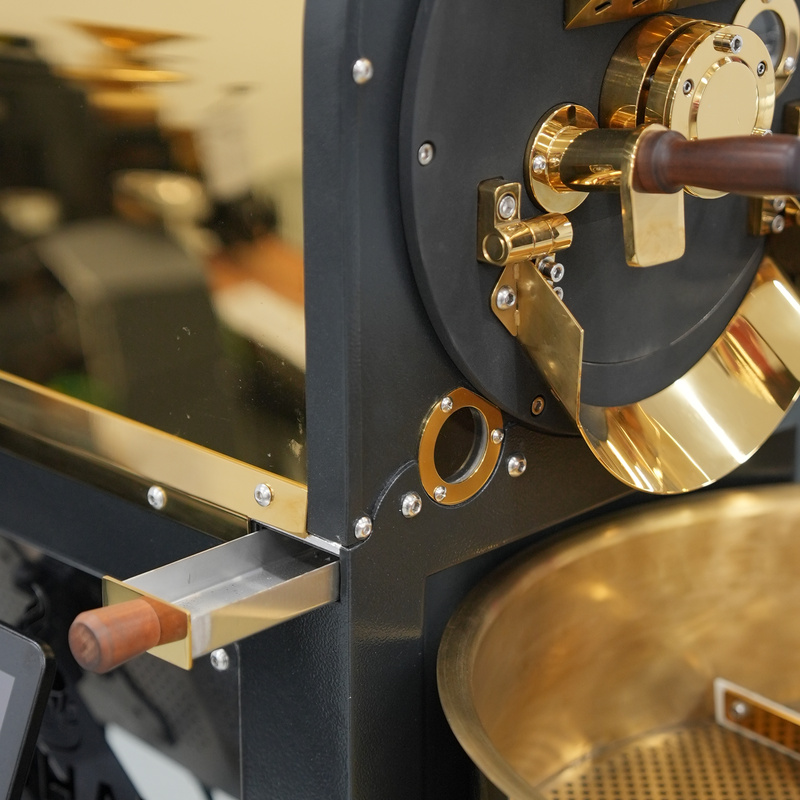
A drum is a cylinder that turns inside a box with a fire under it, with a few millimetres between its edge and the front plate. Those few millimetres are where a roaster is won or lost. Too tight and the drum scrapes, or beans jam and burn. Too loose and beans fall through into the firebox, chaff builds up, and heat leaks where it should not. Getting it right is a machining job, and it happens here.
Where this step sits
Machining follows stress relief and precedes balancing. The drum leaves this step with its final dimensions, its shaft fitted, and its clearance to the front plate defined.
What is machined, and why
The outer diameter and the ends. The cast drum is turned so its outside is truly cylindrical and its end faces are square to the axis. This is what allows a uniform gap to the front plate all the way round, on every rotation.
The shaft bore and shaft fit. The drum’s shaft boss is bored on the drum’s true centre, so that when the shaft is fitted the drum rotates about its own axis — not about a point slightly off it. An off-centre drum wobbles; a wobbling drum has a gap that opens and closes on each turn.
The front plate and its opening. The front plate is machined so its opening is concentric with the drum shaft bearing. Drum and plate are then fitted as a pair, and the running clearance is set and checked.
Vanes and internal features. Cast-in mixing vanes are dressed where necessary so that they lift and drop beans without catching at the front plate.
Why the clearance matters to the coffee
- Too tight: beans caught between drum edge and front plate are crushed or scorched, and the fragments show up as tipping and burnt notes. In the worst case the drum stalls.
- Too loose: whole beans drop into the firebox and burn, giving a smoky, ashy background to every batch, and chaff accumulates where it is a fire risk.
- Uneven: a gap that is tight on one side and loose on the other gives both faults at once, and makes the roaster impossible to clean properly.
Our roast defects guide covers how these show up in the cup. Most of them are prevented on the lathe.
What this means for you
- Even roasting across the batch, because the drum’s contact with the beans and the air path around it are the same at every point of rotation.
- No scraping, no jammed beans, no drum stall.
- A machine that can be cleaned to bare metal at the front plate, because the gap is uniform and accessible.
How to verify this on any roaster
With the machine cold and the drum door open, turn the drum slowly by hand and watch the gap between drum edge and front plate through a full rotation. It should not visibly change. Ask the factory what running clearance the drum is set to; a machined drum has a number.
Frequently asked questions
Does clearance change as the drum heats up?
Yes — cast iron expands with temperature, and the clearance is set cold so that it is correct at roasting temperature. This is another reason the drum must be stress-relieved and machined properly: an unstable drum’s hot clearance is unpredictable.
Can the clearance be adjusted on site?
On our machines the drum position relative to the front plate can be checked and, within limits, adjusted by a technician during maintenance. The setting is described in the manual. It should not need adjustment in normal service.
Are the mixing vanes machined too?
Vanes are cast as part of the drum and dressed where they meet the front plate area. Their shape determines how beans are lifted and dropped, which affects roast evenness; that is a design matter set for each drum size.
What happens if a drum is out of tolerance after machining?
It is re-machined if wall thickness allows, or scrapped. It does not go into a machine. This is checked at the first of the three inspections.
Final thoughts
The lathe is where a drum stops being a casting and becomes a precision part. The next step is balancing so that the precision part also runs quietly. These drums go into the YS series and SD series; or return to the full build sequence.
Tell us your country, voltage, gas type and kilograms per week — we will send the matching spec sheet for that model. Request the spec sheet · WhatsApp: +86 184 0771 4607
Last updated: September 15, 2026