
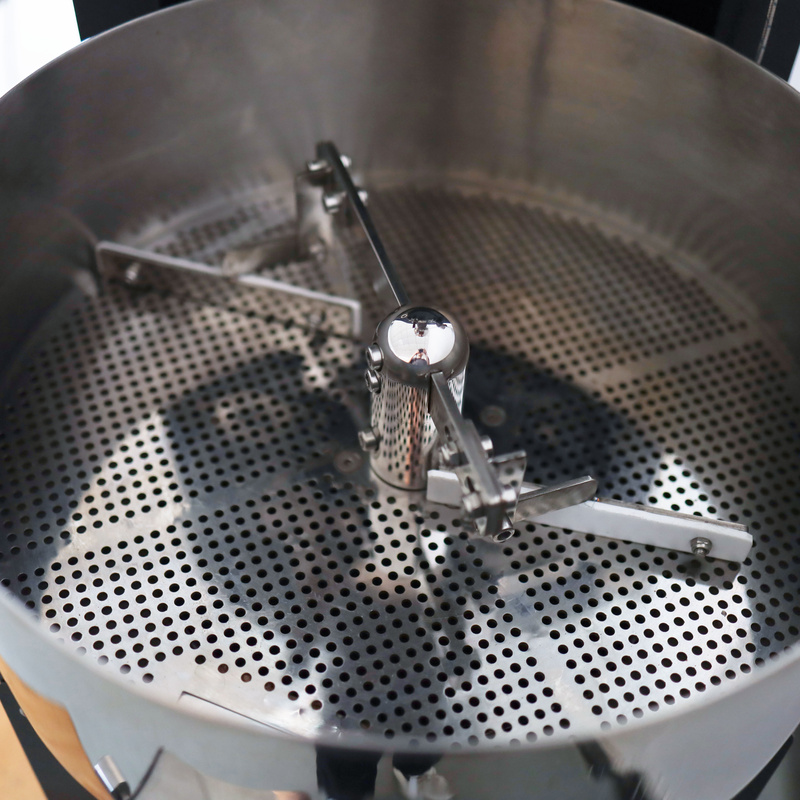
A roaster has four things that turn: the drum, the cooling stirrer, the cooling fan and the exhaust fan. On a simple machine they share a motor and a belt, which means they share a speed and a fate — slow the drum and you slow the exhaust; stop for cooling and you stop roasting. On the YS series each has its own motor. This page explains why that is worth the extra parts.
Where this step sits
The drive system is fitted after the drum is balanced and the control panel is wired, and before final assembly of the cyclone, cooling tray and trim.
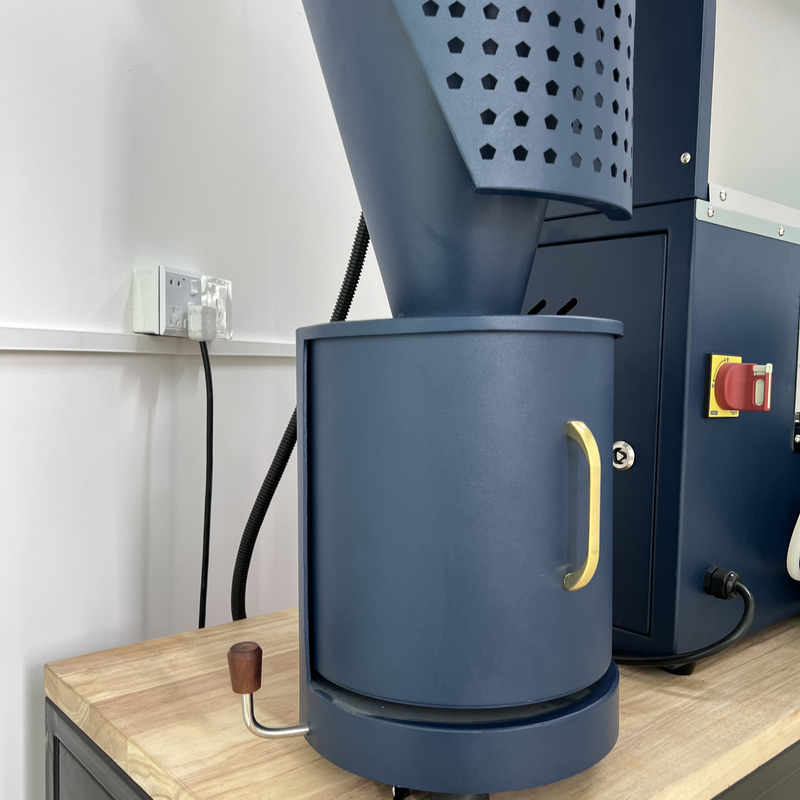
Four motors, four jobs
| Drive | What it does | Why it is independent |
|---|---|---|
| Drum motor | Turns the drum; speed is adjustable from the control panel | Drum speed is a profiling tool — it changes how beans are lifted and dropped and how much they contact the wall. It must be set without affecting airflow |
| Exhaust fan motor | Pulls air through the drum and out to the cyclone and stack | Airflow controls the balance of convective heat and clears smoke and chaff. It must be set without affecting the drum |
| Cooling fan motor | Pulls room air down through the cooling tray | Runs at full speed during cooling and off otherwise; independent so it can run while the next batch is roasting |
| Cooling stirrer motor | Turns the arm that moves beans across the tray | Runs only during cooling; independent for the same reason |
The motors on the YS series are made by ADDKA, a Japanese manufacturer. They are standard industrial units — see key components — which is what lets us say that a replacement can be sourced locally if it ever has to be.
What independent drives make possible
Roast and cool at the same time. With separate drives for the tray and the drum, the cooling tray can be clearing the last batch while the next is already roasting. On a production day this is the difference between a batch every roast time and a batch every roast time plus cooling time — and it is what allows continuous operation over a long shift on the industrial YS sizes.
Adjust one thing at a time. Drum speed and airflow are the two mechanical variables a roaster uses to shape a profile. When they are on separate motors, you change one and the other stays where you set it.
Simpler to maintain. Four small standard motors are easier to inspect, replace and keep as spares than one large custom drive with a belt system feeding everything.
Bearings and transmission
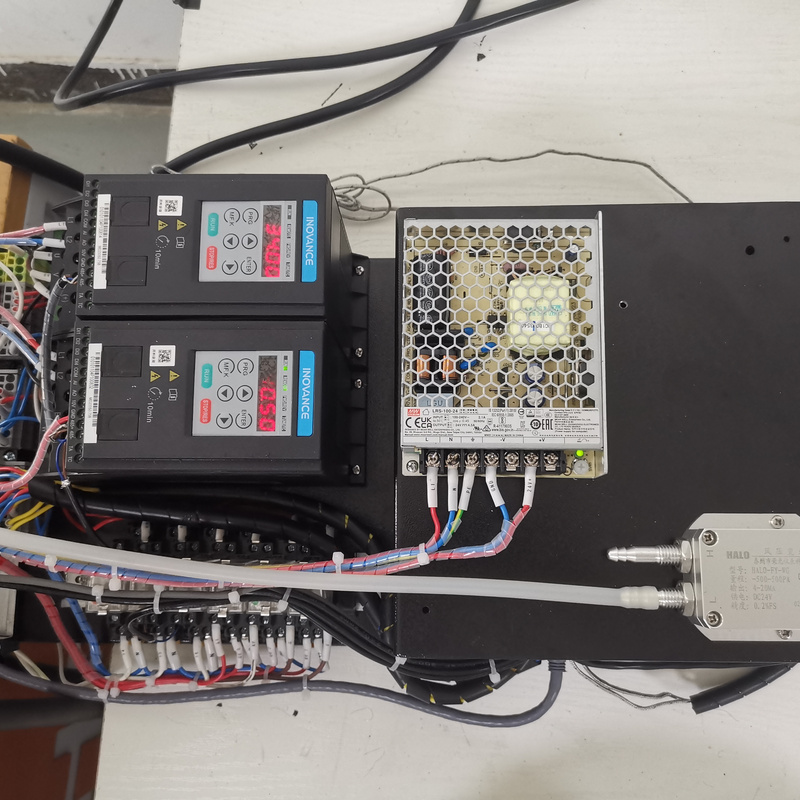
The drum runs on sealed industrial bearings sized for the drum, at each end of the shaft — see the balancing page for why balance is what makes them last. Fans are direct-driven or belt-driven depending on the model; where belts are used they are standard sizes listed in the manual. Bearings and belts are the wear items of the drive system and are on the recommended spares list.
What this means for you
- Higher throughput from the same drum size, because cooling no longer interrupts roasting.
- Profiles you can actually reproduce, because drum speed and airflow are set independently and hold.
- A drive system your local technician can service with parts from the manual.
How to verify this on any roaster
Ask: how many motors, and what does each one drive? Then ask whether the cooling tray can run while the drum is roasting. If one motor drives everything through belts, the answer to the second question is no, and the machine’s real hourly output is lower than its batch size suggests.
Frequently asked questions
Do the SD and DY series also have independent drives?
The SD Pro and DY series have separate drives for drum, cooling and fans appropriate to their size; the four-independent-ADDKA-motor arrangement described here is the YS series configuration. The spec sheet for each model lists its drive layout.
Can the drum speed be adjusted during a roast?
Yes, from the control panel on models with variable drum speed, and the setting is recorded with the profile on Siemens-controlled machines.
What happens if a motor fails?
The affected function stops; the others continue. Motors are standard units — the part number is in the manual, and we ship replacements by courier or you source locally. See warranty and spare parts.
Are the motors rated for my voltage?
Motors are specified for the voltage and frequency you order — 220–240 V 50/60 Hz single phase on 1–15 kg machines, 220 V or 380 V on 20–30 kg machines, 380 V three phase on 60 kg and larger and on electric-heated YS models. See the control panel page.
Final thoughts
Four motors instead of one is a decision about how a roastery runs, not about how a brochure reads. It is why a YS roaster’s hourly output is its batch size times its roast cycle, with no cooling penalty. Next: final assembly, where the cyclone and cooling tray go on. Models are on the YS series page, or return to the full build sequence.
Tell us your country, voltage, gas type and kilograms per week — we will send the matching spec sheet with the drive layout for that model. Request the spec sheet · WhatsApp: +86 184 0771 4607
Last updated: September 15, 2026