
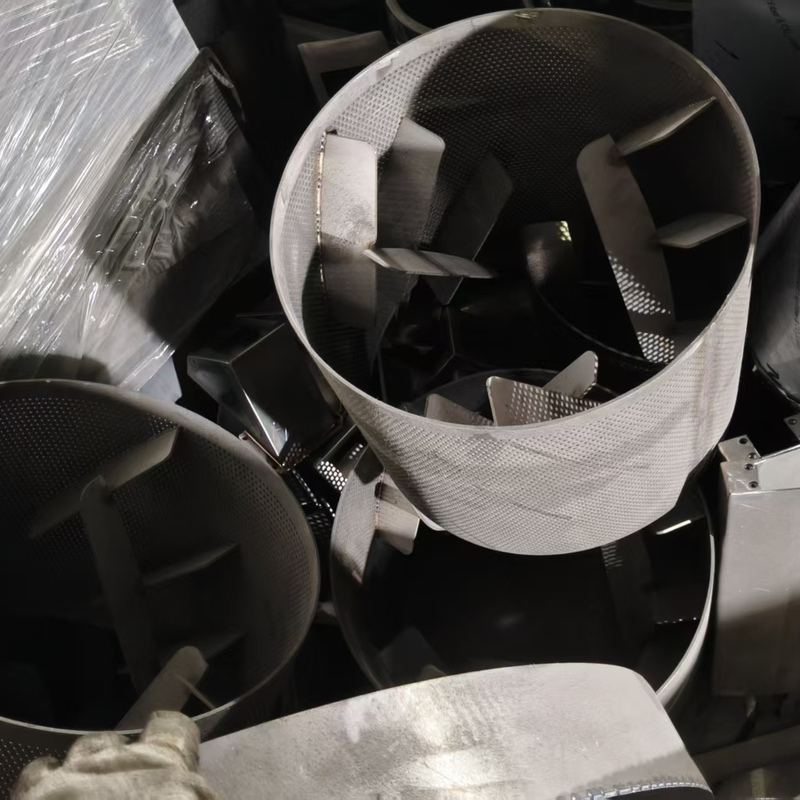
“Stainless steel roaster” is the most common phrase on roaster listings and the least informative. Which parts are stainless? Which grade? What is the drum? A roaster is made of three or four different metals, each chosen for a different job, and the choices decide how the machine roasts and how long it lasts. This page is the material list.
Where this step sits
Material selection is the first step of the build. It is followed by incoming material inspection and then drum casting.
Part by part
| Part | Material on Yoshan roasters | Why |
|---|---|---|
| Drum — SD and YS series | Cast iron | Thermal mass for stable, repeatable roasting; no seam |
| Drum — DY and EC-500G | 304 food-grade stainless steel | Lighter, faster-responding drum for 0.2–2.5 kg batches |
| Roaster body / firebox — SD and YS | Cast iron | Holds heat around the drum; rigid mounting for the drum shaft |
| Front plate, panels, hopper, cyclone, cooling tray | 304 stainless steel | Food contact, corrosion resistance, cleanable, takes a brushed or mirror finish |
| Outer shell — YS series | Electroplated 304 steel | Corrosion protection in humid and coastal environments |
| Frame and structural parts | Steel, powder-coated | Strength; a hard, chip-resistant finish |
| Trier (sampling spoon) and door handle | Stainless with wooden grip | Heat-safe handling |
| Gas train | Brass fittings and valves, steel pipe | Gas-safe, threaded, serviceable |
Why cast iron where the heat is
The drum and the body around it see the burner every day. Cast iron stores heat in its mass and releases it evenly, which is why a cast drum turns around faster after charge and drifts less between batches. That argument is made in full on the cast iron drum page. On the smallest machines — DY-1, DY-2 and the EC-500G sample roaster — the batch is small enough that a 304 stainless drum’s faster response is the better choice, and we use it there.
Why 304 stainless where the coffee touches
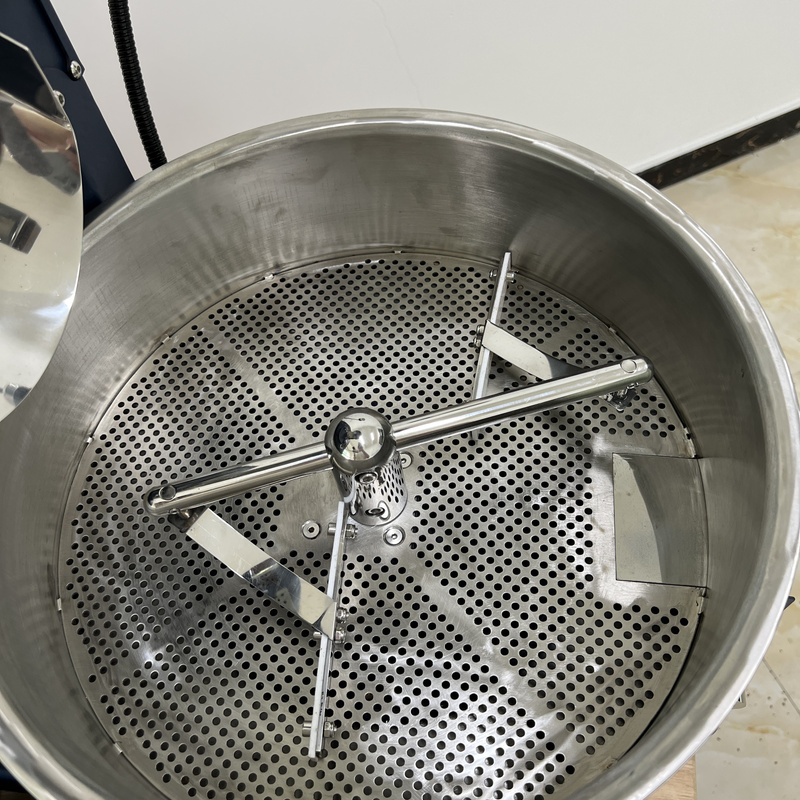
304 is the food-grade austenitic stainless steel used in commercial kitchens and food processing. On a roaster it is the right material for anything beans touch after roasting — cooling tray, chute, hopper — and for anything that must stay clean and presentable: front plate, cyclone, trim. It is also the material we brush or polish for the machine’s finish.
There are cheaper stainless grades. The most common substitute is 201, which contains less nickel and more manganese, costs less, and corrodes sooner — especially in humid or coastal air, and especially where it is heated. A machine described as “stainless steel” with no grade stated is, more often than not, 201 in the parts that are not visible.
How to tell 304 from 201 yourself
You do not need a laboratory.
- Ask for the grade in writing. A supplier that uses 304 will say 304. A supplier that says “stainless” is telling you something by not saying which.
- The magnet test. 304 in its annealed, as-supplied condition is essentially non-magnetic; a magnet slides off or clings very weakly. 201 and the 400-series ferritic grades attract a magnet clearly. Bent and welded 304 can become slightly magnetic at the worked areas, so test a flat panel, not an edge.
- Look at the mill certificate. Every batch of sheet we buy arrives with a mill certificate stating the grade and composition; that is what our incoming material inspection checks. Ask any supplier for theirs.
What this means for you
- The parts that roast are heavy and hold heat; the parts that touch roasted coffee are food-grade and cleanable; the parts you see are finished to last. That is a deliberate division, not a cost decision.
- A YS roaster in Manila, Jeddah or Mombasa does not rust at the panel seams after two humid summers — see the electroplated shell page.
- If you ever need to repair or modify the machine locally, the materials are standard: a fabricator knows what cast iron, 304 and mild steel are and how to work them.
Frequently asked questions
Is a 304 stainless drum worse than a cast iron drum?
Not worse — different. For sample and small-batch roasting, fast response matters more than thermal mass and a stainless drum is the right tool. For production batches from 1.5 kg upward, stability matters more, and cast iron wins. We use each where it belongs.
Does cast iron contaminate the coffee?
No. A seasoned cast iron drum — one that has run its first batches and carries a light film of coffee oils — is inert to the beans. Cast iron has been the standard drum material in coffee roasting for well over a century.
Which parts are powder-coated steel and could chip?
The frame and the outer body panels that are painted in your chosen colour. Powder coating is harder and thicker than wet paint and chips only under a sharp impact. Where a panel must never mark, we use brushed stainless instead — see brushed and polished finishes.
Can you provide material certificates with the machine?
Yes. Ask when you order and the mill certificates for the stainless used on your machine are added to the document pack.
Final thoughts
Materials are the one part of a roaster you can check without switching it on: ask the grade, bring a magnet, read the certificate. The next step in the build is inspecting those materials when they arrive, followed by casting the drum. The small stainless-drum machines are the DY series and the EC-500G sample roaster; or return to the full build sequence.
Tell us your country, voltage, gas type and kilograms per week — we will send the matching spec sheet with the material of every major part for that model. Request the spec sheet · WhatsApp: +86 184 0771 4607
Last updated: September 17, 2026