
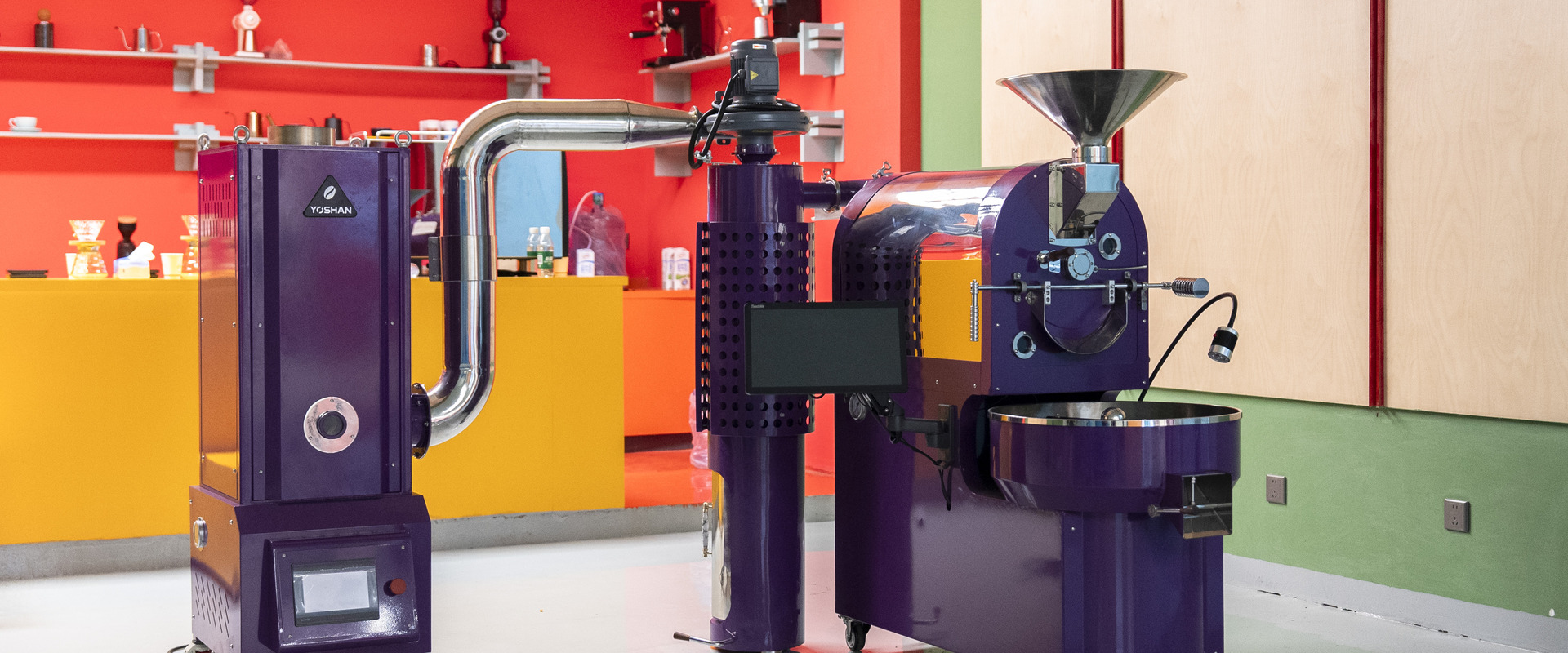
If you are planning a coffee roasting plant — a 15 to 60 kg line rather than a machine in a shop — the mistakes that cost the most are not wrong purchases. They are right purchases made in the wrong order: a roaster bought before the emissions permit, a lease signed before anyone measured the ceiling. Here are the six things to settle, in the order they depend on each other, with the numbers for each.
1. The Permit Comes Before the Machine
Ask your local air-quality or environmental authority, in writing, what a roaster of your batch size at your address requires of you. The answer decides whether you need an afterburner, a smoke filter or only a stack of a certain height — and afterburners change the duct route, the ceiling height and the gas load, so nothing else on this page can be finalised until you have it. Some authorities issue a standard permit for coffee roasters with the temperature and residence-time figures spelled out; the afterburner guide explains what they mean. Ask the fire department and the building department the same question at the same time; retrofitting an afterburner into a finished room adds 20–40% to the project.
2. The Five Site Numbers
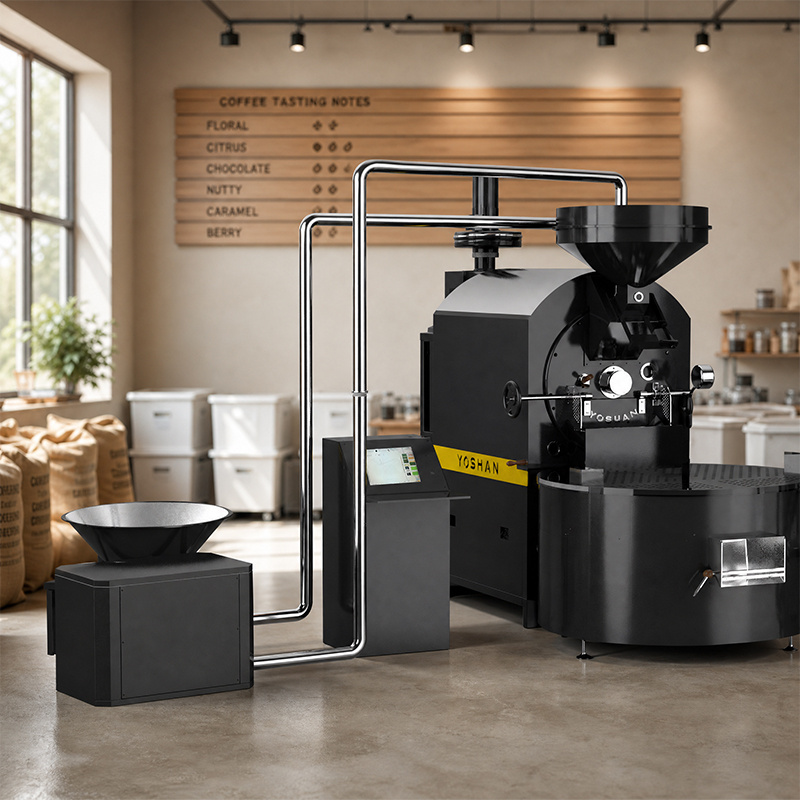
Before you sign your lease, put five numbers on one page:
| Number | What you need | Why |
|---|---|---|
| Floor area | About 100 m² supports up to 500 kg a week; add roughly 50 m² for every further 500 kg | Green storage, cooling swing, 1 m service access around the machine, packing, cupping |
| Clear height | 4 m minimum from 20 kg up; 4–6 m where an afterburner stack or loader column stands | The commonest reason a plant cannot install the afterburner it bought |
| Floor loading | 800–3,000 kg for the roaster zone; green storage on pallets is heavier | A concrete slab is usually fine; a mezzanine or a timber floor is not |
| Door and route | Crate dimensions, not machine dimensions, through every opening | A 30 kg roaster does not come apart to fit a doorway |
| Where the stack exits | A route to outside air away from neighbours' windows, with room for a cleanout | Decides the duct length and therefore the fan and the afterburner size |
Send us the floor plan with those five numbers marked and we check them against the line before you commit; we do that at quotation stage without charge.
3. Utilities: Gas, Power, Air
Gas. Size your gas line for every burner that will run at once at full output — the roaster and, if you have one, the afterburner — not for one machine. An undersized supply drops pressure mid-roast and ruins the batch. A licensed gas engineer sizes the line, regulator and manifold from the burner ratings we give you.
Power. Gas-heated drums up to 15 kg run on single-phase 220–240 V; from 20 kg the fans and loader make three-phase 380–415 V the normal supply, and electric heating requires it. A 30–60 kg line with full automation draws around 7–15 kW before the burner. Give your roasting area its own sub-panel. The voltage guide lists what to send us.
Compressed air. Pneumatic loaders and some afterburner valves want clean, dry air at 5–7 bar — a small dedicated compressor with a dryer, or a branch from the plant supply.
Drainage. Chaff and cleaning water need a floor drain routed away from production; water-quench cooling needs one by the tray.
4. Match the Equipment as a Line
At plant scale the ancillaries are not options; they are what stops your roaster being your bottleneck. A 60 kg drum fed by hand and cooled into buckets runs at a fraction of its rated output.
| Line | What ships together | Factory price (ex-works) |
|---|---|---|
| 15 kg | SD-15 Pro: roaster, loader, destoner; afterburner quoted when your permit needs it | USD 16,999 |
| 20 kg | SD-20 Pro: roaster, loader, destoner | On the quote — see the price guide |
| 30 kg | SD-30 Pro full set: roaster, auto loader, destoner, afterburner | USD 51,499 |
| 60 kg | SD-60 Pro full set: roaster, auto loader, destoner, afterburner | USD 61,999 |
| YS smart line | YS-20 / YS-30 / YS-60 with Siemens PLC and loader | USD 18,999 / 23,999 / 39,999 |
The full sets are specified as one system — hopper heights, flanges, duct diameters and control wiring matched by us — which is the cheapest way to avoid the adaptor-and-technician week that mixed-supplier lines go through. Add a sample roaster (SD 100G Plus, USD 899) for incoming green evaluation so the production drum never becomes your QC instrument. The industrial roaster guide places each size; the equipment list covers what to add when.
5. Workflow: One Direction
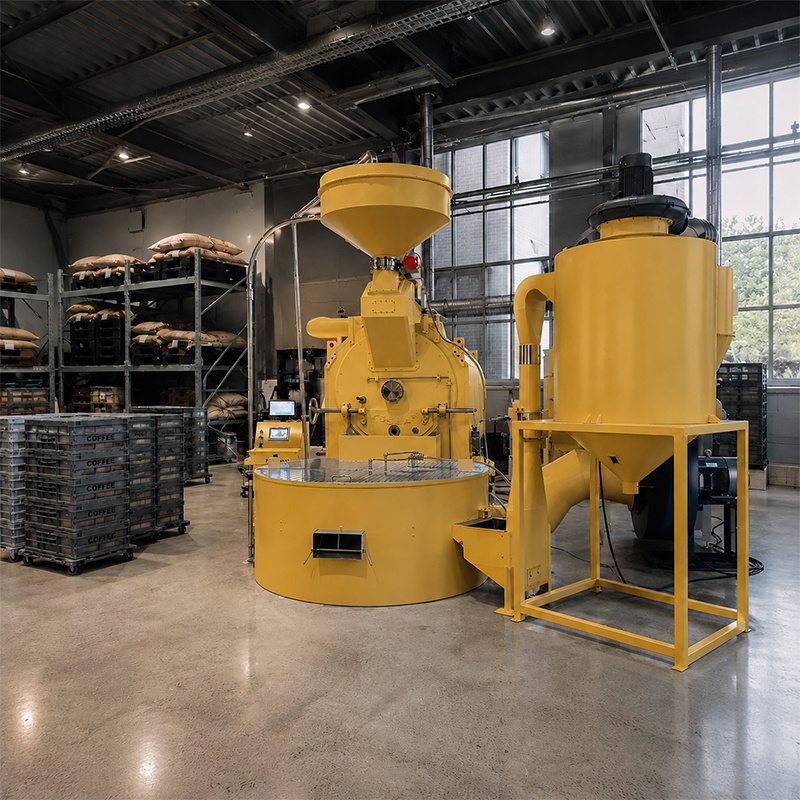
Lay your plant out so green coffee travels one way: storage → destoner → loader → roaster → cooling → packing → dispatch. A straight line or a U, with the afterburner placed to keep the duct short. Every backtrack costs you labour every day for as long as you run the plant. Leave a marked space for a second roaster on the same gas manifold and sub-panel — the plants that grow smoothly are the ones that drew it in on day one. The layout guide turns dimensions into a plan.
6. Budget and Timeline
For a 30–60 kg plant, the equipment is roughly half the project:
- Roaster line: USD 51,499–61,999 (SD full sets)
- Site preparation — gas, electrical, drainage, floor: widely variable; published plant examples run from a few thousand to tens of thousands depending on what the building already has
- Ventilation and afterburner installation: the duct, stack and the trades to fit them
- Permits and compliance
- Freight, duty and installation: your own lines — the shipping guide has the sequence
Timeline from order to first production run is typically 4–8 months: build and shipping 6–10 weeks; site preparation 4–8 weeks, which runs in parallel; installation and commissioning 2–4 weeks. Permitting is usually the critical path, which is why it is item 1.
The Mistakes We See Most
- Machine before permit. The permit can specify the equipment; buying first means buying twice.
- Gas line sized for one roaster when the plan is two.
- No sample roaster, so the production drum does the cupping lab's job.
- Low ceiling discovered after delivery. Measure your clear height to the underside of the lowest beam, not to the roof.
- No space for the second machine, so growth means a move.
Frequently Asked Questions
What is the minimum space for a coffee roasting plant?
Work from your weekly kilos: around 100 m² covers a line up to about 500 kg a week including green storage, cooling, packing and a cupping bench, and each further 500 kg needs roughly another 50 m². Clear height matters as much as area — 4 m from 20 kg up, more where an afterburner stack stands — and the crate route from the door to the machine position is the number most people forget to check.
Do I need an afterburner?
That is your authority's decision, not ours, and it is the first question to ask. Many cities require one above a certain batch size or in mixed-use districts; others accept an electrostatic filter or a stack. Whatever the answer, the afterburner's position goes on the drawing from 15 kg up, because it changes the duct and the height even if the unit is bought later.
How long does it take to set up a plant from scratch?
Plan on four to eight months from order to the first saleable batch. Manufacture and shipping take six to ten weeks, site work four to eight weeks in parallel, and installation with commissioning two to four weeks. The variable is the permit: if you start the application when you sign the lease, the machine arrives to a ready room; if you start it when the crate lands, the crate waits.
Manual or fully automatic for a production plant?
For a plant running shifts and supplying accounts that expect the same bag every week, the PLC machine pays for itself: saved profiles run the same on the night shift as on yours, every batch is logged, and a second operator can be trained in days. Keep a manual mode for profile development — our SD Pro and YS machines have both — and see the PLC guide for what automation does not do.
What does a 30–60 kg full set cost, all in?
The equipment is USD 51,499 for the SD-30 Pro set and 61,999 for the SD-60 Pro set, ex-works, with loader, destoner and afterburner included. Freight, duty, installation and the site work are your own lines and depend on your building; published plant projects put the whole at roughly double the equipment. Send us the floor plan and the address and we quote the equipment landed at your port.
Can you review my building drawings?
Yes, at quotation stage and without charge. Send the floor plan with the five site numbers — area, clear height, floor loading, door route and stack exit — plus your gas and power supply, and our engineers mark where the line fits, where the duct runs and what needs to change before the concrete is poured.
Final Thoughts
A coffee roasting plant setup goes right when the six decisions are made in order: permit, site numbers, utilities, matched equipment, workflow, then budget and timeline. Get the first two in writing before the lease, and the roaster arrives to a room that is ready for it. Send us your floor plan and your weekly kilos and we will check the order with you. Talk to our engineers.
Get a Quote → WhatsApp +86 184 0771 4607Last updated: September 23, 2026
Pingback: Coffee Destoner Guide: Sizing, Types & Setup | Yoshan
Pingback: 20 kg Coffee Roaster: What Changes Stepping Up From 12 kg | Yoshan