
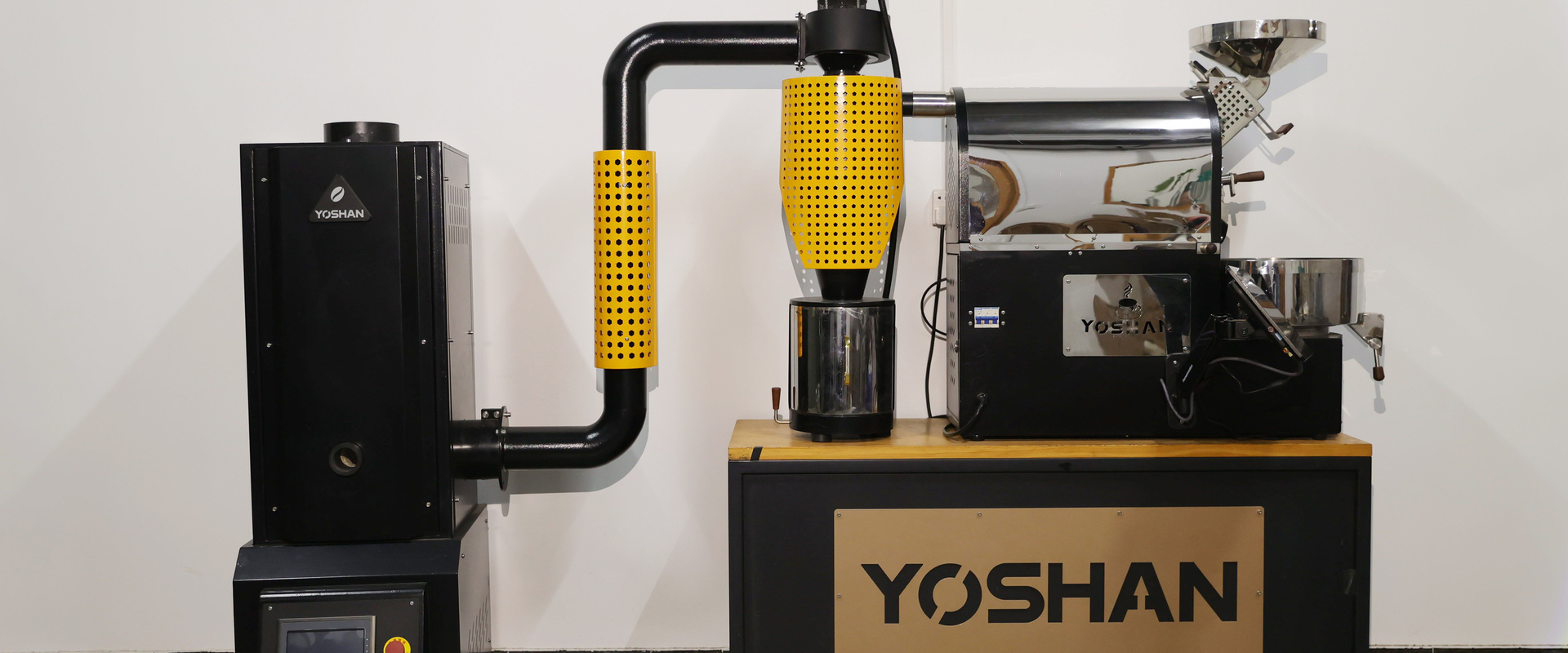
You are here because the machine you have is not enough any more. Maybe it is a home roaster that cannot keep up with the cafe, maybe you have signed your first wholesale account. An entry-level commercial coffee roaster is the step up — but "entry-level" gets used for everything from a rebadged home unit to a 3 kg production drum. Here is how to tell them apart and pick the one your first year needs.
The Four Things That Make a Roaster "Commercial"
Price is not one of them. These four are:
1. A drum that can run all afternoon. A home roaster does one or two batches and needs a rest. A commercial drum — stainless or cast iron, properly insulated, with a real motor — recovers its temperature between batches so batch six tastes like batch one. If you cannot do back-to-back batches, you cannot supply a customer.
2. A chaff cyclone. Chaff is the papery skin that comes off the beans. In volume it is a fire risk and a mess. A commercial machine collects it in a cyclone outside the drum; a home machine leaves it to you. Most fire inspectors treat the cyclone as a requirement, not an option.
3. A bean probe you can trust. The probe is a temperature sensor buried in the moving beans. On a commercial machine it sits where it reads bean mass, not air, and it feeds a controller or a laptop so you can log the roast and repeat it. That repeatability is what a wholesale customer is buying from you.
4. Output measured in kilos an hour. Anything below about 4 kg of green an hour cannot support a business — you spend the whole day roasting and still run short. Our smallest commercial drum, the SD-1.5 Pro, is rated at 4–9 kg an hour; the SD-3 at 8–12.
If a machine you are looking at fails any one of these, it is a home roaster with a commercial price tag.
Three Kinds of Entry-Level Machine, and Who Each Suits
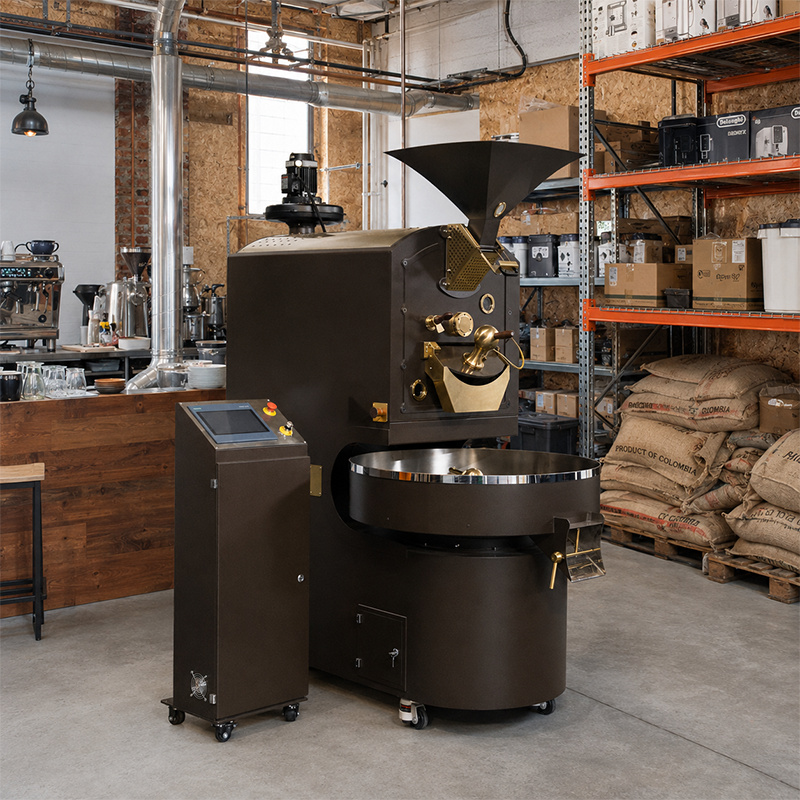
In the 1–3 kg class we build three quite different machines. They are not a ladder; they are three answers.
| DY-1 / DY-2 | SD-1.5 Pro | SD-3 | |
|---|---|---|---|
| Batch | 0.2–1.5 kg / 0.3–2.5 kg | 1–1.8 kg | 2–3 kg |
| Drum | 304 stainless steel | Cast iron, double wall | Cast iron |
| Roast cycle | 12–15 min | 6–12 min after 180°C preheat | 10–15 min after preheat |
| Rated output | — | 4–9 kg/h | 8–12 kg/h |
| Heating | LPG / natural gas / electric | Gas (electric build available) | Gas (electric build available) |
| Control | Manual gas, drum speed, airflow | PLC touch screen, full-auto or manual | Manual (the SD-3 Pro adds the PLC at USD 8,889) |
| Power | AC 220–240V, 50/60Hz | AC 220V / 50Hz | AC 220V / 50Hz |
| Footprint | 1200 × 850 × 1200 mm, 150 kg (DY-2) | 1350 × 800 × 1150 mm, 130 kg | About 1.3 × 0.9 × 1.7 m with hopper; 230 kg |
| Factory price (ex-works) | USD 2,599 / 3,399 | USD 5,399 | USD 4,599 (SD-3 Pro: USD 8,889) |
| Who it suits | Learning, testing accounts, a cafe under 25 kg a week | A cafe that wants recipes it can hand to staff | A cafe plus first wholesale accounts, 25–60 kg a week |
Pick the DY if you are still learning, or your volume is genuinely small, or you need electric heating on ordinary single-phase power. It is the machine that teaches you, because everything is under your hand.
Pick the SD-1.5 Pro if consistency matters more than volume — a cafe where two different people will roast, or where you want to save a recipe and repeat it exactly. Same batch size as a DY-1, very different control.
Pick the SD-3 if you already know your first year will pass 25 kg a week. It is the most common "first real machine" we ship, because it covers a cafe and two or three accounts on one roasting afternoon.
Full detail is on the DY series, SD series and commercial coffee roasters pages, and the single-size guides for 1 kg, 2 kg and 3 kg.
Manual or Automatic: One Teaches You, One Protects You
This is the choice most buyers underrate.
A manual gas machine — the DY, or the SD-3 in manual mode — puts the gas valve, the airflow and the drum speed under your hand. You learn what a roast feels like, and when something goes wrong you know why. It is slower to master and easier to understand.
A PLC machine — the SD-1.5 Pro, or an SD Pro of any size — stores a profile and repeats it. ("PLC" is just the programmable controller behind the touch screen.) It protects you from bad days and lets a second person roast to your recipe. What it does not do is teach you what the recipe is doing.
If you are the only roaster and you want to become good at it, start manual. If you are a cafe owner who wants coffee the same every week without being the one at the drum, start with the PLC. Neither is the "better" machine; they solve different problems.
Gas or Electric at This Size
Gas — LPG or natural — is the default, for the usual reasons: responsive heat, lower running cost, and single-phase power for the motor and fans.
Electric heating is the right choice when you cannot get gas where the machine will live. Two things to know before you choose it:
- On the DY series, electric heating runs on ordinary single-phase 220V — the heating elements draw about 4.2–4.4 kW, so you need a proper circuit, but not three-phase. The machine ships without a plug; your electrician fits one to your local standard.
- On the SD series, the SD-1.5 Pro electric build is a fully hot-air machine on 380V three-phase; the SD-3 electric build uses heating elements and runs on 220V or 380V three-phase, at USD 4,899 and a 40–60 day build. If you only have single phase, tell us early and we will confirm what is possible.
Whichever you choose, send us the actual voltage and frequency at your wall. This is the single most common reason a first machine arrives and does not start. The voltage guide shows what to check.
The 1 kg Electric Everyone Recommends — and When It Is the Right Call
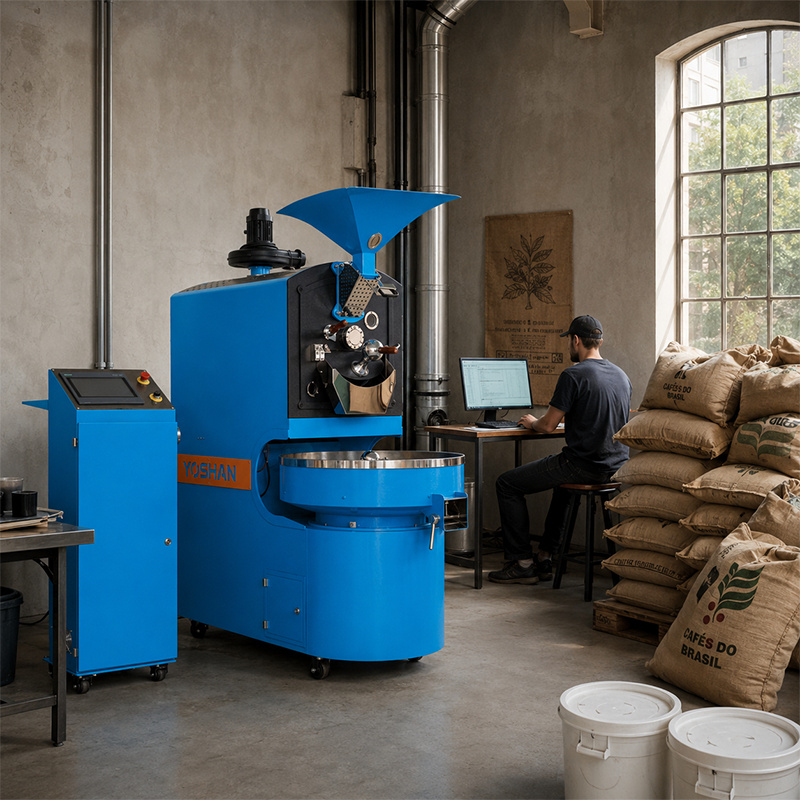
Search "entry-level roaster" and the lists agree on one thing: a 1 kg electric machine, priced around USD 5,000–6,000, no gas line, plug it in and roast. The guides favour it for a reason that has nothing to do with the coffee — it avoids the gas fitter, the flame safety conversation and the "building-like" ventilation expectations that come with a burner. For a cafe in a leased unit with no gas supply and under 25 kg a week, that logic is sound, and you should not let anyone talk you out of it.
Three things to put beside it before you decide.
Output is hours, not kilos. A 1 kg machine realistically gives 3–5 kg of green an hour; the same guides work backwards from a three-day, 24-hour roasting week to reach 60–80 kg. If you are the barista as well, you will not have 24 hours, and the honest weekly figure is a third of that.
Electric needs a circuit too. A 1 kg electric drum draws 3–4.5 kW — more than a standard wall socket in most countries — so the "no installation" claim usually still means an electrician, as the section above explains for our own electric builds.
The batch decides the ceiling, not the heating. The DY-2 at USD 3,399 runs 1.5–2 kg batches on electric or gas, in the same footprint as a 1 kg machine, which means the first wholesale account does not force a second purchase. Running cost is a rounding error either way — published figures put electric roasting at roughly USD 0.15–0.25 per kilo — so choose on batch size and on what comes out of your wall, not on the fuel.
The Real Cost Is How Soon You Outgrow It
Entry-level prices vary enormously — published US retail for a 2 kg machine runs past $20,000, while our factory prices ex-works are USD 2,599 for the DY-1, USD 3,399 for the DY-2, USD 3,299 for the SD-1.5 (USD 5,399 as the SD-1.5 Pro) and USD 4,599 for the SD-3. But the number that matters more is how long the machine lasts you.
Buy a 1 kg drum when your first year needs 40 kg a week, and you will be buying again in twelve months — paying freight, duty and installation twice, and selling a used machine that recovers little. Buy a 3 kg when you need 15 kg a week and you have tied up money in capacity you will not use for two years.
The honest way to size it: work out your weekly kilos for month three, and buy the drum where that sits at 60–80% of what the machine can do in the hours you actually have. The sizing guide has the maths.
Before You Order: Five Things to Confirm
- Voltage, phase and frequency at your site — and whether you want gas or electric heating.
- Gas type — bottled LPG or piped natural gas.
- Exhaust route — where the cyclone and duct go, and what your local authority requires.
- Delivery term and inclusions — EXW, FOB or CIF; what is in the crate; spares.
- Warranty and parts — one year on the complete machine is our standard, with extensions available; spares ship from our factory.
Frequently Asked Questions
Is it worth buying the SD-3 Pro straight away instead of the manual SD-3?
Only if someone other than you will roast in the first year, or a wholesale account will expect the same bag every week from day one. Otherwise the manual machine teaches you more and costs about four thousand dollars less, and the Pro's saved profiles become valuable exactly when you have profiles worth saving. Most first buyers who choose the Pro early use it in manual mode for six months anyway.
How do I test an entry-level machine before I commit?
Ask for the test-roast video of the actual unit, with the nameplate in shot and the flame visible, before the balance is paid; a factory does this as routine. For a machine in this class, watch three things in the video: the drum turning smoothly when empty, the cooling tray clearing a batch, and the airflow changing when the damper moves. If the supplier sends a brochure clip instead, that is your answer.
Can an entry-level roaster share a room with the cafe's customers?
Yes, and many do, with two conditions: the duct goes outside, not into the room, and the chaff cyclone is emptied every session, because the smell of stale chaff is the thing customers notice. The electric DY-2 is the usual choice for a customer-facing corner because it needs no gas fitter; a small ESP filter handles the visible smoke if the landlord asks.
What is the resale value if I outgrow it in two years?
Modest but real for a well-kept machine with its log: the buyers are the next cafe starting where you started, and a DY-2 or SD-3 with a clean drum, a maintenance record and its documents sells within weeks. Keep the crate photos, the CE declaration and the batch log from day one — they are what a buyer of a used machine asks for, as the used vs new guide explains.
How much green should I order for the first month?
About 20 kg of the cheapest coffee you can find for seasoning and practice, then one 60 kg sack of the coffee you intend to sell. Practice on the cheap coffee until the curve repeats, then move to the sack; buying three origins before you can repeat one is the commonest way a first month turns into three.
Final Thoughts
An entry-level commercial coffee roaster is commercial because of its drum, its cyclone, its probe and its output — not its price. Pick between the DY, the SD-1.5 Pro and the SD-3 by what your first year needs and by whether you want a machine that teaches you or one that repeats for you. Send us your weekly volume and your power supply and we will confirm which. Get a factory-direct quote.
Get a Quote → WhatsApp +86 184 0771 4607Last updated: September 17, 2026